
Hold baby semi-upright
About 45 degrees — not lying flat. This position makes baby work a bit harder to get milk out, similar to breastfeeding.
GUIDE
Published on ·Updated on
The general rule: about 2.5 oz of formula per pound of body weight per day, divided across feeds. But the details change a lot from month to month.
This is the guide you'll come back to. How much per feed, how many feeds per day, and what the daily maximum looks like — from the first week through the first birthday.
Free 2-min quiz. Personalized intake plus a formula match.
“All infant formulas must meet requirements that ensure optimal nutrition for babies. If your baby's formula is sold in the U.S., it has the nutrients your baby needs.”
 Dr. Matthew Badgett, MD, Pediatrician, Cleveland Clinic
The most commonly cited guideline comes from the American Academy of Pediatrics: offer about 2.5 ounces of formula per pound of body weight per day. For an 8-pound baby, that's about 20 ounces. For a 12-pound baby, about 30 ounces.
This is a useful starting point, but it's not a precise formula. (Ironically, there's no exact formula for how much formula to give.) Babies vary. Some are hungrier. Some are more efficient. Some have faster metabolisms. The 2.5 oz rule gets you in the neighborhood, but your baby's hunger cues and output are the final word.
The rule also has a ceiling: it works well up to about 12-14 pounds, after which daily intake plateaus around 32 oz rather than continuing to increase proportionally with weight. A 20-pound baby does not need 50 oz of formula per day.
| Age | Per Feed | Feeds/Day | Daily Total | Notes |
|---|---|---|---|---|
| Newborn (0-2 weeks) | 1-2 oz | 8-12 | 12-20 oz | Baby's stomach is tiny — about the size of a cherry at birth, growing to a walnut by day 7. Feed on demand, every 2-3 hours. Wake baby to feed if it's been 3+ hours. |
| 2 weeks - 1 month | 2-3 oz | 7-9 | 16-24 oz | Intake ramps up quickly. A growth spurt around 2-3 weeks may temporarily increase appetite. Baby should be back to birth weight by 10-14 days. |
| 1-2 months | 3-4 oz | 6-8 | 20-28 oz | Feeds start to space out a little. You may get one longer stretch at night (3-4 hours). Growth spurt around 6 weeks can spike demand temporarily. |
| 2-4 months | 4-5 oz | 5-7 | 24-32 oz | Many babies settle into a more predictable pattern. This is when the 2.5 oz per pound guideline is easiest to apply. Growth spurt around 3 months. |
| 4-6 months | 5-6 oz | 4-6 | 24-36 oz | Baby may show signs of readiness for solids (sitting with support, interest in food, loss of tongue-thrust reflex). Formula remains the primary nutrition source. |
| 6-9 months | 6-8 oz | 3-5 | 24-32 oz | Solids are now part of the picture, but formula is still the main event. Offer formula before solid meals to maintain milk intake. Daily total may dip slightly as solids increase. |
| 9-12 months | 6-8 oz | 3-4 | 16-24 oz | Solids are increasing in variety and volume. Formula intake naturally decreases. By 12 months, your baby transitions to whole milk (or continues formula per pediatrician guidance). |
| Baby's Weight | Estimated Daily Total | What This Looks Like |
|---|---|---|
| 6 lbs (2.7 kg) | 15 oz | Typical for small newborns or preemies after discharge. May need more frequent, smaller feeds. |
| 8 lbs (3.6 kg) | 20 oz | Average birth weight range. About 2-3 oz per feed, 8-10 times per day. |
| 10 lbs (4.5 kg) | 25 oz | Typical around 1-2 months. About 3-4 oz per feed, 6-8 times per day. |
| 12 lbs (5.4 kg) | 30 oz | Typical around 2-3 months. About 4-5 oz per feed, 6-7 times per day. |
| 14 lbs (6.4 kg) | 32 oz (approaching max) | Typical around 3-5 months. Daily intake plateaus near 32 oz as baby grows. |
| 16+ lbs (7.3+ kg) | 28-32 oz | Typical around 4-6 months. Formula intake levels off — bigger babies don't need proportionally more. |
| 18-22 lbs (8-10 kg) | 24-32 oz (plus solids) | Typical for 6-12 months. Solids contribute increasing calories. Formula gradually decreases. |
You'll see this number referenced a lot: most babies should not exceed about 32 ounces of formula per day. Here's what that actually means.
| Question | Answer |
|---|---|
| What's the 32 oz guideline? | The AAP recommends that most babies should not exceed about 32 oz (approximately 1 liter) of formula per day. This is a guideline, not an absolute rule. |
| Why does a maximum exist? | Beyond 32 oz, additional formula doesn't provide proportional nutritional benefit. Excess intake can lead to overfeeding, excessive weight gain, and may displace other nutrients once solids are introduced. |
| When does it apply? | The 32 oz guideline becomes relevant around 2-4 months when daily intake approaches this level. It's less relevant for newborns (who don't reach 32 oz) and older babies (who are eating solids). |
| What if my baby wants more? | If your baby consistently seems hungry after 32 oz, talk to your pediatrician. They may recommend introducing solids earlier (if developmentally ready), adjusting feeding schedule, or evaluating whether the hunger cues are actually comfort-seeking rather than true hunger. |
These indicators matter more than hitting an exact ounce target. A baby who takes 22 oz one day and 28 oz the next is not a problem — they're self-regulating.
Overfeeding is more common with bottle feeding than breastfeeding because the bottle delivers milk regardless of suction effort. Paced bottle feeding helps prevent this.
Paced bottle feeding is a technique that puts your baby in control of how much and how fast they eat. It mimics the rhythm of breastfeeding and helps prevent overfeeding. If you're only going to learn one feeding technique, make it this one.
About 45 degrees — not lying flat. This position makes baby work a bit harder to get milk out, similar to breastfeeding.
Not tipped up. The nipple should be only half-full of milk. This prevents gravity from pushing milk into baby's mouth faster than they want.
Touch the nipple to baby's lips and let them open and latch on — don't push it in. This encourages active feeding.
Tip the bottle down (or remove it briefly) every ounce or two. Watch for hunger cues to resume. This gives baby time to register fullness.
Turning head away, relaxing hands, slowing sucking, or pushing bottle away. Stop feeding when baby signals they're done — even if the bottle isn't empty.
Paced feeding is slower than regular bottle feeding. This is by design — it reduces the risk of overfeeding and is gentler on baby's digestive system.
A bottle warmer is not strictly necessary — warm water in a bowl works fine. But at 2 AM, the Philips Avent warmer (~$35) means you press a button and it is done in three minutes with no hot spots. It uses a water bath, not steam, so it is safe for breast milk nutrients.
Tinylog earns a small commission on purchases made through these links, at no cost to you.
Want to save a few bucks? promo.new is worth a quick look. It won't always have your product, but when it does, the savings are real.
When you introduce solids around 6 months, the relationship between food and formula starts shifting. Here's the general trajectory:
6-7 months: Solids are exploratory. Baby is tasting and learning to eat, not getting significant calories from food. Formula intake stays roughly the same — around 24-32 oz per day.
7-9 months: Solids are becoming a real part of the diet. Baby may eat 2-3 small meals per day. Formula intake may dip slightly to 24-28 oz per day. Offer formula before solid meals to keep milk intake up.
9-12 months: Solids are a significant calorie source. Formula intake drops to about 16-24 oz per day. Baby is eating 3 meals plus snacks. This is a normal and expected decrease.
At 12 months: Most babies transition from formula to whole cow's milk (about 16-24 oz per day) or continue on a toddler formula per your pediatrician's guidance. The AAP recommends whole milk, not reduced fat, for children 12-24 months.
For a complete feeding chart that covers both formula and solids, see our baby feeding chart by age.
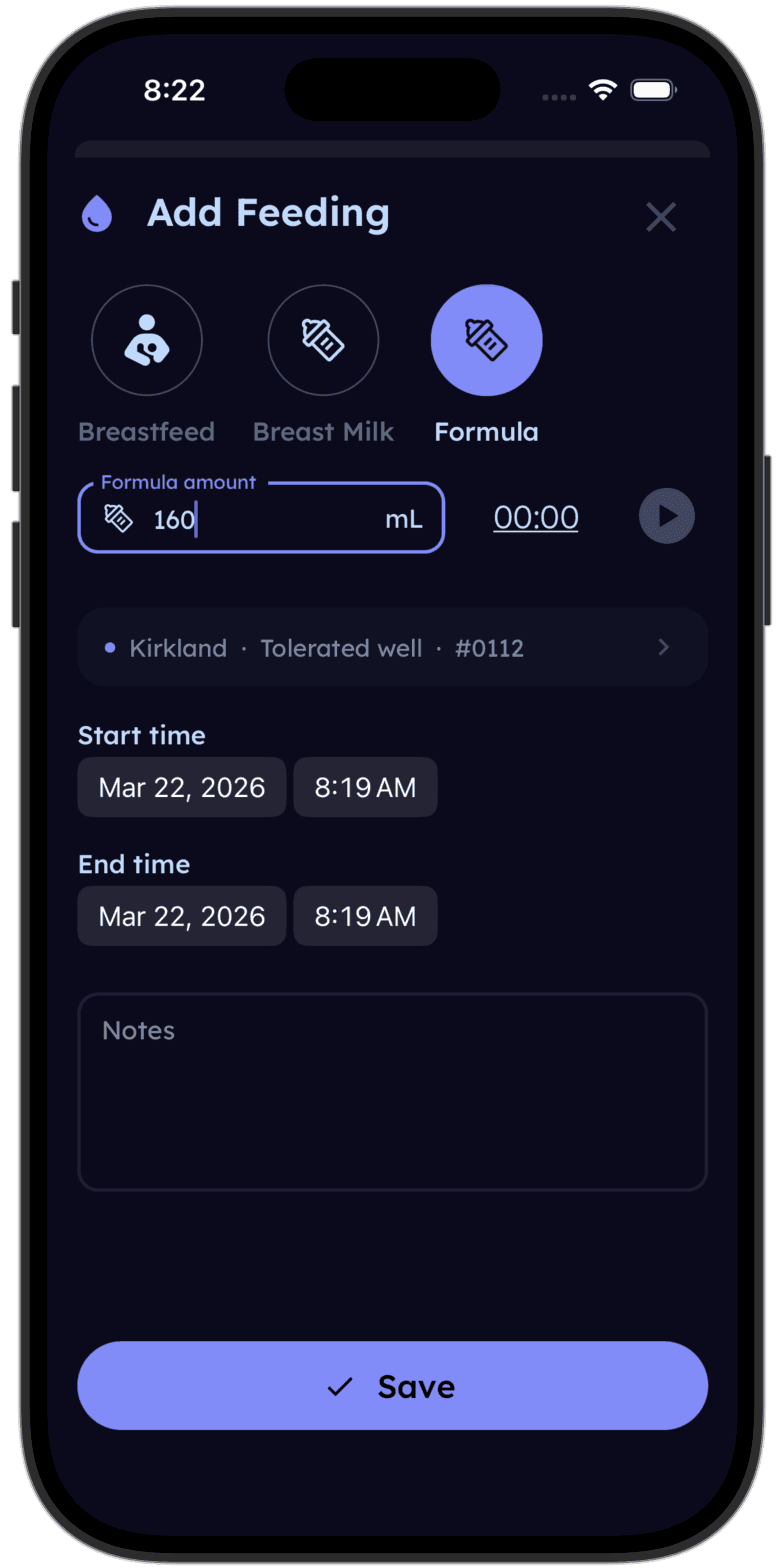
Log each bottle in seconds and your daily total builds automatically. See if you're trending toward 32 oz, notice the dip when a growth spurt ends, and bring your pediatrician actual numbers instead of 'I think around 24 ounces?' It takes less time than washing a bottle.


The amounts in this guide are guidelines, not rules. Your baby is an individual. But talk to your pediatrician if:
Bringing a few days of feeding data to the appointment — either from a tracking app or written notes — makes the conversation much more productive. Your pediatrician can assess the numbers in the context of your baby's growth curve and health history.
For more on understanding your baby's growth trajectory, see our growth percentiles guide.
How much formula your baby needs changes constantly through the first year. The general framework is:
Use the 2.5 oz per pound guideline as a starting point, watch your baby's hunger and fullness cues, track output (wet diapers and weight gain), and don't fixate on hitting an exact ounce target. Your baby's body knows what it needs. Your job is to offer the right amount at the right times and let them take it from there.
Tracking daily totals makes this so much easier. Tinylog adds up each bottle automatically so you can see whether your baby is consistently under or over the guidelines — without doing math at every feed.
If your baby is refusing formula, our formula refusal guide covers the most common causes and fixes by age. And if you want to know about formula recalls before they hit the news, sign up for free recall alerts.
Baby Feeding Chart — How much and how often by age
Switching Formulas — How to do it safely
Best Baby Formulas 2026 — An evidence-based guide
This guide is for informational purposes only and is not a substitute for professional medical advice. If you have concerns about your baby's feeding or growth, please consult your pediatrician.