GUIDE

Baby Teething Chart

Most babies get their bottom front teeth first, between 6 and 10 months — but the normal range is huge.

The 'standard' teething chart is an average, not a rule. Some babies cut their first tooth at 4 months. Others wait until 15 months. Both are perfectly normal. Here is the actual order, the real timelines, and what to do if your baby is ahead or behind.

The Standard Teething Order — And Why Your Baby Might Not Follow It

Every teething chart you find online shows the same neat progression: bottom front teeth first, then top front teeth, then the teeth fill in from front to back until all 20 baby teeth are in place by age 3. And for most babies, this general pattern holds — but the timing and exact sequence vary enormously from one baby to the next.

The chart below shows the average eruption timeline based on population studies. The key word is average. Your baby's teeth will come in on their own schedule, and the range of normal is far wider than most parents expect. A first tooth anywhere from 4 months to 15 months is considered normal. The full set of 20 primary teeth is usually complete by age 2.5 to 3.

The order matters less than parents think. Whether the bottom teeth come before the top, or the lateral incisors show up before the central ones, the important thing is that teeth are coming in. Truly abnormal teething patterns — like a baby with no teeth at 18 months or teeth erupting in a very unusual location — are rare and usually caught at routine dental or well-child visits.

Baby Teething Chart: Eruption Order and Timeline
Lower central incisors (bottom front 2)
Typical Eruption Age6–10 months
Falls Out Around6–7 years
NotesUsually the first teeth to appear
Upper central incisors (top front 2)
Typical Eruption Age8–12 months
Falls Out Around6–7 years
NotesOften follow within weeks of the bottom pair
Upper lateral incisors (beside top front)
Typical Eruption Age9–13 months
Falls Out Around7–8 years
NotesFill in the top smile
Lower lateral incisors (beside bottom front)
Typical Eruption Age10–16 months
Falls Out Around7–8 years
NotesComplete the bottom row of front teeth
First molars (top and bottom)
Typical Eruption Age13–19 months
Falls Out Around9–11 years
NotesLarger surface area — often more uncomfortable
Canines / cuspids (top and bottom)
Typical Eruption Age16–23 months
Falls Out Around9–12 years
NotesThe pointed teeth that fill the gap between incisors and molars
Second molars (top and bottom)
Typical Eruption Age23–33 months
Falls Out Around10–12 years
NotesThe last baby teeth to arrive — completes the set of 20
These are population averages. Individual babies may be several months ahead of or behind these ranges, and that is completely normal. Source: American Academy of Pediatric Dentistry (AAPD) and American Dental Association (ADA).

How to Read This Chart (Without Panicking)

The single most important thing to understand about teething timelines is that the normal range is enormous. When the chart says "lower central incisors: 6 to 10 months," it means that is the window in which most babies get those teeth. But some babies get them at 4 months, and others do not get them until 12 or even 14 months. None of these scenarios, on their own, indicate a problem.

Parents tend to focus on the earliest age in the range and worry if their baby has not hit that mark. But pediatric dentists typically are not concerned unless a baby has zero teeth by 18 months. Even then, the most common explanation is simply genetics — late teethers tend to have parents who were also late teethers.

If your baby is on the earlier side, there is no need to rush dental care, but you should start brushing as soon as that first tooth appears. If your baby is on the later side, take comfort in the fact that fewer teeth means fewer teeth to brush and a longer window before you need to worry about tooth decay from nighttime bottles or breastfeeding.

Normal Teething Variations
First tooth at 4 months
Normal?Normal
ExplanationOn the early side but within the normal range. Some babies are even born with teeth (natal teeth).
First tooth at 12 months
Normal?Normal
ExplanationSlightly later than average but very common. Family history is the strongest predictor of timing.
No teeth at 15 months
Normal?Usually normal
ExplanationLate teething is almost always genetic. Mention it at your next well-child visit, but this alone is rarely a concern.
Teeth come in out of order
Normal?Normal
ExplanationThe chart shows averages. Upper teeth first, canines before molars, or other variations are all common.
Two or more teeth at once
Normal?Normal
ExplanationSome babies cluster multiple teeth in a short period. It may mean a few rough days but is developmentally fine.
Gap between teeth
Normal?Normal
ExplanationSpacing between baby teeth is actually a good sign — it means there may be enough room for the larger permanent teeth later.
If you have specific concerns about your baby's teething pattern, bring them up at your next well-child visit or first dental appointment. Most 'unusual' patterns are completely normal.

What Teething Actually Causes — And What It Does Not

This is where teething guides usually go off the rails. The internet is full of symptoms attributed to teething that have no support in medical research. The problem is not just misinformation — it is that parents sometimes dismiss genuine illness as "just teething" and delay seeking care.

A landmark study by Macknin et al. (2000) followed 125 infants prospectively and found that the only symptoms consistently associated with teething were gum rubbing, drooling, and irritability. A systematic review by Massignan et al. (2016) confirmed these findings across multiple studies: gum irritation, increased biting, drooling, and mild irritability were the only symptoms reliably linked to tooth eruption.

Notably, fever (temperature of 100.4°F / 38°C or higher), diarrhea, rash (other than localized drool rash), and congestion were NOT consistently associated with teething in these studies. The timing overlap is what confuses everyone: babies start teething around the same age that maternal antibodies wane and babies start putting everything in their mouths. So they get more infections at the same time teeth are coming in, and the infections get blamed on teething.

This does not mean your teething baby cannot also be sick. It means that when a baby has a true fever, diarrhea, or significant runny nose, the cause is likely something other than teething, and it deserves evaluation rather than dismissal.

Teething Symptoms: What the Evidence Says
Gum swelling or tenderness
Evidence LevelStrong — consistently supported in research
NotesThe gums may look red or swollen where the tooth is pushing through
Increased drooling
Evidence LevelStrong — one of the most consistent findings
NotesDrooling can start weeks before a tooth actually appears
Desire to bite or chew on things
Evidence LevelStrong — pressure on the gums provides relief
NotesThis is a coping mechanism, not just a coincidence
Irritability
Evidence LevelModerate — supported by several studies
NotesUsually mild and intermittent, not all-day screaming
Mild temperature elevation (below 100.4°F / 38°C)
Evidence LevelWeak to moderate — slight elevation possible but not true fever
NotesA temperature of 100.4°F or higher is NOT a teething symptom — see your pediatrician
Fever (100.4°F / 38°C or higher)
Evidence LevelNot supported — studies consistently show teething does not cause true fever
NotesA baby with fever has something else going on and needs medical evaluation
Diarrhea
Evidence LevelNot supported — no causal link established
NotesTiming coincidence: teething age = age when babies put everything in their mouths
Runny nose / congestion
Evidence LevelNot supported
NotesCoincides with age of frequent viral infections, not caused by teething itself
Based on Macknin et al. (2000), Wake et al. (2000), and the systematic review by Massignan et al. (2016). The distinction between teething symptoms and coincidental illness is one of the most important things parents can understand.
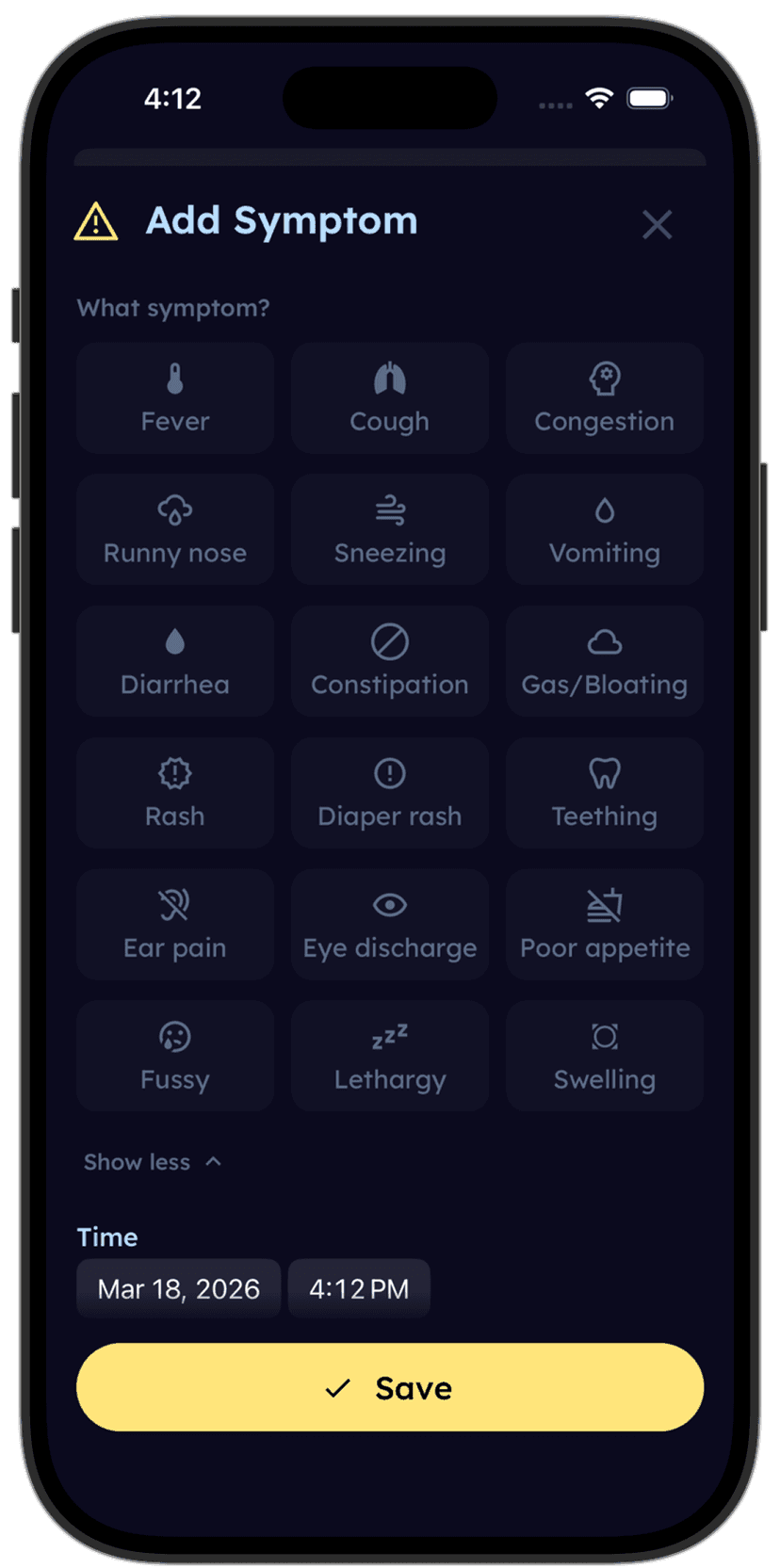
tinylog milestone tracking screen showing tooth eruption log

Log each tooth and spot your baby's teething pattern.

Some babies cluster multiple teeth in a short period. Others space them out over months. Logging when each tooth appears in tinylog helps you see the pattern — and gives you a complete dental timeline to share with your baby's dentist at that first visit.

Download on the App StoreGet It On Google Play

The Teething Timeline at a Glance

Here is a rough month-by-month guide to what you might see, keeping in mind that your baby may be well ahead of or behind this timeline:

4 to 7 months: For many babies, the first signs of teething start here — increased drooling, gum rubbing, and a desire to chew on things. The lower central incisors are usually the first to appear, but some babies show teething signs for weeks or months before any tooth actually breaks through.

8 to 12 months: The upper front teeth typically join the party, giving your baby that classic gummy-plus-two-teeth smile. The lateral incisors (the teeth on either side of the front four) may also start appearing toward the end of this window.

13 to 19 months: First molars arrive. These are a different experience from the front teeth — the surface area is larger, and many parents report that molars cause more discomfort. Your baby may have a few rough days when these are coming through.

16 to 23 months: The canines (pointed teeth between the incisors and molars) fill in. These are the teeth that create the complete front smile.

23 to 33 months: Second molars — the last of the baby teeth — come in at the very back. By about age 3, most children have all 20 primary teeth. These teeth will serve them until they start losing them around age 6 or 7.

What Your Pediatrician Wants You to Know

Pediatricians and pediatric dentists share a common frustration: teething is blamed for far too many symptoms, and sometimes this leads to delayed evaluation of genuine illness. Here is what they want parents to understand:

Teething does not make babies seriously ill. A teething baby may be fussy and drooly, but should not have a high fever, persistent diarrhea, a body rash, or appear significantly unwell. If your baby has these symptoms, something else is going on — even if a tooth happens to be coming through at the same time.

The first dental visit should happen by age 1 or within 6 months of the first tooth. This is the recommendation from both the AAP and the AAPD. Many parents wait until their child has a full set of teeth, but early dental visits establish a baseline, catch problems early, and get your child comfortable with the dentist before any procedures are needed.

Baby teeth matter. They hold space for permanent teeth, aid in speech development, and are essential for chewing. Decay in baby teeth can affect the permanent teeth developing underneath and can cause pain and infection.

Variations in timing are almost always normal. Unless your baby has no teeth by 18 months, there is very rarely a cause for concern. Even then, the most likely explanation is genetics.


Practical Tips

The tooth you see is only part of the story

A tooth can cause discomfort for days or even weeks before it breaks through the gum. The pressure of the tooth moving upward through the bone and gum tissue is what causes most of the discomfort — not just the moment it cuts through the surface. So if your baby seems uncomfortable but you cannot see a tooth yet, it may still be on its way.

Family history is your best predictor

Ask your parents and your partner's parents when they got their first teeth. Teething timing is strongly genetic. If both parents were late teethers, there is a good chance your baby will be too. If one parent teethed early and the other late, the timing could go either way.

Girls tend to teethe slightly earlier than boys

On average, girls get their first tooth a few weeks before boys. This is a population-level trend with huge individual variation, so it should not be used to predict your specific baby's timeline. But if your daughter is teething at 5 months and your friend's son is not teething at 8 months, both are perfectly normal.

Baby teeth matter more than you think

Baby teeth are temporary, but they serve critical functions: holding space for permanent teeth, enabling proper speech development, and allowing your child to eat solid foods. Taking care of baby teeth from the start prevents problems with the permanent teeth waiting underneath.

Related Guides

Sources

  • Macknin, M. L., et al. (2000). Symptoms associated with infant teething: a prospective study. Pediatrics, 105(4), 747-752.
  • Wake, M., et al. (2000). Teething and tooth eruption in infants: A cohort study. Pediatrics, 106(6), 1374-1379.
  • Massignan, C., et al. (2016). Signs and symptoms of primary tooth eruption: A meta-analysis. Pediatrics, 137(3), e20153501.
  • American Academy of Pediatric Dentistry (AAPD). Guideline on infant oral health care.
  • American Dental Association (ADA). Eruption charts.
  • American Academy of Pediatrics (AAP). Teething: 4 to 7 months. HealthyChildren.org.

Medical Disclaimer

This guide is for informational purposes only and is not a substitute for professional medical advice. If your baby has a fever of 100.4°F (38°C) or higher, is refusing to eat, or seems unusually unwell, contact your pediatrician — these symptoms are not typical of teething alone.

Get this chart in your inbox.
We'll email you this teething chart so you can reference it whenever a new tooth appears.
Log each tooth as it arrives — build your baby's dental timeline.
Download tinylog free — track milestones with a single tap.
Download on the App StoreGet It On Google Play