
Keep it short
Three to four steps is enough: bath (or wash), pajamas, book, song. A 20-minute routine works as well as a 45-minute one, and it's easier to maintain on tough nights.
GUIDE
Published on
Consistent bedtime routines are one of the strongest predictors of better infant sleep. Babies with a nightly routine fall asleep faster, wake less often, and sleep longer. But the routine itself can be simple.
The research is unusually clear on this one. A bedtime routine doesn't have to be elaborate — but having one matters more than most parents realize.
Log bedtime and see patterns
“Your goal should be to set up a consistent routine that's calming and will help them wind down. Follow the routine every night, and your baby will begin to understand when it's time to sleep.”
 Dr. Heidi Szugye, DO, Pediatrician, Cleveland Clinic
This is one of those parenting topics where the evidence is unusually clear. A 2009 study by Mindell et al. in the journal Sleep followed 405 mothers and infants and found that introducing a consistent bedtime routine led to significant improvements in sleep onset latency, number of night wakings, and total sleep duration — within just three weeks.
A follow-up study by the same group in 2015 confirmed these findings across a larger, multi-cultural sample. Babies with a nightly bedtime routine fell asleep faster, slept longer, and woke less during the night. The benefits were dose-dependent: the more consistently the routine was followed, the better the sleep outcomes.
The mechanism isn't mysterious. A predictable pre-sleep sequence gives babies environmental and behavioral cues that sleep is approaching. Dim lights, warm bath, quiet voice — these cues help regulate the circadian system and trigger melatonin production. Understanding how baby sleep cycles work helps explain why these cues matter so much. Without those cues, babies rely more on exhaustion to fall asleep, which often means overtiredness, cortisol spikes, and worse sleep overall.
| Aspect | With Routine | Without Routine |
|---|---|---|
| Sleep onset latency | Babies fall asleep 15-20 min faster on average | Variable — some nights fast, some nights a battle |
| Night wakings | Fewer night wakings reported across multiple studies | More frequent night wakings, especially after 4 months |
| Total sleep duration | About 30-60 min more total sleep per night | Shorter total sleep on average |
| Parent stress | Lower bedtime-related stress — predictability helps parents too | Higher stress and uncertainty around bedtime |
| Flexibility | Less flexible — routine becomes expected | More flexible — no rigid sequence to follow |
| Travel/disruption impact | Portable routine helps in new environments | No routine to disrupt, but also no anchor in unfamiliar settings |
These benefits appear consistently across multiple studies and age groups.
The fix for most of these is keeping the routine simple and short.
Some babies genuinely sleep well without a formal routine — temperament plays a role.
These tend to become more pronounced after 4 months when sleep architecture matures.
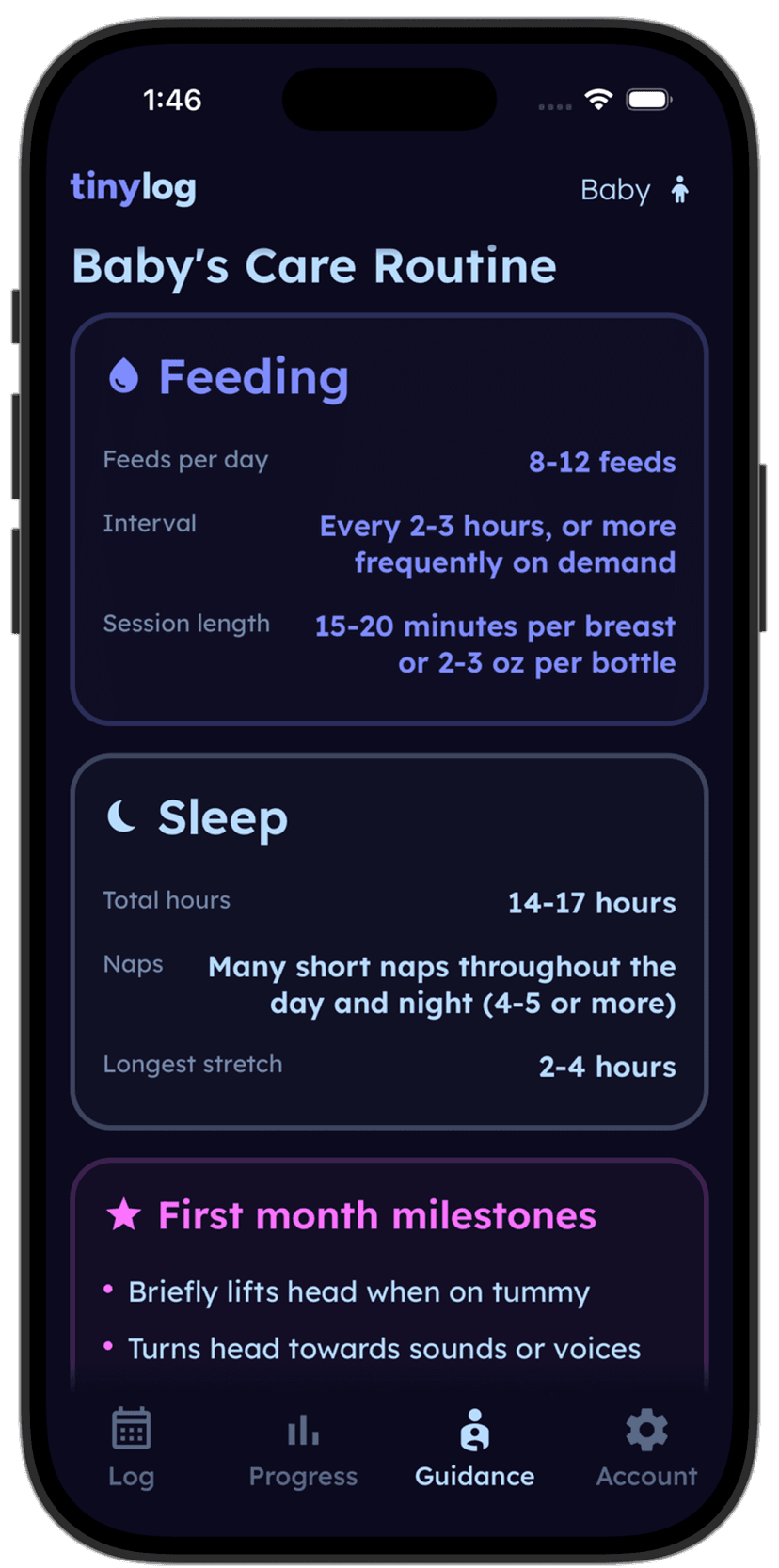
Log bedtime and wake times in Tinylog to see if your routine is actually shortening sleep onset. Over a few weeks, the pattern becomes obvious.


The best bedtime routines are short, consistent, and calming. Research suggests 20-30 minutes is ideal. Here is a sample that hits every evidence-based cue:
Bath (5-10 min) — warm water drops core body temperature afterward, which triggers drowsiness. Even a quick wash counts. Pajamas and diaper (2-3 min) — tactile cue that sleep is coming. Book or quiet song (5-10 min) — low stimulation, close contact, familiar voice. Into the crib — drowsy but awake if possible, asleep if that's where you are right now. Pairing your routine with a dark room environment strengthens these cues further.
That's it. You don't need a massage station, essential oils, a sound machine playlist, and a meditation app. The simplicity is the point — it's easier to maintain, easier for other caregivers to replicate, and easier to bring on the road.
Some babies are naturally easy sleepers. They eat, they get drowsy, they go down without a fight. If that describes your baby, a formal routine may feel unnecessary — and honestly, it might be. Not every baby needs the same level of environmental cueing.
The catch is that sleep often changes. The baby who went down easily at 2 months may start fighting bedtime at 4 months when sleep cycles mature. Having an established routine before that happens gives you a tool to lean on. If you're currently routine-free and sleep is good, consider introducing a light version now so it's in place when you might need it.
Three to four steps is enough: bath (or wash), pajamas, book, song. A 20-minute routine works as well as a 45-minute one, and it's easier to maintain on tough nights.
The consistency of sequence is what builds the association. Bath then book then song — every night. The specific activities matter less than the predictable order.
A routine that starts at 6:30 PM one night and 8:45 PM the next loses much of its circadian benefit. Aim for the same start time within a 15-20 minute window.
This guide is for informational purposes only and is not a substitute for professional medical advice. Consult your pediatrician for guidance specific to your baby.