
Use red or amber if you need light
Red wavelengths (620-750nm) have the least impact on melatonin. If you need a night light for feeds or diaper changes, choose a dim red or amber bulb. Avoid anything blue, white, or green.
GUIDE
Published on
A dark room is better for sleep quality. Even dim light suppresses melatonin production in infants. But a low-wattage, warm-colored night light for feeds and diaper changes won't ruin sleep if used briefly.
The science on this one is straightforward — darkness wins. But practical nighttime parenting sometimes needs a little light.
Log sleep and spot patterns
“Babies need to sleep in a dark room. If a parent comes to check on the baby during the night, they should not turn on any lights but use nightlights if necessary.”
 Dr. Nilong Vyas, MD, MPH, Pediatrician, Sleepless in NOLA
Infant melatonin production is more sensitive to light than adult melatonin production. A 2012 study published in the Journal of Clinical Endocrinology & Metabolism found that even moderate room light in the hours before bedtime suppressed melatonin by over 50% in preschool-aged children. Infants are likely even more sensitive because their circadian systems are still developing.
Melatonin does two things that matter for baby sleep: it signals to the brain that it's time to sleep, and it helps maintain sleep through the night. When light suppresses melatonin, babies take longer to fall asleep and are more likely to wake during lighter sleep cycles. This is true even for dim ambient light — the threshold for melatonin suppression in young children is lower than most parents expect.
This doesn't mean you need a NASA-grade light seal on your nursery. It means that the darker you can make the room, the better your baby's biology can do its job. A reasonably dark room with blackout curtains is enough for most families.
| Aspect | Dark Room | Dim Light |
|---|---|---|
| Melatonin production | Maximized — darkness is the primary trigger for melatonin release | Suppressed — even dim light reduces melatonin output in infants |
| Sleep onset | Faster — melatonin helps babies transition to sleep | Slower — light signals alertness to the brain |
| Sleep duration | Associated with longer consolidated sleep | May fragment sleep, especially in light-sensitive babies |
| Night feed practicality | Harder to see for diaper changes and feeds | Easier for nighttime caregiving tasks |
| Parent comfort | Some parents feel uneasy in complete darkness | Night light provides reassurance for checking on baby |
| Early morning wake-ups | Blackout conditions help prevent early light-triggered waking | Any ambient light can trigger early wake-ups, especially in summer |
Darkness is the biologically optimal sleep environment for infants.
Most of these are solvable — a dim red light for feeds addresses the practical issues.
A dim red/amber night light is a reasonable compromise for practical nighttime needs.
The impact varies by light color and intensity. Red/amber under 5 lux is generally acceptable.
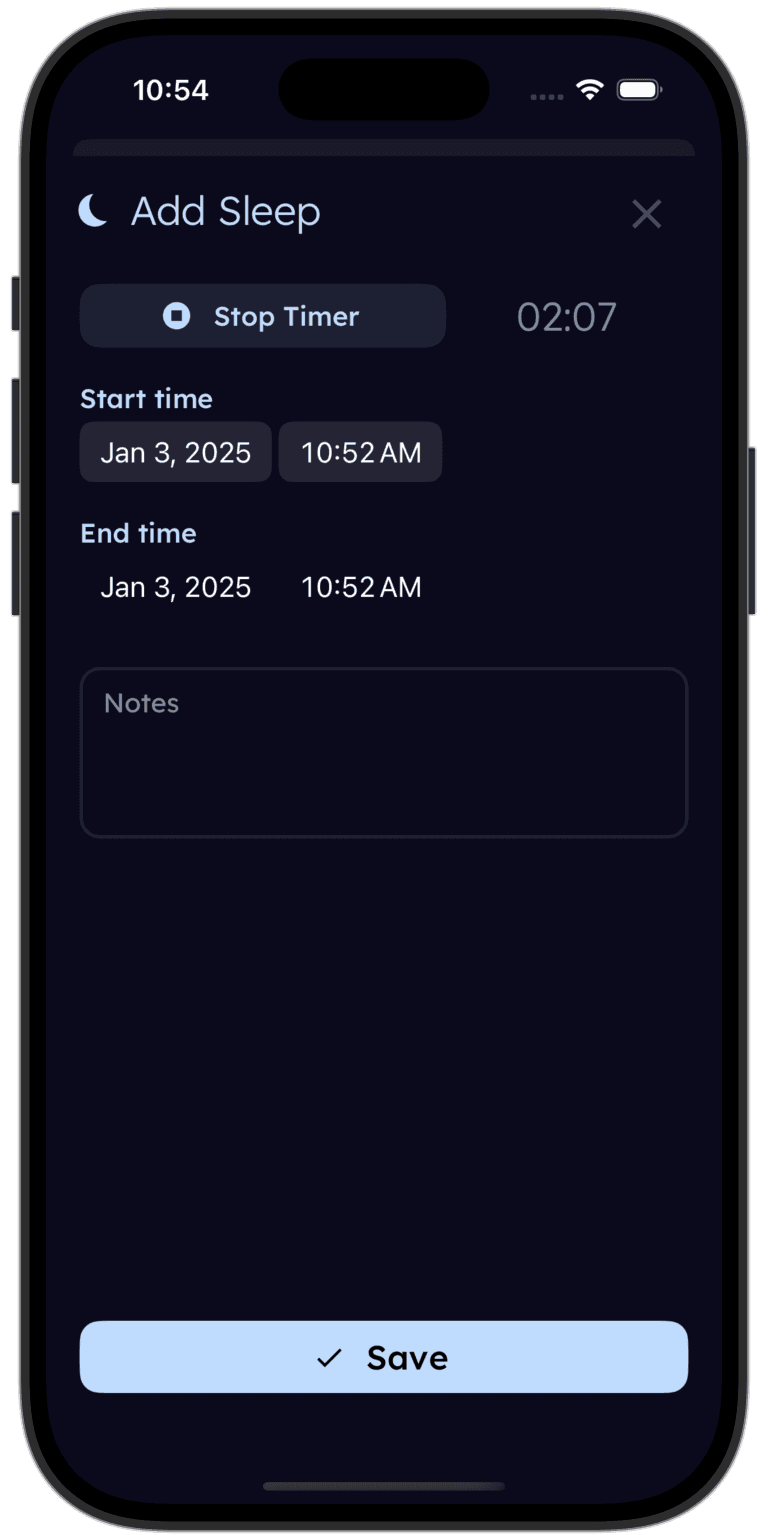
Log sleep onset, wake times, and night wakings in Tinylog. Try a darker room for a week and compare the data — the difference often shows up clearly.


Pure darkness is ideal for sleep biology, but you still need to change diapers at 2 AM without falling over the ottoman. The solution is a dim, warm-colored light that you turn on only when needed and keep off the rest of the night.
A red or amber night light in the 1-5 lux range gives you enough visibility for nighttime tasks without significantly disrupting melatonin. The key is the color — red wavelengths (620-750nm) have minimal impact on melatonin production, while blue and white light are the most disruptive even at low levels. Many baby-specific night lights now come in red/amber options for exactly this reason.
For the sleep environment itself, aim for as dark as possible. Blackout curtains or shades are the single most effective investment for baby sleep, especially for naps during the day and for preventing 5 AM summer wake-ups. Pairing darkness with a consistent bedtime routine maximizes both the circadian and behavioral cues that promote better sleep. They don't need to be expensive — even a temporary blackout blind that sticks to the window works.
If your baby is sleeping well in a room with some ambient light, you don't necessarily need to change anything. Sleep quality is the ultimate test. But if your baby is struggling with sleep onset, frequent night wakings, or early morning wake-ups, making the room darker is one of the simplest, lowest-risk interventions you can try.
Start by blocking outside light sources — streetlights, hallway light, device LEDs. Add blackout curtains if you don't have them. Switch any night light to red or amber. Give it 3-5 days and see if the pattern shifts. If your baby is no longer sleeping through the night, a darker room is one of the simplest fixes to try first. For most babies, the difference is noticeable within the first week.
Red wavelengths (620-750nm) have the least impact on melatonin. If you need a night light for feeds or diaper changes, choose a dim red or amber bulb. Avoid anything blue, white, or green.
If you can read text on your phone screen in your baby's room with the lights off, the room isn't dark enough. For optimal sleep, the room should be dark enough that you can barely see your hand in front of your face.
Use bright light exposure during the day and darkness at night to help set your baby's circadian clock. Open curtains in the morning, do feeds in well-lit rooms during the day, and keep things dim starting 30-60 minutes before bedtime.
This guide is for informational purposes only and is not a substitute for professional medical advice. Consult your pediatrician for guidance specific to your baby.