GUIDE

Bilingual From Birth vs. One Language First

Babies can absolutely learn two languages from birth without confusion or delay. Their brains are wired for it. The 'one language first' approach isn't necessary — but it's also fine if that's what works for your family.

The bilingual baby debate has a clear answer from research: two languages from day one works. The harder question is how to make it practical in your household.

Track your baby's language milestones

Log first words in any language

Babies are like sponges, and so much brain development happens between birth and 3 years of age.
Sarah Stanton, MA, Speech-Language Pathologist, Cleveland Clinic

The Confusion Myth

Let's address the biggest concern first: no, two languages will not confuse your baby. This myth persists despite decades of research to the contrary. Babies can distinguish between languages from birth — newborns just days old can differentiate the rhythm patterns of two different languages (Byers-Heinlein et al., 2010).

By 6-8 months, bilingual babies show distinct neural responses to each of their languages. They're not hearing a jumbled mix — they're processing two separate systems. Petitto et al. (2001) demonstrated that bilingual babies babble in both languages on the same timeline as monolingual babies, and their brains show differentiated patterns for each language.

The "confusion" that relatives often point to — mixing words from both languages in a single sentence — is actually a sign of competence, not confusion. Linguists call this code-mixing, and bilingual adults do it constantly. When your toddler says "I want mas leche," they're demonstrating knowledge of both languages and the ability to use them strategically.

Bilingual From Birth vs. One Language First
Language timeline
Bilingual From BirthBabbling and first words on same schedule as monolingual babies
One Language FirstBabbling and first words on typical monolingual timeline
Vocabulary size
Bilingual From BirthSmaller in each language individually, but total across both is comparable
One Language FirstLarger vocabulary in one language
Code-mixing
Bilingual From BirthNormal and expected — reflects understanding of both systems, not confusion
One Language FirstNot applicable — only one language system active
Cognitive benefits
Bilingual From BirthResearch suggests advantages in executive function and cognitive flexibility
One Language FirstNo specific cognitive advantage or disadvantage
Parent effort
Bilingual From BirthRequires intentional exposure strategy; community support varies
One Language FirstHappens naturally in the dominant language environment
Long-term fluency
Bilingual From BirthDepends on sustained exposure — 30%+ of waking input per language is often cited
One Language FirstStrong fluency in the community language is virtually guaranteed
Bilingual development is not a compromise — it's an addition. Total vocabulary and communication skills across both languages are comparable to monolingual peers.

Bilingual From Birth Advantages

  • Babies' brains are uniquely equipped to distinguish and acquire multiple languages simultaneously
  • Research shows potential cognitive benefits including stronger executive function
  • Preserves cultural identity and family connection across generations
  • Earlier acquisition means more native-like pronunciation in both languages
  • Bilingualism is associated with greater cognitive flexibility and metalinguistic awareness

The cognitive benefits of bilingualism are an active area of research, with the strongest evidence supporting advantages in executive function tasks.

Bilingual From Birth Challenges

  • Requires consistent, meaningful exposure in the minority language — passive input isn't enough
  • Family members or others may question the approach or worry about confusion
  • Finding childcare, books, and media in the minority language can be challenging
  • Vocabulary in each language may be smaller initially, which can worry parents at checkups

The biggest practical challenge is ensuring enough input in the minority language. The community language will take care of itself.

One Language First Advantages

  • Simpler to implement — the dominant community language provides abundant input naturally
  • Easier for all caregivers to participate in language development consistently
  • Vocabulary benchmarks from pediatric screenings are designed for monolingual development
  • Less logistical complexity — books, media, school are all in one language
  • Baby builds a strong foundation that a second language can later be added to

Starting with one language is a perfectly valid choice. A second language can be introduced later — it just requires more deliberate effort.

One Language First Challenges

  • The window for effortless, native-like acquisition narrows over time
  • A second language introduced later requires more deliberate effort
  • May miss the opportunity to connect baby with heritage language and culture early
  • The community language will dominate regardless — starting early gives the minority language a head start

The 'sensitive period' for language acquisition makes early exposure easier, but it doesn't close a door. Children can learn languages at any age.

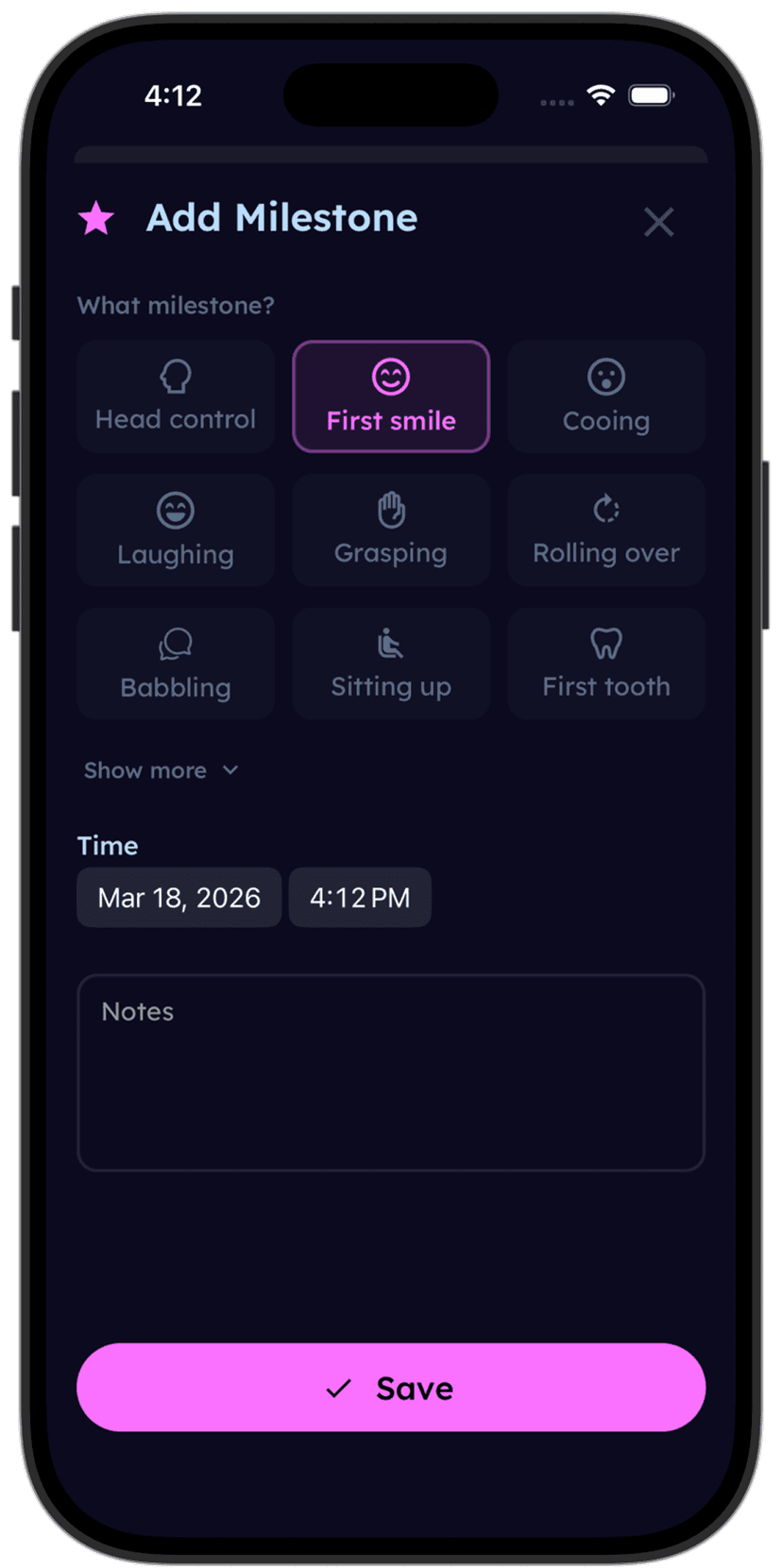
Tinylog milestone tracking showing baby's language development

Track language milestones in every language.

Log first words, first phrases, and communication milestones in Tinylog — in whatever language they come. Seeing when each word appears helps you track progress across both languages.

Download on the App StoreGet It On Google Play

Making Bilingualism Work Practically

The research is clear that bilingual exposure from birth works. The harder question is how to implement it in your daily life. The two most common strategies are OPOL (One Parent, One Language) and the minority language at home approach.

OPOL means each parent consistently speaks only one language to the baby. This creates clear associations and ensures exposure to both languages. The minority language at home approach means the whole family speaks the non-community language at home, relying on school, peers, and the outside world for the community language.

Both work. Neither is required to be 100% rigid. What matters most is that your child gets consistent, interactive exposure to the minority language — because the community language will develop with minimal effort. Talk to your baby, read to them, and play with them in the language you want them to learn. That interactive input is what builds language, not background audio or TV.


What to Tell Concerned Family Members

If grandparents or others express concern about "confusing the baby," share this: every major pediatric and linguistic organization supports bilingual exposure from birth. The AAP, the American Speech-Language-Hearing Association, and decades of research all confirm that babies' brains are built for multiple languages — these are part of the developmental leaps that happen naturally in the first years. Code-mixing is normal. Slightly smaller vocabulary in each individual language is normal. And the long-term cognitive and cultural benefits are well-documented.

Tips That Apply Either Way

Quantity and quality both matter

Research suggests a child needs about 30% of their waking input in a language to develop functional fluency. But the quality matters too — interactive, responsive conversation is far more effective than background TV or audio in the second language.

Don't panic about code-mixing

When your toddler says a sentence with words from both languages, that's not confusion — it's a sophisticated language strategy. Bilingual adults code-mix too. It shows your child knows both systems and is using them flexibly.

The community language will win without effort

If you live in an English-speaking country, your child will learn English. It's everywhere — school, peers, media, stores. Your effort should go toward the minority language, because that's the one that needs intentional support to survive.

Related Guides

Sources

  • Petitto, L. A., et al. "Bilingual Signed and Spoken Language Acquisition from Birth: Implications for the Mechanisms Underlying Early Bilingual Language Acquisition." Journal of Child Language, 2001.
  • Byers-Heinlein, K., Burns, T., & Werker, J. "The Roots of Bilingualism in Newborns." Psychological Science, 2010.
  • Bialystok, E. "Reshaping the Mind: The Benefits of Bilingualism." Canadian Journal of Experimental Psychology, 2011.
  • De Houwer, A. "Parental Language Input Patterns and Children's Bilingual Use." Applied Psycholinguistics, 2007.
  • Hoff, E., et al. "Dual Language Exposure and Early Bilingual Development." Journal of Child Language, 2012.

This guide is for informational purposes only and is not a substitute for professional medical advice. Consult your pediatrician for guidance specific to your baby.

Get this comparison in your inbox.
We'll send you this guide so you can share it with family members who are worried about 'confusing' the baby.
Track language milestones in every language your baby hears.
Log first words and phrases in Tinylog — whether they come in English, Spanish, Mandarin, or any other language your baby is learning.
Download on the App StoreGet It On Google Play