GUIDE

Wonder Weeks & Developmental Leaps

Developmental leaps are real. Your baby's brain genuinely goes through periods of rapid change that can cause fussiness, clinginess, and sleep disruption. The timing isn't as predictable as the Wonder Weeks app suggests, but the pattern is real.

Here's what the research actually says about developmental leaps, which ones to expect, and what you can do when your baby is going through one.

Track milestones in the app

Free trial • Log development and fussy periods

What Are Developmental Leaps?

A developmental leap is a period when your baby's brain is going through rapid neurological change. New connections are forming, new abilities are emerging, and the way your baby perceives the world is literally shifting.

The problem? This process is uncomfortable. Imagine waking up one day and suddenly being able to hear frequencies you couldn't hear before, or seeing colors that didn't exist yesterday. That's kind of what a developmental leap feels like for your baby. Everything is different, and different is scary when you're 3 months old.

That's why leaps almost always come with fussiness, clinginess, and sleep disruption. Your baby isn't being difficult. They're adjusting to a brain that just upgraded its software without asking permission.

The 10 Developmental Leaps: What to Expect

The Wonder Weeks framework identifies 10 major leaps in the first 20 months. The ages below are approximate, and your baby might hit them a week or two earlier or later. That's perfectly normal.

Developmental Leaps Overview
Leap 1
Approximate Age~5 weeks
What's DevelopingChanging Sensations
Fussy Period~1 week
What You'll NoticeBaby starts noticing the world is different than the womb. Increased alertness, more awake time, more crying. You might notice them staring at high-contrast patterns or tracking objects briefly.
Leap 2
Approximate Age~8 weeks
What's DevelopingPatterns
Fussy Period~1-2 weeks
What You'll NoticeBaby begins recognizing simple patterns like their own hands, your face, and repeated sounds. The social smile usually appears around this time. They start to realize that their hands belong to them.
Leap 3
Approximate Age~12 weeks
What's DevelopingSmooth Transitions
Fussy Period~1-2 weeks
What You'll NoticeMovements become smoother and more intentional. Baby can follow objects with their eyes, reach for things (badly), and their mood transitions become less abrupt. Head control improves noticeably.
Leap 4
Approximate Age~19 weeks
What's DevelopingEvents
Fussy Period~2-4 weeks
What You'll NoticeThis is often the hardest leap. Baby understands that things happen in sequences: reaching, grabbing, putting in mouth is now a connected event, not three random actions. This is the infamous 4-month regression territory.
Leap 5
Approximate Age~26 weeks
What's DevelopingRelationships
Fussy Period~2-3 weeks
What You'll NoticeBaby understands spatial relationships, like distance between objects and that something is inside something else. They start to grasp cause and effect. This is when babies get fascinated by dropping things from the high chair. Repeatedly.
Leap 6
Approximate Age~37 weeks
What's DevelopingCategories
Fussy Period~2-4 weeks
What You'll NoticeBaby starts grouping things into categories: food vs. not food, animals vs. people, things that are mine vs. not mine. Stranger anxiety often peaks here because they now clearly categorize familiar vs. unfamiliar people.
Leap 7
Approximate Age~46 weeks
What's DevelopingSequences
Fussy Period~2-4 weeks
What You'll NoticeBaby understands that actions need to happen in a certain order. They might try to put a shoe on before a sock and get frustrated. They know there's a sequence, they just can't get it right yet. First words often appear around this leap.
Leap 8
Approximate Age~55 weeks
What's DevelopingPrograms
Fussy Period~2-4 weeks
What You'll NoticeBaby can now follow and create multi-step programs like stacking blocks, putting things in and taking them out, and simple pretend play. They understand that different sequences lead to different results.
Leap 9
Approximate Age~64 weeks
What's DevelopingPrinciples
Fussy Period~2-3 weeks
What You'll NoticeToddler starts understanding abstract principles like flexibility, fairness, and mine vs. yours. Negotiations and tantrums increase because they now have opinions about how things should work but can't always articulate them.
Leap 10
Approximate Age~75 weeks
What's DevelopingSystems
Fussy Period~2-3 weeks
What You'll NoticeThe final leap. Toddler begins understanding that they're part of larger systems: family, daycare, the world. They grasp social rules, turn-taking, and that other people have different feelings than they do.
Ages are calculated from the due date, not the birth date. If your baby was born 2 weeks early, shift everything forward by about 2 weeks. Preemies should use their adjusted age.

Leap 4 (around 19 weeks) deserves a special callout. This is widely considered the hardest leap, and it coincides with the 4-month sleep regression. Your baby's sleep architecture is permanently changing from newborn-style sleep to adult-style sleep cycles, AND they're going through a major cognitive leap at the same time. It's a double hit. If you're in this one right now, we're sorry. It ends.

Signs Your Baby Is in a Leap

  • Clinginess, wanting to be held constantly, crying when put down
  • More fussing and crying than usual, sometimes for no obvious reason
  • Sleep disruption: more night wakings, shorter naps, harder to settle
  • Changes in appetite, eating more or less than usual
  • Wanting to nurse or bottle-feed for comfort more often
  • Being wary of strangers or people they normally like
  • Wanting to go back to baby basics, more cuddling, less independence

Not every baby shows every sign. Some babies barely fuss during leaps. Others are a mess for weeks. Both are normal.

Signs the Leap Is Ending

  • A new skill appears, sometimes overnight, sometimes gradually
  • Baby suddenly seems older, more capable, more aware
  • Sleep often improves (sometimes dramatically)
  • Mood lifts and baby seems happier and more engaged
  • Baby wants more independence than before the leap
  • You notice them doing something they definitely couldn't do last week

The 'after' phase is the payoff. New skills often appear surprisingly quickly once the fussy period ends.

What to Do During a Leap

Don't fight the clinginess

During a leap, your baby's world is literally changing. The neural connections forming in their brain are making everything look, feel, and sound different. Of course they want to cling to the one constant in their life: you. This isn't a bad habit forming. It's a temporary need that will pass when the leap ends.

Maintain routines loosely

Keep your normal schedule as a framework, but be flexible about the details. If naps are shorter, that's okay. If bedtime needs to move earlier because they're exhausted, do it. The structure helps even when it's not working perfectly. It gives your baby predictability during an unpredictable internal experience.

Don't sleep train during a leap

If you're in the middle of sleep training or planning to start, a developmental leap is not the time. Your baby's brain is reorganizing and they genuinely need more comfort right now, not less. Wait until the leap passes and things stabilize, then resume. You won't lose progress by pausing.

Watch for the new skill

The silver lining of every leap is the ability that emerges at the other end. Pay attention. After a few rough days, you'll suddenly notice your baby doing something new. Rolling over, babbling differently, reaching with intention, understanding a word. That moment makes the rough patch worth it.

This isn't a regression, it's progression

The fussiness isn't your baby going backward. It's the growing pain of going forward. Their brain is building new connections, and that process is genuinely uncomfortable and confusing for them. Reframing it this way can make the hard days feel a little more manageable.


The Science: What's Real and What's Overhyped

The Wonder Weeks became enormously popular through the book and app by Frans Plooij and Hetty van de Rijt. Millions of parents use it. But as with anything this popular, it's worth understanding what the science actually says.

What the research supports

Developmental neuroscience clearly shows that brain development happens in spurts, not at a steady pace. During these growth spurts, babies' behavior changes: more fussiness, more sleep disruption, and then new abilities emerge. This pattern has been documented across multiple studies and cultures. The broad strokes of the Wonder Weeks model are consistent with this research.

Where it gets shaky

A 2019 study by Carolina de Weerth and colleagues attempted to replicate the specific timing predictions of Wonder Weeks and found the predicted fussy periods didn't match observed fussiness in the babies they studied. The precise week-by-week calendar may be more of a rough guide than a scientific timetable. Babies develop on their own schedule, and predicting behavior down to the week is probably too ambitious.

The bottom line

Use the Wonder Weeks framework as a helpful mental model, not a precise predictor. If your baby is suddenly fussy and clingy, and they're roughly in the age range for a leap, it's reasonable to think that's what's happening. But don't panic if your baby's fussy periods don't match the app's predictions exactly. Individual variation is enormous.

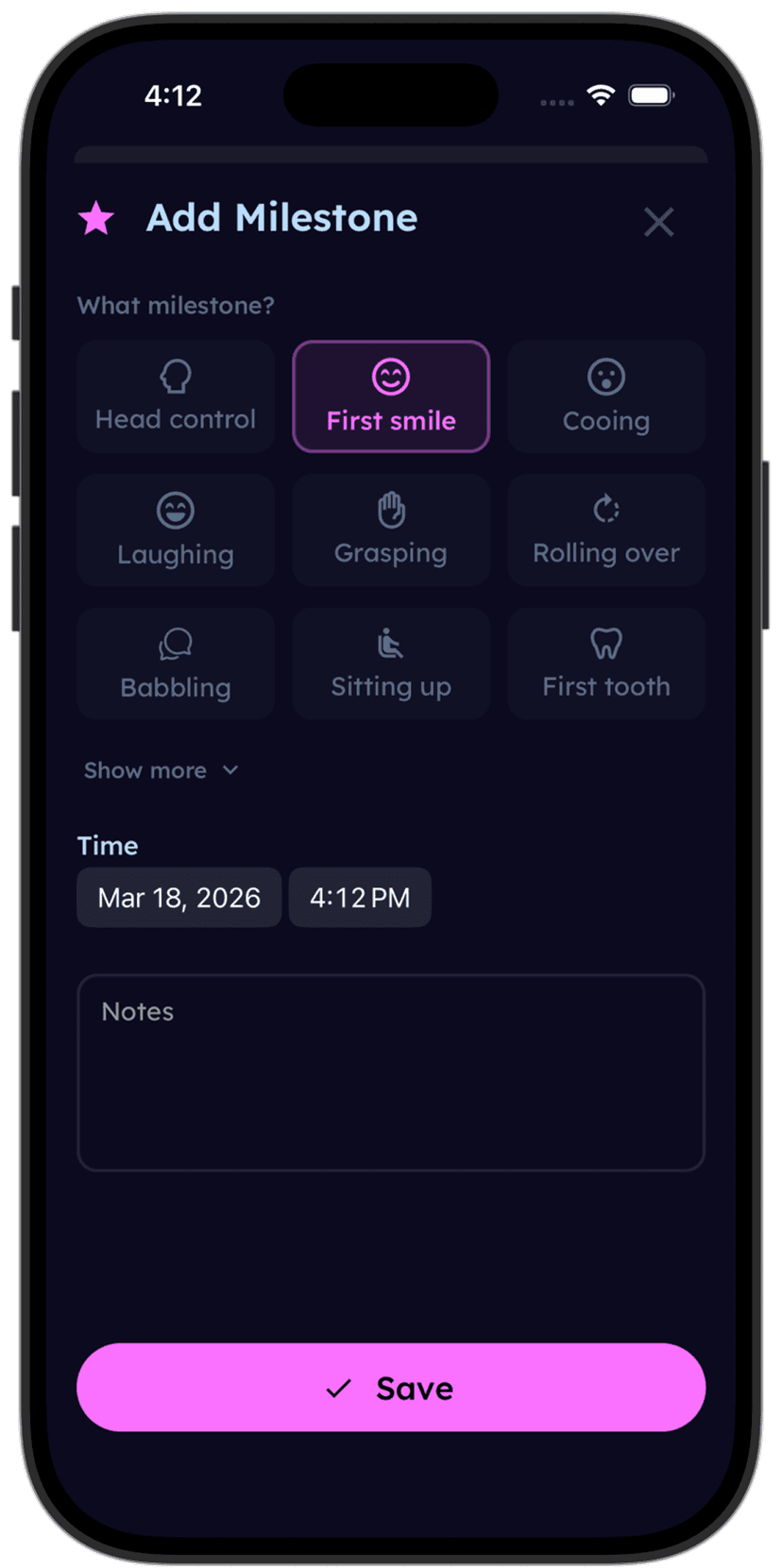
tinylog app showing milestone tracking alongside daily activity logs

When your baby is suddenly fussy and clingy, it helps to see the bigger picture.

tinylog lets you track milestones, fussy periods, and sleep side by side. After a few weeks, you can look back and see the pattern: fussy period, then a new skill. It makes the hard days feel less random and more like progress.

Download on the App StoreGet It On Google Play

Leaps vs. Sleep Regressions

Parents often talk about leaps and sleep regressions as separate things, but they're deeply connected. Many so-called sleep regressions are actually the sleep disruption caused by a developmental leap.

The 4-month regression lines up with Leap 4. The 8-month regression overlaps with Leap 6 (when separation anxiety peaks). The 12-month regression coincides with Leaps 7-8 and the explosion of mobility and language.

Understanding this connection helps because it tells you why sleep fell apart, and more importantly, that it's temporary. Your baby's brain is doing something incredible. Sleep will recover once the leap settles.

For more on sleep regressions and how to handle them, see our baby sleep cycles guide.

A Note on the Wonder Weeks App

The Wonder Weeks app will send you notifications telling you exactly when your baby is in a "stormy" or "sunny" period. A lot of parents find this reassuring. When your baby is inexplicably fussy, it's nice to open an app and see "oh, they're in a leap."

Just take the precise timing with a grain of salt. The app calculates from your baby's due date using a fixed schedule. Real babies don't follow fixed schedules. If your baby seems like they're in a leap but the app says they shouldn't be, trust your baby. If the app says they're in a leap but your baby is perfectly happy, trust your baby.

The framework is a useful lens, not a crystal ball.

Related Guides

Sources

  • Plooij, F. X., & van de Rijt, H. (2017). The Wonder Weeks. Kiddy World Publishing.
  • de Weerth, C., Zijlmans, M. A. C., Mack, S., & Bolhuis, J. E. (2019). Is there evidence for a predictable pattern in fussy behaviour of babies? A replication study. PeerJ Preprints.
  • Thelen, E., & Smith, L. B. (1994). A Dynamic Systems Approach to the Development of Cognition and Action. MIT Press.
  • Johnson, M. H. (2011). Developmental Cognitive Neuroscience. Wiley-Blackwell.
  • Bornstein, M. H. (2014). Human Infancy... and the Rest of the Lifespan. Annual Review of Psychology, 65, 121-158.
  • World Health Organization (WHO). (2006). Motor Development Study: Windows of Achievement for Six Gross Motor Development Milestones.
  • Sadeh, A., Mindell, J. A., Luedtke, K., & Wiegand, B. (2009). Sleep and sleep ecology in the first 3 years: a web-based study. Journal of Sleep Research, 18(1), 60-73.

Medical Disclaimer

This guide is for informational purposes only and is not a substitute for professional medical advice. If you have concerns about your baby's development, behavior, or health, please consult your pediatrician.

Send this to my inbox.
We'll email you this guide so you can check it when your baby is being inexplicably fussy. Again.
Is this a leap or just a bad day?
Download tinylog free. Track milestones, fussy periods, and sleep to see patterns over time.
Download on the App StoreGet It On Google Play