
GUIDE
ByHeart vs. Enfamil
Published on ·Updated on
ByHeart uses whole protein and includes lactoferrin — at roughly 2x the cost of Enfamil. Enfamil NeuroPro has MFGM, wider availability, and decades of market presence. Both are FDA-compliant.
ByHeart is one of the most expensive mainstream formulas available. Enfamil NeuroPro is one of the most established. This guide breaks down whether ByHeart's protein innovation and lactoferrin justify a price tag that is double Enfamil's.
Log formula and bottles
“All infant formulas must meet requirements that ensure optimal nutrition for babies. If your baby's formula is sold in the U.S., it has the nutrients your baby needs.”
 Dr. Matthew Badgett, MD, Pediatrician, Cleveland Clinic
The Honest Starting Point
ByHeart and Enfamil NeuroPro sit at opposite ends of the formula market spectrum. ByHeart is one of the newest and most expensive formulas available — a startup's bet on protein innovation. Enfamil is one of the oldest and most established — a century-old brand with hospital distribution contracts and massive market share.
Both are FDA-compliant. Both are nutritionally complete. The question is whether ByHeart's whole-protein approach, lactoferrin addition, and premium positioning justify a price tag that is roughly double Enfamil's.
The honest context: over a year of formula feeding, the difference between ByHeart and Enfamil is approximately $1,000–1,500. Between ByHeart and a store brand, it is $1,900–2,500. That is real money. Whether it buys better outcomes for your baby is the question this guide addresses.
For a broader look at formula feeding, see our baby feeding chart.
| Feature | ByHeart | Enfamil NeuroPro | What It Means |
|---|---|---|---|
| Manufacturer | ByHeart (founded 2019) | Reckitt / Mead Johnson (est. 1905) | ByHeart is a startup. Enfamil has over a century of formula manufacturing. |
| Protein source | Organic grass-fed whole milk protein (not separated) | Nonfat milk, whey protein concentrate | ByHeart keeps protein intact. Enfamil separates and recombines. Both work. |
| Fat source | Patented blend: organic high oleic sunflower, coconut, soy oils | Palm olein, soy, coconut, high oleic sunflower oils | ByHeart avoids palm olein. Enfamil uses it. |
| Carbohydrate source | Organic lactose | Lactose | Both use lactose. No corn syrup solids in either. |
| Signature ingredients | Lactoferrin, whole protein, patented fat blend | MFGM (milk fat globule membrane) | Different bioactive strategies. Both have promising but limited evidence. |
| DHA source | Algal oil | Algal and fungal oils | Both use algal DHA. |
| Clinical trials | Conducted own growth study | Multiple manufacturer-funded studies on MFGM | Both brands invest in clinical research. Neither is independently validated at scale. |
| Price per oz (powder) | ~$2.20–$2.60/oz prepared | ~$1.10–$1.30/oz prepared | ByHeart costs roughly 2x Enfamil per ounce |
| Available at | byheart.com, limited retail | Everywhere — grocery, pharmacy, online | Enfamil wins decisively on availability. |
The Ingredient Differences That Actually Matter
ByHeart and Enfamil take genuinely different approaches to formulation. Here is what matters.
Protein: whole vs. separated
ByHeart's defining feature is its whole-protein approach. Most formulas (including Enfamil) separate milk into skim milk and whey protein concentrate, then recombine them. ByHeart keeps the protein from organic grass-fed milk intact, arguing this is closer to breast milk and may be easier to digest.
This is an interesting idea. ByHeart conducted a clinical trial showing their formula supports growth comparable to breast milk. However, growth equivalence is the expected baseline for all FDA-compliant formula — it is not a differentiator. Whether whole protein produces measurably different outcomes than separated protein in healthy babies is unproven.
Lactoferrin: ByHeart's signature bioactive
ByHeart includes bovine lactoferrin, a protein found in breast milk that supports immune function and iron absorption. A 2009 JAMA study showed lactoferrin supplementation reduced late-onset sepsis in preterm infants. However, evidence in healthy term infants is still emerging, and no major pediatric organization has recommended lactoferrin as an essential formula ingredient.
MFGM: Enfamil's headline
Enfamil NeuroPro includes MFGM from milk fat concentrate. Research on MFGM shows promising results for cognitive development, but studies are generally short-term and manufacturer-funded. ByHeart does not specifically add MFGM, though its whole-protein approach may retain some milk fat components.
Palm olein
Enfamil uses palm olein oil. ByHeart does not. If constipation is a concern, the palm-free option may be relevant.
What the Marketing Doesn't Tell You
ByHeart's marketing positions it as the formula that "does what formula never has" — implying that previous formulas were inadequate. In reality, all FDA-compliant formulas have successfully nourished millions of babies for decades. ByHeart's innovations are incremental improvements in formulation, not a fundamental rethinking of infant nutrition.
ByHeart's clinical trial, while commendable (most formula brands rely on general ingredient research rather than product-specific trials), demonstrated growth equivalence to breast milk — the same standard every formula meets. The trial did not demonstrate superiority.
Enfamil's NeuroPro branding implies proprietary brain-boosting technology. MFGM is a naturally occurring compound in breast milk, and its evidence in formula is promising but limited. The "NeuroPro" name is marketing, not a clinical designation.
At $2.20–2.60/oz, ByHeart is roughly 3x the cost of store-brand formula that meets the same FDA nutritional baseline. Parents should not feel pressured to spend $300/month on formula when $90/month options are nutritionally complete. If the premium fits your budget and values, ByHeart is a thoughtful formula. If it does not, your baby will thrive on Enfamil or a store brand.
| Product | Typical Price | Cost Per Oz (Prepared) | Monthly Estimate |
|---|---|---|---|
| ByHeart Whole Nutrition (powder, 22 oz) | $46–$54 | ~$2.40/oz prepared | ~$250–$300/month |
| Enfamil NeuroPro (powder, 20.7 oz) | $33–$38 | ~$1.20/oz prepared | ~$150–$175/month |
| Store brand (for reference) | $16–$23 | ~$0.70–$0.85/oz prepared | ~$90–$120/month |
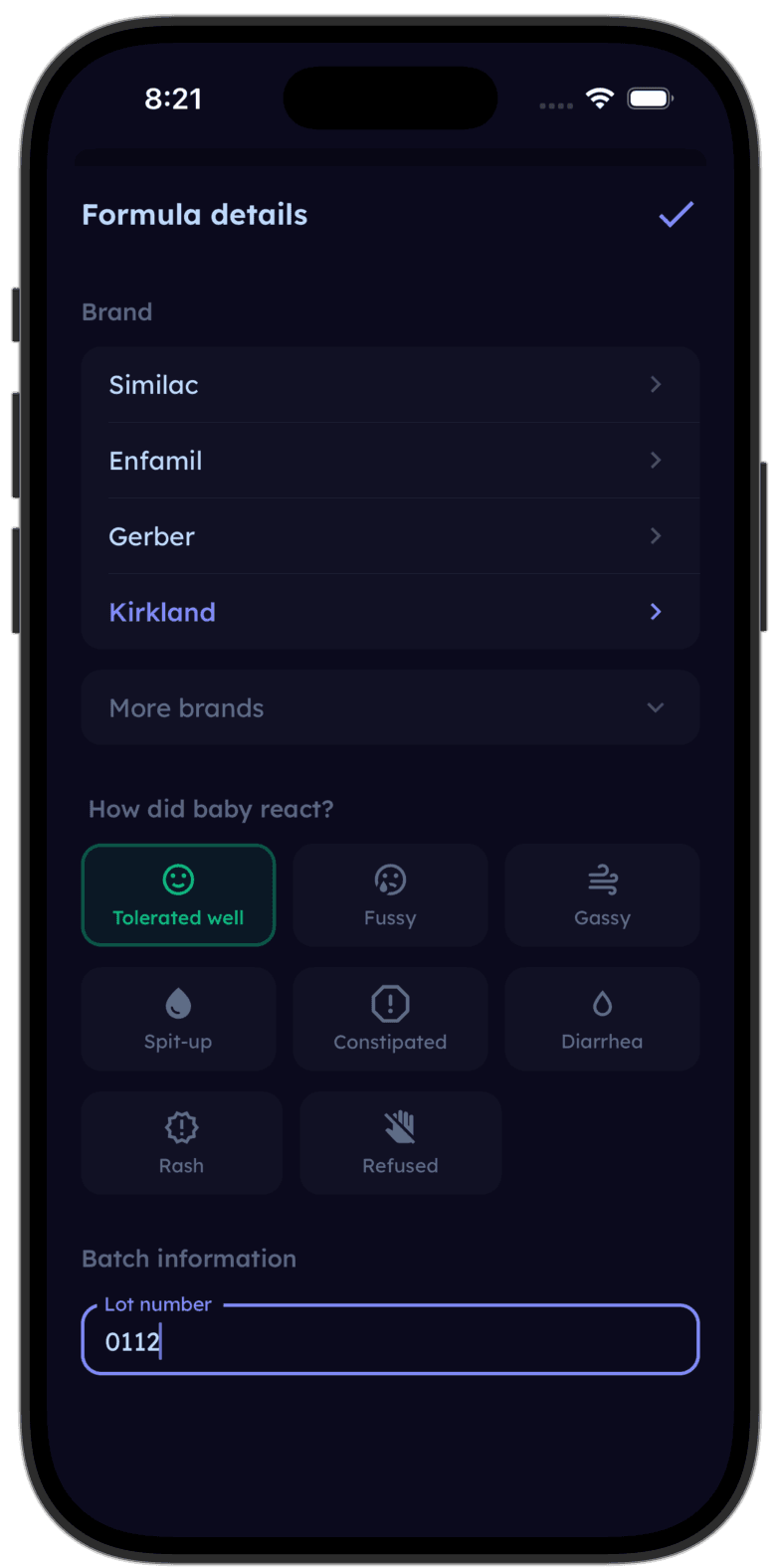
Tinylog tracks formula intake so you can spot what's working.
Log each bottle in seconds — see daily totals, track which formula your baby is on, and have real data ready for your pediatrician. Especially useful during formula transitions.


Taste, Mixing, and Practical Differences
Taste: ByHeart has a creamier taste from the whole protein. Enfamil is milder. Taste preference varies by baby.
Mixing: ByHeart can be slightly thicker. Both dissolve well with adequate mixing. A formula pitcher works for either.
Availability: Enfamil wins by a wide margin. Available at every grocery store and pharmacy. ByHeart is primarily DTC through byheart.com. Running out at midnight means waiting for delivery with ByHeart; with Enfamil, you drive to the nearest store.
WIC: Enfamil is WIC-eligible in many states. ByHeart is not. If you receive WIC benefits, this may be the deciding factor.
Supply reliability: ByHeart operates at smaller scale and may be more susceptible to supply disruptions. Having a conventional backup formula your baby has tried is practical advice.
When to Talk to Your Pediatrician
Switching between ByHeart and Enfamil does not require a doctor's visit for most healthy babies. Contact your pediatrician if your baby shows signs of intolerance.
Signs to Discuss With Your Pediatrician
- Your baby is consistently refusing feeds or eating significantly less than expected
- Persistent vomiting (not just spit-up) after most feedings
- Blood or mucus in stools
- Significant fussiness that does not improve after 1–2 weeks on a new formula
- Poor weight gain or weight loss
- Signs of allergic reaction: hives, facial swelling, wheezing, or difficulty breathing (seek immediate care)
Most formula discomfort (mild gas, occasional spit-up) is normal. Give any new formula at least 1–2 weeks before deciding it is not working.
The Bottom Line
ByHeart offers genuine formulation innovation — whole protein, lactoferrin, no palm olein — at a significant premium. Enfamil offers MFGM, widespread availability, and a century of manufacturing experience at roughly half the price.
Choose ByHeart if: you value whole-protein formulation and lactoferrin, the premium price fits your budget, and limited retail availability is not a dealbreaker.
Choose Enfamil if: you want broad availability, WIC eligibility, MFGM addition, and a lower price point.
Either works well if: your baby is healthy and full-term. Both are FDA-compliant and nutritionally complete.
If you are switching, tracking feeds and symptoms for 1–2 weeks gives you real data. Tinylog logs feeds, diapers, and fussiness so you can see what is working.
For more, see ByHeart vs. Similac, Bobbie vs. ByHeart, and Enfamil vs. Similac.
Related Guides
-
Best Baby Formulas 2026 — An evidence-based guide
-
ByHeart vs. Similac — What justifies the price difference
-
Bobbie vs. ByHeart — New-generation formula showdown
Sources
- U.S. Food and Drug Administration. "21 CFR Part 107 — Infant Formula." Code of Federal Regulations.
- American Academy of Pediatrics. "Choosing an Infant Formula." HealthyChildren.org, 2024.
- Manzoni P, et al. "Bovine lactoferrin supplementation for prevention of late-onset sepsis in very low-birth-weight neonates." JAMA, 2009.
- Timby N, et al. "Neurodevelopment, nutrition, and growth until 12 mo of age in infants fed a low-energy, low-protein formula supplemented with bovine milk fat globule membranes." American Journal of Clinical Nutrition, 2014.
- U.S. FDA. "Infant Formula Guidance Documents and Regulatory Information." fda.gov, 2023.
This guide is for informational purposes only and is not a substitute for professional medical advice. Formula recommendations should be discussed with your pediatrician, especially for babies with allergies, reflux, or other medical conditions.
Frequently asked questions
- Is ByHeart worth the extra cost over Enfamil?
- That depends on your priorities. ByHeart uses whole protein, includes lactoferrin, and avoids corn syrup solids — at roughly 2x the cost. Enfamil NeuroPro includes MFGM, is widely available, and is WIC-eligible. Both meet FDA standards. The premium buys ingredient innovation, not proven different outcomes.
- What makes ByHeart different from other formulas?
- ByHeart uses whole protein from organic grass-fed milk (most formulas separate milk into skim + whey), includes bovine lactoferrin, and has a patented fat blend. It also conducted its own clinical trial. These are genuine differences in formulation approach.
- Does ByHeart have MFGM like Enfamil?
- ByHeart does not specifically market MFGM. Its whole-protein approach may retain some milk fat components, but MFGM is not a highlighted ingredient. Enfamil NeuroPro specifically adds MFGM from milk fat concentrate.
- Is ByHeart available at regular stores?
- ByHeart is primarily sold direct-to-consumer through byheart.com, with limited retail expansion. Enfamil is available at virtually every grocery store, pharmacy, and major retailer. For emergency purchases, Enfamil is far more accessible.
- What is lactoferrin and why does ByHeart include it?
- Lactoferrin is an iron-binding protein found in breast milk that supports immune function. Research shows potential benefits for reducing infections, particularly in preterm infants. ByHeart includes bovine lactoferrin. The evidence is promising but still emerging for term infants.