
GUIDE
CuboAi Gen 3 vs. Infant Optics DXR-8 PRO
Published on
Both are excellent baby monitors with fundamentally different approaches. CuboAi Gen 3 offers AI-powered safety alerts and flexible mounting. Infant Optics DXR-8 PRO delivers rock-solid reliability with zero internet dependency. Your pick depends on whether you want smart detection features or a bulletproof dedicated feed.
The CuboAi Gen 3 and Infant Optics DXR-8 PRO sit near the top of every baby monitor recommendation list, but they could not be more different in philosophy. CuboAi connects to your Wi-Fi and uses computer vision to detect covered faces, rollovers, and danger zone breaches. Infant Optics uses a closed radio signal and a dedicated parent unit that never touches the internet. Both approaches have real merit — the right choice depends on what matters most to your family.
Log naps, wake windows, and overnight stretches
Two Baby Monitors, Two Completely Different Approaches
The CuboAi Gen 3 and Infant Optics DXR-8 PRO are both highly rated baby monitors, but they solve the same problem in opposite ways. One bets on AI and connectivity. The other bets on simplicity and independence.
CuboAi Gen 3 is a Wi-Fi smart camera that uses computer vision to detect covered faces, rollovers, and danger zone breaches. It streams 1080p HD video to your phone and includes AI-powered safety alerts for free — no subscription needed for the core stuff.
Infant Optics DXR-8 PRO is a closed-circuit dedicated monitor with its own parent unit. It never touches the internet. There is no app, no subscription, and no cloud. You get a camera, a screen, and a clear picture of your sleeping baby.
We compared specs, real parent feedback, long-term costs, and privacy implications to help you figure out which one makes sense for your nursery.
For more on sleep patterns by age, check our baby sleep schedule by age guide.
| Feature | CuboAi Gen 3 | Infant Optics DXR-8 PRO | What It Means |
|---|---|---|---|
| Connection type | Wi-Fi (2.4 GHz) | FHSS closed signal (no Wi-Fi needed) | Infant Optics works without internet. CuboAi requires a stable Wi-Fi connection. |
| Camera resolution | 1080p HD with 135° wide-angle lens | 720p HD | CuboAi is sharper and captures more of the room in a single frame. |
| Viewing device | Smartphone app (iOS / Android) | Dedicated 5-inch parent unit | CuboAi lets you watch from anywhere. Infant Optics keeps a screen always on and in your hand. |
| AI safety alerts | Covered-face, rollover, danger zone, cry detection | None | CuboAi's AI detection is its biggest differentiator. Infant Optics is a camera only. |
| Night vision | Infrared with enhanced low-light sensor | Infrared (clear, no visible light) | Both perform well in total darkness. Slight edge to CuboAi in low-light clarity. |
| Two-way audio | Yes | Yes | Tie. Both let you talk to your baby from the parent unit or app. |
| Camera lenses | Fixed 135° wide-angle lens | Interchangeable optical lens system (normal, wide-angle, zoom) | Infant Optics lets you swap physical lenses for different rooms. CuboAi's wide angle covers most setups. |
| Mounting options | Floor stand, wall mount, or crib mount | Tabletop or wall mount | CuboAi offers more placement flexibility, especially with the included floor stand. |
| Range | Anywhere with internet | Up to 700 ft (line of sight) | CuboAi works from the office or across town. Infant Optics is limited to your home but has zero lag. |
| Subscription required | Core AI alerts included free — premium plan optional ($50/yr) | No subscription — ever | Neither requires a subscription for the basics. CuboAi's premium plan adds video history and sleep data. |
| Security / hacking risk | AES 256-bit encryption, GDPR compliant | No internet connection — zero hacking risk | Infant Optics wins on privacy by design. CuboAi is well-encrypted but still internet-connected. |
| Smart home integration | Alexa, Google Home | None | CuboAi connects to your smart home ecosystem. Infant Optics is a standalone system. |
AI Safety Alerts: CuboAi's Biggest Advantage
The feature that sets CuboAi Gen 3 apart from most monitors on the market is its AI-powered detection system. Here is what it actually does:
- Covered-face alert: The camera uses computer vision to detect when a blanket, lovey, or pillow covers your baby's face. You get an immediate push notification. This is especially useful in the early months before your baby can move objects away from their face independently.
- Rollover alert: Detects when your baby rolls onto their stomach and sends a notification. Helpful before your baby can roll back on their own.
- Danger zone alert: You draw virtual boundaries in the app — around the crib edge, near a door, by stairs. The camera alerts you if your baby crosses them. This becomes genuinely valuable once your baby starts crawling.
Infant Optics DXR-8 PRO does not have any of these features. It shows you the video feed and plays audio — that is it. You are the detection system.
If AI safety alerts are the main reason you are shopping for a monitor, CuboAi is the clear pick. If you are comfortable watching the feed yourself and do not need automated detection, Infant Optics keeps things simple.
Reliability and Latency: Where Infant Optics Shines
Here is something that does not show up on spec sheets: what happens at 3 AM when your baby cries and you groggily reach for your monitor.
With the Infant Optics DXR-8 PRO, you pick up the parent unit and the feed is already there. No loading. No buffering. No "connecting to camera..." spinner. The FHSS signal runs on its own frequency, independent of your home network. If your internet goes down, the monitor keeps working. If your router reboots overnight, nothing changes. The feed just works.
With the CuboAi Gen 3, you open an app on your phone. The stream loads over Wi-Fi and usually connects within a few seconds — but "usually" and "always" are different things. If your router is congested, if there is a firmware update pending, or if your phone's Wi-Fi dropped to save battery, you might wait a few extra seconds. That can feel like an eternity when your baby is screaming.
For parents who value always-on reliability above everything else, the Infant Optics approach is hard to beat.
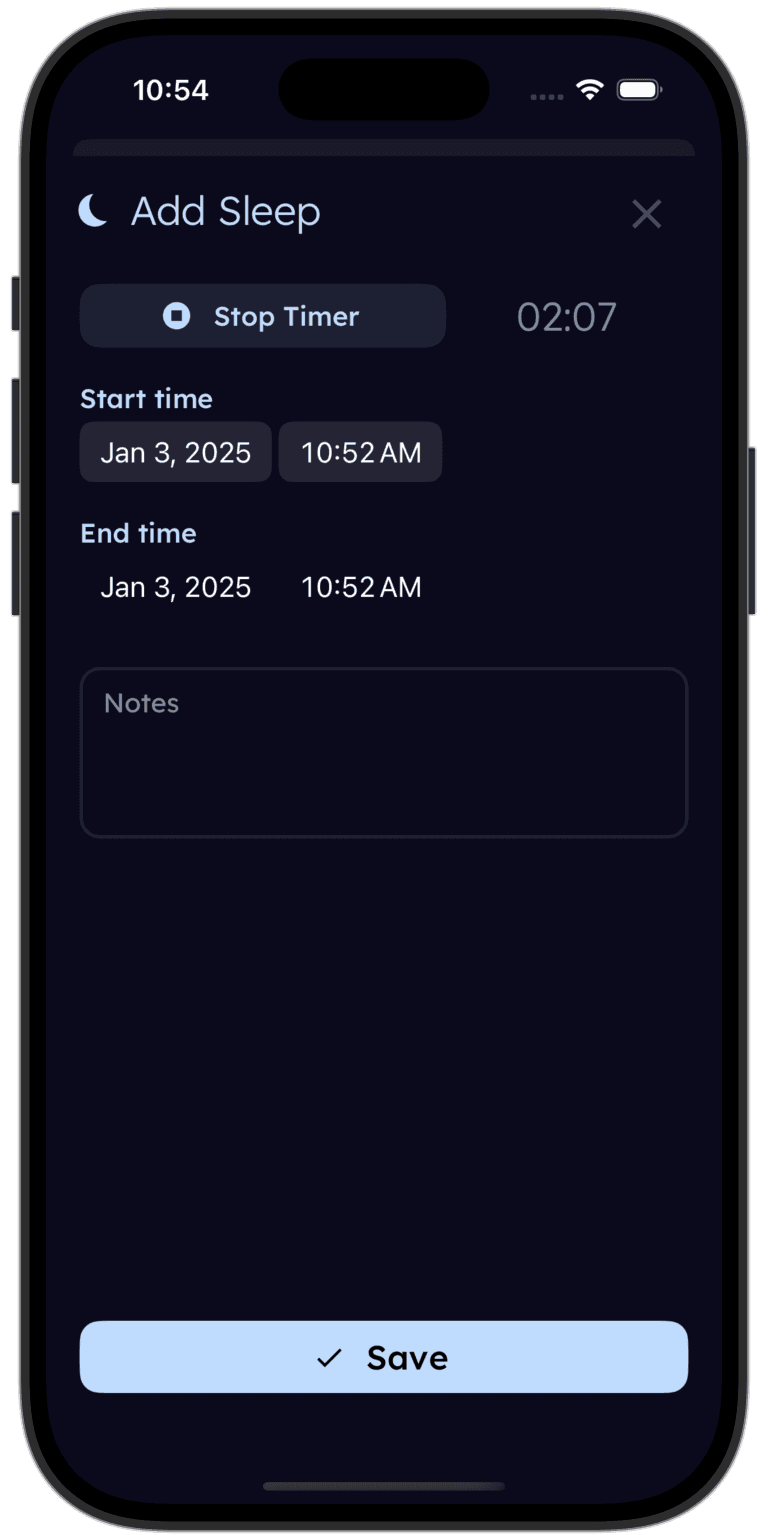
Tinylog tracks sleep so you can spot patterns.
Log naps and nighttime sleep, track wake windows, note regressions, and share your baby's sleep data with your pediatrician.


Privacy and Security: A Real Conversation
This is not paranoia — it is a practical consideration. Any camera connected to the internet carries some risk. There have been documented cases of Wi-Fi baby monitors being accessed by unauthorized people. It is rare with modern encryption, but it is not impossible.
CuboAi Gen 3 uses AES 256-bit encryption and is GDPR compliant. If you use a strong Wi-Fi password, keep firmware updated, and enable two-factor authentication, the risk is very low. But the camera is still on your home network, and that network is connected to the wider internet.
Infant Optics DXR-8 PRO has zero hacking risk because the signal never touches the internet. The FHSS (Frequency-Hopping Spread Spectrum) signal hops between frequencies, making even local interception extremely difficult. There is no account to compromise, no cloud storage to breach, no app to exploit.
If internet-connected cameras in the nursery make you uneasy, Infant Optics removes that concern entirely.
Video Quality and Camera Flexibility
On raw image quality, CuboAi Gen 3 wins. Its 1080p HD sensor with a 135-degree wide-angle lens produces a sharp, expansive image. You can see the full crib and a good chunk of the room without repositioning the camera. The enhanced low-light sensor also delivers slightly better night vision images.
Infant Optics DXR-8 PRO shoots at 720p, which is good but visibly less sharp — especially if you zoom in to check details. However, it has a trick that CuboAi does not: interchangeable optical lenses. The standard lens comes in the box, and you can buy a wide-angle or zoom lens separately ($10–$15 each). Want a tighter shot in a small nursery? Swap the lens. Moving the camera to a bigger room? Switch to wide-angle. It is a thoughtful design.
Both have infrared night vision that works well in a pitch-dark nursery. Neither emits visible light that could disturb your baby's sleep.
| Product | Typical Price | Subscription | Monthly Cost |
|---|---|---|---|
| CuboAi Gen 3 (camera + floor stand) | $200–$260 | Free tier included — premium $50/yr (optional) | $0–$5/mo |
| Infant Optics DXR-8 PRO (camera + parent unit) | $165–$200 | None — ever | $0 |
| CuboAi Gen 3 (2-year total cost with premium) | $200–$260 + $100 | $50/yr × 2 | ~$300–$360 total |
| Infant Optics DXR-8 PRO (2-year total cost) | $165–$200 | $0 | ~$165–$200 total |
Total Cost of Ownership
The upfront prices are fairly close — CuboAi Gen 3 runs $200–$260 for the camera and stand, while Infant Optics DXR-8 PRO runs $165–$200 for the camera and parent unit.
But the real cost story is what happens over time.
Infant Optics DXR-8 PRO costs nothing after purchase. Zero. No subscription, no cloud fees, no account required. You might spend $10–$15 on an extra lens, and that is it. Over two years, your total cost is $165–$215.
CuboAi Gen 3 is free for core features (covered-face alerts, danger zone, cry detection). But if you want the premium plan — 18-hour video playback, time-lapse, sleep analytics — that is $50/year. Over two years with premium, your total cost is $300–$360.
That said, CuboAi's free tier is genuinely generous. If you skip the premium plan and just use the AI safety alerts, the total cost is comparable to Infant Optics with a lot more functionality.
Choose CuboAi Gen 3 If
- You want covered-face and rollover alerts without buying a separate wearable
- Danger zone detection matters to you — your baby is mobile or soon will be
- You prefer viewing the monitor feed on your phone from anywhere
- You want a wider-angle 1080p camera that captures more of the room
- You need flexible mounting options (floor stand, wall, or crib rail)
- Smart home integration with Alexa or Google Home is useful to you
Choose Infant Optics DXR-8 PRO If
- Reliability is your top priority — you want a feed that works during internet outages
- You are not comfortable with a Wi-Fi camera in your baby's room
- You prefer a dedicated parent unit that is always on and never needs charging your phone
- You want interchangeable lenses to customize the view for different rooms
- You want zero recurring costs — buy once and you are done
Where to Buy
If you want AI-powered safety alerts and a sharp 1080p wide-angle feed, the CuboAi Gen 3 (~$230 for the camera + stand) delivers covered-face detection, rollover alerts, and danger zone monitoring — all included free. The optional premium plan is only $50/year if you want video history and sleep data. It is a lot of monitor for the money.
If you want a dedicated monitor that works every single time with zero internet dependency, the Infant Optics DXR-8 PRO (~$180 for camera and parent unit) is the gold standard for reliability. No subscription, no cloud, no hacking risk, and interchangeable lenses are a nice bonus. Pick it up at 3 AM and the feed is already there.
Our honest take: if AI safety alerts give you peace of mind, go CuboAi. If you just want a dead-simple, always-on video feed of your baby, go Infant Optics. Both are excellent monitors that will serve you well.
Tinylog earns a small commission on purchases made through these links, at no cost to you.
Tip: check promo.new before purchasing. It's hit or miss depending on the product, but when it hits, you'll be glad you checked.
The Bottom Line
The CuboAi Gen 3 and Infant Optics DXR-8 PRO are both top-tier baby monitors, but they are built for different kinds of parents.
CuboAi Gen 3 wins on AI safety alerts (covered-face, rollover, danger zone), video quality (1080p wide-angle), mounting flexibility, remote phone access, and smart home integration. It gives you the most features per dollar, especially on the free tier.
Infant Optics DXR-8 PRO wins on connection reliability, zero latency, complete privacy, no recurring costs, and the comfort of a dedicated always-on parent unit. It does one thing — show you your baby — and does it without fail.
For most families, the deciding question is simple: do you want a smart monitor that watches your baby for you, or a reliable monitor that lets you watch your baby yourself? Both are valid answers.
If you are tracking your baby's sleep patterns — and the early months are a good time to start — Tinylog makes it easy to log naps, bedtimes, and overnight stretches regardless of which monitor you choose.
Related Guides
- Baby Sleep Schedule by Age — How much sleep your baby needs at every stage
- 4-Month Sleep Regression — Why it happens and how to get through it
- Baby Feeding Chart — How much your baby should eat by age
- Is My Baby's Sleep Normal? — What to expect and when to worry
Sources
- CuboAi.com. "CuboAi Gen 3 Smart Baby Monitor — Product Information." 2026.
- InfantOptics.com. "DXR-8 PRO Baby Monitor — Product Information." 2026.
- Consumer Reports. "Best Baby Monitors of 2026." consumerreports.org, 2026.
- Wirecutter (NYT). "The Best Baby Monitors." nytimes.com/wirecutter, 2026.
- BabyGearLab. "Best Baby Monitor Reviews." babygearlab.com, 2026.
- American Academy of Pediatrics. "Safe Sleep Recommendations." aap.org, 2024.
- FCC.gov. "Wireless Baby Monitor Safety Information." fcc.gov, 2025.
This guide is for informational purposes only. Baby monitor choice depends on your family's specific needs and nursery setup. Always follow AAP safe sleep guidelines regardless of which monitor you use.
Frequently asked questions
- Does the CuboAi Gen 3 require a subscription?
- No — not for its core features. Covered-face alerts, rollover alerts, danger zone alerts, cry detection, and live HD streaming are all included free. The optional premium plan ($50/year) adds 18-hour video playback, time-lapse recordings, and sleep analytics. Most parents find the free tier is plenty.
- Can the Infant Optics DXR-8 PRO connect to my phone?
- No. The DXR-8 PRO uses a dedicated 5-inch parent unit with its own screen. It does not have Wi-Fi, an app, or any internet connectivity. This is a deliberate design choice that eliminates hacking risk and removes dependency on your home network.
- Which monitor has better video quality?
- CuboAi Gen 3 streams at 1080p HD with a 135-degree wide-angle lens. Infant Optics DXR-8 PRO streams at 720p. The CuboAi image is noticeably sharper, especially when zooming in. However, the Infant Optics feed has zero latency, which some parents prefer over raw resolution.
- Are Wi-Fi baby monitors safe from hacking?
- Modern Wi-Fi monitors like the CuboAi Gen 3 use AES 256-bit encryption to protect streams. Using a strong Wi-Fi password, enabling two-factor authentication, and keeping firmware updated reduces risk significantly. The Infant Optics DXR-8 PRO has zero hacking risk because it never connects to the internet.
- Which monitor is better for a crawling or mobile baby?
- CuboAi Gen 3 has a danger zone alert feature that lets you draw virtual boundaries in the app. The camera sends a push notification if your baby crosses them. Infant Optics does not have this feature — you would need to watch the feed yourself. For active babies, CuboAi's AI detection is a clear advantage.
- Can I use either monitor with multiple cameras?
- Yes. CuboAi Gen 3 supports multiple cameras on a single account, viewable from the app. Infant Optics DXR-8 PRO supports up to four cameras on one parent unit and can display split-screen or cycle between views. Both work well for families with multiple children.