GUIDE

Developmental Milestones vs. Growth Milestones

Developmental milestones track skills — rolling, babbling, grasping. Growth milestones track physical size — weight, length, head circumference. Both matter, but they measure completely different things.

Your baby can be small for their age and developmentally advanced, or big for their age and a little behind on motor skills. Here's why that's normal.

Track milestones and growth together

Log skills and measurements in one place

We encourage families to tell their doctor what they have noticed about their children's milestones and behavior, as well as any concerns that other care providers have shared with them about their child. There are helpful therapies and sometimes medical treatments that can ease those symptoms considerably.
Dr. Michelle M. MaciasDr. Michelle M. Macias, MD, FAAP, Developmental-Behavioral Pediatrician, American Academy of Pediatrics

Two Types of Progress, One Baby

When your pediatrician talks about your baby's "milestones," they could mean two very different things. Developmental milestones are the skills your baby acquires — rolling over, making eye contact, babbling, picking up a Cheerio. Growth milestones are about physical size — how much your baby weighs, how long they are, how their head circumference is trending.

These two categories are tracked separately because they measure fundamentally different aspects of your baby's health. A baby's brain development (reflected in developmental milestones) and their physical growth (reflected in growth percentile charts) are influenced by different factors and follow different timelines. Your baby can be small but developmentally advanced, or large but still working on certain motor skills.

Understanding the difference matters because it affects how you interpret your baby's progress — and whether you need to worry. A baby at the 15th percentile for weight who's rolling, babbling, and engaging socially is doing great. A baby at the 85th percentile for weight who hasn't rolled by 7 months may need an evaluation — activities like tummy time can help build the strength needed for rolling. The numbers and the skills tell different stories.


Developmental vs. Growth Milestones
What it measures
Developmental MilestonesSkills and abilities — motor, language, cognitive, social
Growth MilestonesPhysical size — weight, length, head circumference
How it's assessed
Developmental MilestonesObservation of behaviors (can baby roll, grasp, babble?)
Growth MilestonesMeasurements plotted on growth charts (WHO or CDC)
Typical tracking tool
Developmental MilestonesMilestone checklists (CDC, ASQ-3)
Growth MilestonesGrowth percentile charts (WHO standards)
What influences it
Developmental MilestonesBrain development, practice, environment, stimulation
Growth MilestonesGenetics, nutrition, feeding method, health conditions
Normal variation
Developmental MilestonesWide range — rolling can happen anywhere from 3-6 months
Growth MilestonesWide range — healthy babies span from 5th to 95th percentile
Red flag pattern
Developmental MilestonesNot reaching skills by outer expected age, or losing skills
Growth MilestonesCrossing two or more percentile lines, or no growth over time
How often checked
Developmental MilestonesAt every well-child visit, plus parent observation at home
Growth MilestonesAt every well-child visit via measurements
Both types of milestones have wide normal ranges. What matters most is your baby's individual trajectory over time.

Developmental Milestone Advantages

  • Gives direct insight into brain development and neurological health
  • Parents can observe and encourage many milestones at home
  • Early detection of delays can lead to early intervention, which is most effective before age 3
  • CDC's 2022 updated checklist provides clearer, evidence-based timelines
  • Covers multiple domains — motor, language, cognitive, social-emotional

The CDC updated their milestone checklist in 2022 to reflect when 75% of children reach each skill, making the benchmarks more practical.

Developmental Milestone Challenges

  • Wide normal ranges can make it hard to know when to be concerned
  • Comparisons with other babies' timelines can cause unnecessary anxiety
  • Some milestones are hard to observe outside of specific contexts
  • Checklists don't capture the quality of a skill, just whether it's present

If you're unsure whether your baby is on track, the ASQ-3 screening tool provides a structured way to assess development at home.

Growth Milestone Advantages

  • Objective and measurable — a number on a chart leaves less room for interpretation
  • Growth trends over time reveal nutrition and health patterns early
  • WHO charts provide a reliable standard based on healthy breastfed babies
  • Easy to track at home between doctor visits with a simple scale
  • Percentile tracking catches issues like failure to thrive early

The WHO growth standards are recommended for all children under 2, regardless of feeding method.

Growth Milestone Challenges

  • A single measurement is meaningless — only the trend matters
  • Different growth charts (WHO vs. CDC) can give different percentiles for the same baby
  • Parents often fixate on the percentile number rather than the curve's trajectory
  • Doesn't tell you anything about cognitive, motor, or language development

A single percentile number without context is meaningless. Always look at the trend over multiple measurements.

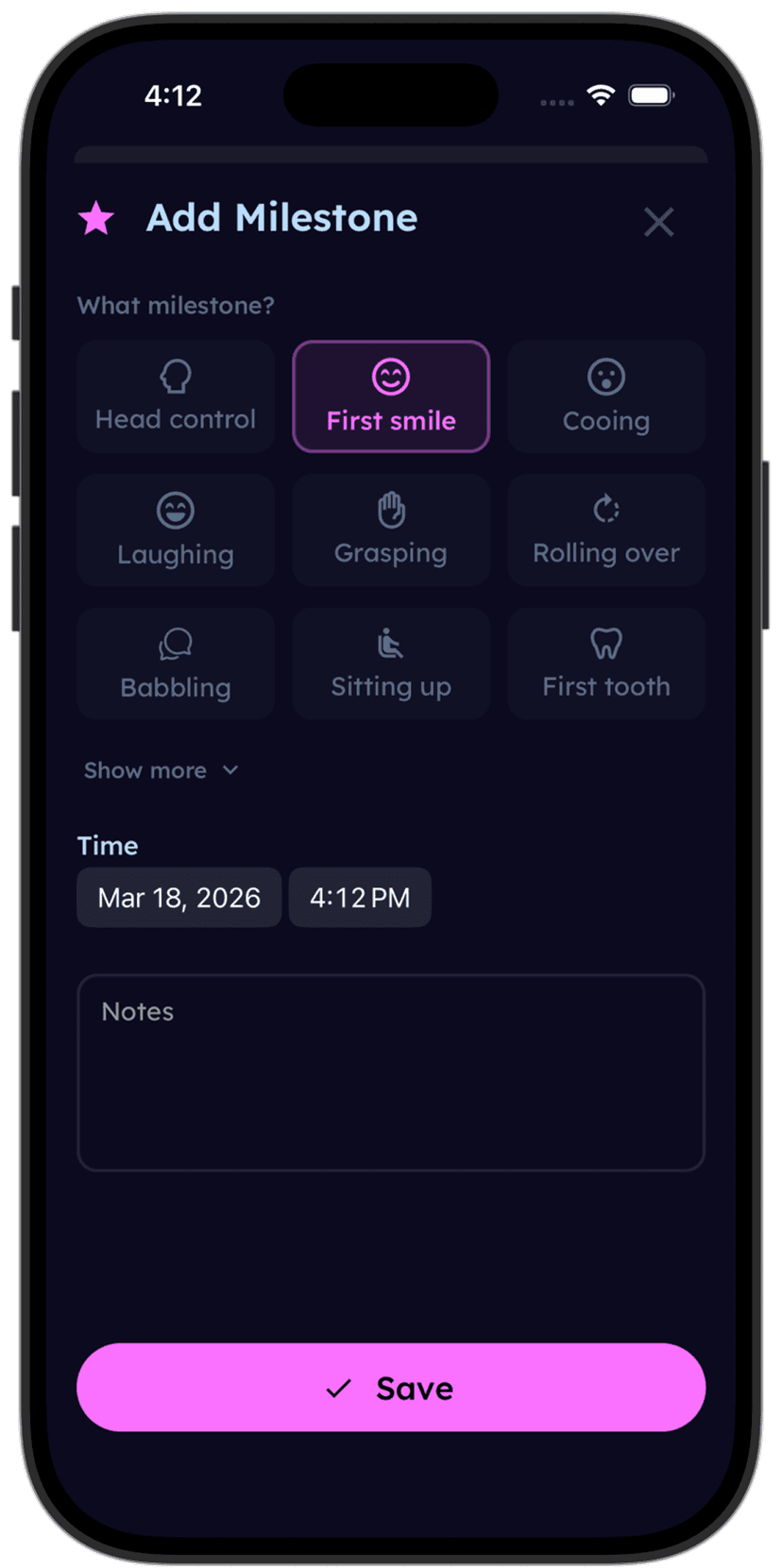
Tinylog milestone tracking showing baby's developmental progress

Track milestones and growth in one place.

Tinylog lets you log developmental milestones as your baby reaches them and track growth measurements over time — so you can see both types of progress together.

Download on the App StoreGet It On Google Play

How They Work Together

The most useful way to think about these two types of milestones is as complementary. Growth tells you about your baby's body — are they getting adequate nutrition, are they physically healthy? Development tells you about your baby's brain — are neural connections forming, is your baby learning to interact with the world?

Sometimes they overlap. A baby with a medical condition affecting growth may also show developmental delays. But often they're independent. The research consistently shows that within the normal range of growth (roughly 5th to 95th percentile), there's no correlation between size and developmental speed. Your small baby isn't behind because they're small. Your big baby isn't ahead because they're big.

Pediatricians track both at every well-child visit precisely because they provide different information. If one is off-track, it guides them toward different next steps — a feeding evaluation for growth concerns, a developmental screening for milestone concerns.

When to Be Concerned

For developmental milestones, talk to your pediatrician if your baby isn't reaching skills by the outer edge of the expected range. The CDC's 2022 milestones were set at the 75th percentile — meaning if your baby hasn't reached a listed milestone by the specified age, it doesn't automatically mean a problem, but it does mean it's worth discussing. Losing a skill that was previously mastered is always worth mentioning.

For growth milestones, the red flag isn't a low percentile — it's a changing trajectory. A baby who has always been at the 20th percentile is fine. A baby who was at the 60th and dropped to the 20th over two visits needs evaluation. Crossing two or more major percentile lines warrants attention.

In both cases, early identification matters. Early intervention services for developmental delays are most effective before age 3. Growth issues caught early are usually more treatable than those caught late.

Tips That Apply Either Way

Track both, but differently

Growth milestones need precise measurements — use a scale and measuring tape or your pediatrician's numbers. Developmental milestones need observation — note when your baby first does something new, not just whether they can.

Use corrected age for preemies

If your baby was born premature, use corrected age (age from due date) when assessing both growth and developmental milestones. This gives a fairer picture until at least age 2.

One snapshot doesn't tell the story

A single measurement or milestone check is just a data point. What matters is the pattern over time — is your baby progressing? That requires regular tracking, which is why pediatricians see babies so frequently in the first year.

Related Guides

Sources

  • CDC. "CDC's Developmental Milestones." Updated February 2022.
  • WHO Multicentre Growth Reference Study Group. "WHO Child Growth Standards." Acta Paediatrica, 2006.
  • Zubler, J. M., et al. "Evidence-Informed Milestones for Developmental Surveillance Tools." Pediatrics, 2022.
  • Lipkin, P. H., & Macias, M. M. "Promoting Optimal Development: Identifying Infants and Young Children with Developmental Disorders Through Developmental Surveillance and Screening." Pediatrics, 2020.

This guide is for informational purposes only and is not a substitute for professional medical advice. Consult your pediatrician for guidance specific to your baby.

Get this comparison in your inbox.
We'll send you this breakdown so you can understand both types of milestones at a glance.
See the full picture of your baby's progress.
Track developmental milestones alongside growth measurements in Tinylog — because both tell an important part of your baby's story.
Download on the App StoreGet It On Google Play