GUIDE

When and How to Wean

There's no single right time to wean. The best time is when you and your baby are ready — whether that's 6 months, 12 months, 2 years, or somewhere in between.

Weaning doesn't have to be an event. For most families, it's a gradual transition that happens over weeks or months. Here's how to do it gently.

The Weaning Question

Weaning is one of those parenting decisions that comes loaded with external pressure from every direction. Wean at 6 months and someone will tell you it's too early. Wean at 2 years and someone will tell you it's too late. Combo feed and someone will have an opinion about that too.

Here's the reality: the "right" time to wean is when it's right for your family. The WHO recommends breastfeeding for 2 years or beyond. The AAP updated their recommendation in 2022 to support breastfeeding for 2 years or longer. But recommendations are population-level guidance, not individual prescriptions. Your circumstances, your baby's needs, your mental health, your work situation, and your personal goals all factor in.

Whatever your timeline, the approach matters. Gradual weaning is gentler on your body (avoiding engorgement and mastitis) and your baby's emotions (avoiding abrupt loss of comfort). This guide covers how to do it at any age.

Weaning Methods Compared
Gradual weaning (recommended)
How It WorksDrop one nursing session every 3-7 days. Start with the session baby is least attached to. Replace with a cup, bottle, snack, or activity.
Timeline2-6 weeks typically
AdvantagesLowest risk of engorgement and mastitis. Emotionally gentlest for baby. Gives your hormones time to adjust.
DisadvantagesSlower process. Requires patience and consistency.
Partial weaning
How It WorksKeep some nursing sessions (usually morning and bedtime) while dropping daytime feeds. Replace dropped feeds with cups/bottles/food.
TimelineOngoing — some families maintain partial nursing for months
AdvantagesPreserves the connection of nursing without the frequency. Baby still gets some breast milk benefits.
DisadvantagesSupply management can be tricky — you need to find a level your body maintains consistently.
Child-led weaning
How It WorksStop offering but don't refuse. Let baby naturally lose interest over time. Distraction and substitution when they ask.
TimelineHighly variable — weeks to months
AdvantagesEmotionally the gentlest approach. Baby weans at their own pace. Low risk of engorgement because the reduction is very gradual.
DisadvantagesUnpredictable timeline. May take longer than you'd prefer. Works better for toddlers than infants.
Rapid weaning (when medically necessary)
How It WorksStopping breastfeeding over a short period. Hand express for comfort only. Cold compresses, tight sports bra, anti-inflammatory medication.
Timeline3-7 days
AdvantagesFast.
DisadvantagesHigh risk of engorgement, clogged ducts, and mastitis. Emotionally difficult for baby and parent. Only recommended when medically necessary.
Gradual weaning is recommended in most situations. Rapid weaning should be reserved for medical necessity. Partial weaning is an underappreciated option — you can keep some feeds and drop others.
Which Feed to Drop First
Mid-day feed
Why This OneBaby is most distracted and least emotionally attached to this one. Easiest to replace with a snack or activity.
Afternoon feed
Why This OneSimilar to mid-day — baby is active and engaged. Offer a cup of milk or a snack instead.
Morning feed
Why This OneAfter the daytime feeds are gone, morning can be dropped. Replace with breakfast and a cup.
Bedtime feed (last to go)
Why This OneThis is usually the most emotionally significant feed for both parent and baby. It's okay to keep this one for a long time, even if all other feeds are gone.
Night feeds
Why This OneNight feeds can be dropped before or after bedtime nursing. If baby is over 12 months with good weight gain, night weaning is usually appropriate.
This is a common order, not a rule. Some babies are easy about bedtime but cling to the morning feed. Follow your baby's cues.

Tips for Gentle Weaning

Replace the feed with something else

Don't just remove a nursing session — substitute it. Offer a cup of milk, a snack, a book, a cuddle, or an activity. Baby needs the nutrition OR the comfort that nursing provided. Make sure they get one or the other.

Don't offer, don't refuse

For toddlers, the classic approach: don't bring up nursing, but don't say no if they ask. Over time, they ask less as the routine changes. This is gentler than abrupt refusal and less confusing for a child who's used to nursing on demand.

Change the routine

If baby always nurses in the rocking chair after nap, stop going to the rocking chair after nap. Offer a snack in the kitchen instead. Changing the environmental cues reduces the association and the request.

Expect some protest (and that's okay)

Even with gradual weaning, your baby may protest the change. This is normal grief — they're losing something they love. Comfort them with extra cuddles, attention, and physical closeness. They'll adjust.

Watch for engorgement

As you drop feeds, your breasts may feel full and uncomfortable. Hand express just enough for comfort — not to empty. Cold compresses and ibuprofen help. If you develop a hard, hot, red area or fever, see your provider — that's mastitis territory.

Hormonal shifts are real

Weaning causes a drop in prolactin and oxytocin. Some parents experience mood changes, sadness, or even depression during weaning. If you feel significantly worse emotionally, talk to your provider. Post-weaning mood changes are a real thing, not something you should push through alone.


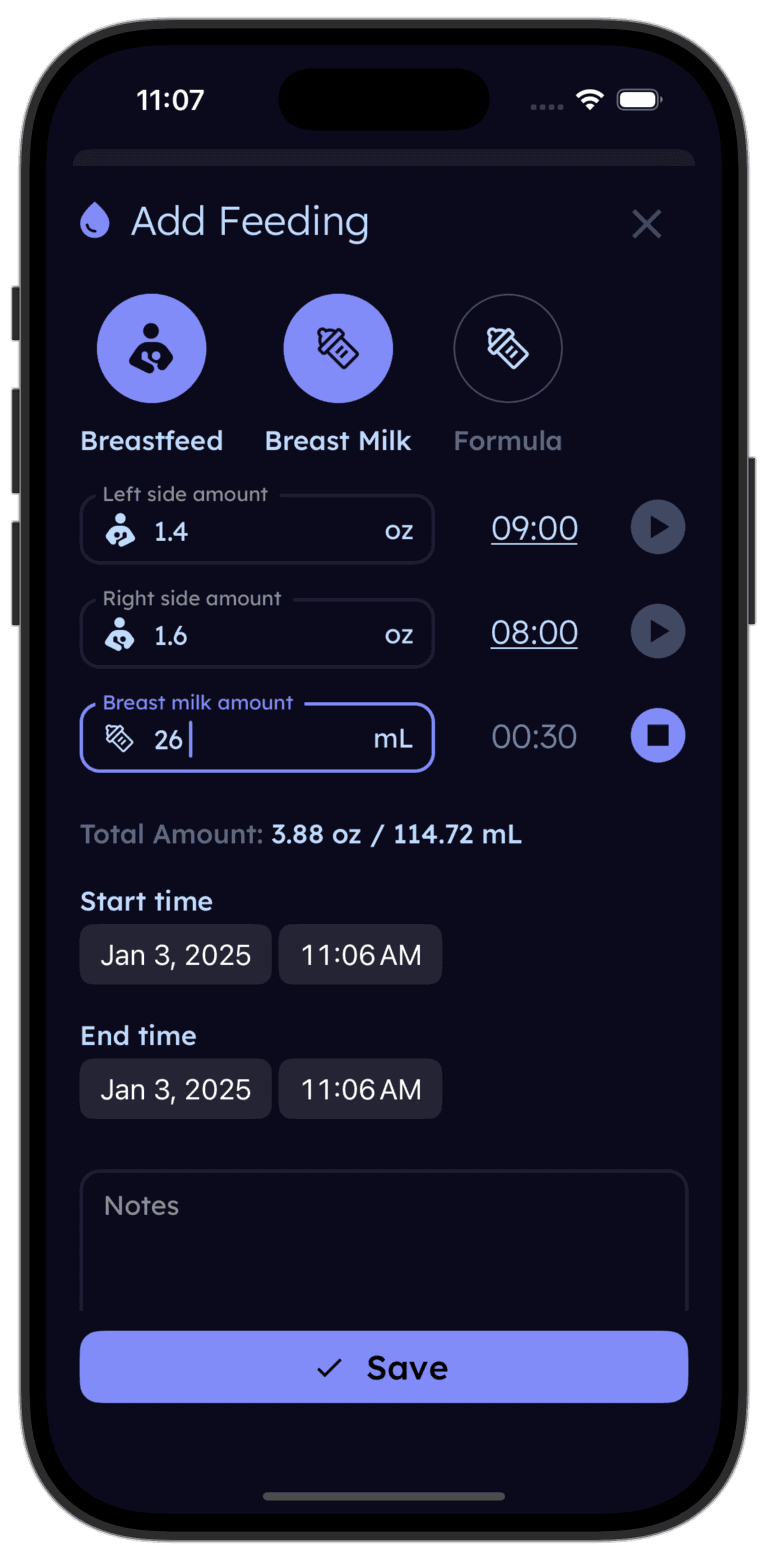
tinylog showing nursing session frequency decreasing over weeks during weaning

Weaning is easier to track than you think — watch nursing sessions decrease over the weeks and know you're on pace.

tinylog shows your nursing frequency over time. As you drop feeds, seeing the number trend down gives you confidence that the process is working — gradually and gently.

Download on the App StoreGet It On Google Play

Weaning by Age: What to Know

Under 6 months: If you wean before 6 months, baby needs formula as a complete breast milk replacement. Introduce a bottle if baby doesn't already take one. Gradually replace nursing sessions with formula bottles.

6-12 months: Baby is starting solids but still needs breast milk or formula as primary nutrition. Replace nursing sessions with formula bottles and solid food meals. Don't give cow's milk as a primary drink before 12 months.

12-18 months: Whole cow's milk (or appropriate alternative) can replace breast milk nutritionally. Baby should be eating a varied diet of solids. Nursing sessions can be replaced with cups of milk, snacks, and meals. Many families find this age range the easiest for weaning.

18-24+ months: Toddlers nurse more for comfort than nutrition at this point. Weaning is more about changing a comfort habit than about nutrition replacement. "Don't offer, don't refuse" and distraction work well. It's a bigger emotional transition at this age — expect more protest and offer more alternative comfort.

For extended breastfeeding beyond a year, see our extended breastfeeding guide.

What the Evidence Actually Says

"You should breastfeed for exactly 12 months." The AAP's 2022 policy statement recommends breastfeeding for 2 years or longer — an update from their previous 1-year recommendation. The WHO has recommended 2+ years for decades. But these are optimal recommendations, not minimums. Any duration of breastfeeding provides benefits.

"Weaning causes depression." Some parents do experience mood changes during weaning due to hormonal shifts (dropping prolactin and oxytocin). This is physiologically real, but it's not universal and it's treatable. If you experience significant mood changes during weaning, talk to your provider. It's not "just sadness" — it can be a real hormonal adjustment that benefits from support.

"If you wean gradually, you won't get engorged." Mostly true, but not guaranteed. Even with gradual weaning, some parents experience engorgement as their body adjusts. The key is to express just enough for comfort without fully emptying, which maintains the signal to reduce production.

When to Get Help and What Kind

See an IBCLC if: you want help creating a weaning plan, you're experiencing engorgement or clogged ducts during weaning, or you want to partially wean while maintaining some nursing sessions.

See your pediatrician if: you're weaning a baby under 12 months (to ensure appropriate formula/food replacement), if baby is refusing alternatives, or if you have questions about nutritional adequacy after weaning.

See your OB/GYN or therapist if: you experience significant mood changes, sadness, or depression during weaning. Hormonal shifts during weaning are real and treatable.

Related Guides

Sources

  • American Academy of Pediatrics (AAP). (2022). Breastfeeding and the Use of Human Milk. Pediatrics, 150(1).
  • World Health Organization. (2023). Breastfeeding recommendations.
  • Academy of Breastfeeding Medicine. (2004). ABM Clinical Protocol #7: Model Breastfeeding Policy.
  • Victora, C. G., et al. (2016). Breastfeeding in the 21st century: Epidemiology, mechanisms, and lifelong effect. Lancet, 387(10017).
  • Lawrence, R. A., & Lawrence, R. M. (2015). Breastfeeding: A Guide for the Medical Profession. 8th edition.

Medical Disclaimer

This guide is for informational purposes only and is not a substitute for professional medical advice. If you're experiencing breastfeeding difficulties, consider consulting an IBCLC (International Board Certified Lactation Consultant) or your pediatrician.

Get this weaning guide in your inbox.
We'll email you this step-by-step approach so you can plan your weaning timeline without pressure.
Track the transition — see feeds decrease naturally over time.
Download tinylog free — watch your nursing sessions taper and know you're on track.
Download on the App StoreGet It On Google Play