
GUIDE
Is Powdered Formula Safe?
Published on ·Updated on
Yes — for most healthy, full-term babies, powdered formula is safe. But it's not sterile, and there are preparation steps that matter.
Powdered infant formula is not required to be sterile under FDA regulations. That sounds alarming, but the actual risk of contamination is extremely low when you follow proper preparation guidelines. Here's what you need to know.
Free 2-min quiz. Instant FDA recall check plus a personalized match.
“All infant formulas must meet requirements that ensure optimal nutrition for babies. If your baby's formula is sold in the U.S., it has the nutrients your baby needs.”
 Dr. Matthew Badgett, MD, Pediatrician, Cleveland Clinic
The Thing Most Parents Don't Know
Here's a fact that isn't prominently displayed on any formula can: powdered infant formula is not sterile. The FDA does not require it to be. This isn't a secret exactly — it's stated in FDA guidance documents — but it's not something most parents learn until they go looking for it.
What this means in practice is that powdered formula can contain low levels of bacteria, including Cronobacter sakazakii and Salmonella, even when manufactured correctly according to FDA standards. The levels are extremely low, and for the vast majority of healthy, full-term babies, they pose no measurable risk. But the bacteria are potentially there, and how you prepare the formula matters.
Ready-to-feed formula, by contrast, is commercially sterile. It's sealed and then heat-treated at temperatures that kill all bacteria. Once you open the container, the clock starts — but until that point, it's a sterile product.
Liquid concentrate falls somewhere in between. It undergoes more processing than powder but isn't quite at the sterility level of ready-to-feed.
| Type | Sterile? | Shelf Life (Opened) | Relative Cost | Prep Time | Best For |
|---|---|---|---|---|---|
| Powdered formula | No | 1 month after opening (use by expiration date if sealed) | $ | 2-3 minutes (mixing required) | Most healthy, full-term babies. Most affordable option. |
| Liquid concentrate | No (but lower risk than powder) | 48 hours after opening (refrigerated) | $$ | 1 minute (dilute with water) | Parents who want a middle ground between cost and convenience. |
| Ready-to-feed | Yes (commercially sterile) | 48 hours after opening (refrigerated) | $$$ | None (pour and serve) | Premature babies, immunocompromised infants, on-the-go, overnight feeds. |
What the Marketing Doesn't Tell You
Formula labels include preparation instructions. They tell you to wash your hands, use the right amount of water, and store formula properly. What they typically don't tell you:
The product is not sterile. You won't find "this product is not sterile" prominently displayed on most powdered formula packaging. The FDA does not require this specific statement on the label. Some brands include it in fine print or on their websites, but it's not standard.
Manufacturer instructions often conflict with WHO guidelines. Most U.S. formula brands instruct parents to use room temperature or lukewarm water for preparation. The World Health Organization recommends water heated to at least 158 degrees F (70 degrees C) to kill potential bacteria. The discrepancy exists because manufacturers are concerned about burn risk and minor nutrient degradation — but the WHO maintains that the bacterial risk outweighs these concerns for high-risk infants.
The cost difference between powder and ready-to-feed is significant by design. Ready-to-feed is the safest option from a sterility standpoint, but it costs 2 to 3 times more than powder. For families already stretching their budget to afford formula, the "just use ready-to-feed" advice can feel disconnected from reality.
| Type | Monthly Cost | Daily Cost | Notes |
|---|---|---|---|
| Powdered formula | $100-$200 | $3-$7 | Most economical. Requires preparation time and clean water. |
| Liquid concentrate | $150-$300 | $5-$10 | Middle ground. Easier to prepare than powder, cheaper than ready-to-feed. |
| Ready-to-feed | $250-$500+ | $8-$17 | Most expensive. No preparation needed. Commercially sterile. |
Putting the Risk in Real Numbers
Let's ground this in data, because "not sterile" sounds scarier than the actual numbers warrant.
| Fact | Number |
|---|---|
| Annual Cronobacter cases in U.S. infants | 4-6 per year (CDC estimate) |
| U.S. infants receiving formula | Approximately 3 million |
| Estimated risk per infant per year | Less than 1 in 500,000 |
| Risk for premature/immunocompromised infants | Significantly higher (exact rate unknown — small numbers make calculation difficult) |
| Salmonella contamination events in formula (last decade) | Fewer than 5 major recalls |
For most healthy, full-term babies over 2 months old, the risk from properly prepared powdered formula is vanishingly small.
The babies who face higher risk are a specific, identifiable group: premature infants, immunocompromised babies, and very young newborns (under 2 months). If your baby falls into one of these categories, the conversation with your pediatrician about formula type is important. For everyone else, proper preparation is the main thing you can control — and it's effective.
For more on Cronobacter specifically, including the 2022 crisis and what's changed since, see our Cronobacter and formula safety guide.
| Step | Details |
|---|---|
| Wash your hands | With soap and water for at least 20 seconds before handling formula, bottles, or nipples. |
| Clean and sterilize equipment | Sterilize bottles, nipples, and rings by boiling for 5 minutes or using a steam sterilizer. Especially important for babies under 3 months. |
| Boil fresh water | Bring water to a rolling boil. Let it cool for no more than 30 minutes — the WHO recommends water be no cooler than 158 degrees F (70 degrees C) when you add the powder. |
| Measure powder accurately | Use the scoop provided with the formula. Level it off — don't pack it. Adding too much or too little powder changes the concentration and can be harmful. |
| Mix thoroughly | Swirl or shake the bottle until the powder is completely dissolved. No clumps. |
| Cool to feeding temperature | Run the bottle under cold water or place it in a bowl of cold water. Test on your inner wrist — it should feel lukewarm, not hot. |
| Feed within 2 hours | Formula at room temperature is a breeding ground for bacteria after 2 hours. If baby doesn't finish the bottle in that window, discard it. |
| Refrigerate if not using immediately | Prepared formula can be stored in the fridge for up to 24 hours. Keep it in the back of the fridge (coldest spot), not the door. |
| Discard leftover formula from a feeding | Once baby's mouth has touched the nipple, bacteria from saliva can multiply in the remaining formula. Don't save it for later. |
When Ready-to-Feed Formula Is the Better Choice
- Baby was born premature (especially before 37 weeks gestational age)
- Baby is under 2 months old and in a NICU or clinical setting
- Baby has a compromised immune system due to illness or medical treatment
- You're traveling and don't have access to clean water or sterilization equipment
- Overnight feeds when you want to minimize preparation steps and error risk
- Your pediatrician has specifically recommended it for your baby's situation
Ready-to-feed is the gold standard for sterility. If cost is a barrier, talk to your pediatrician — some hospitals and WIC programs provide it for high-risk babies.
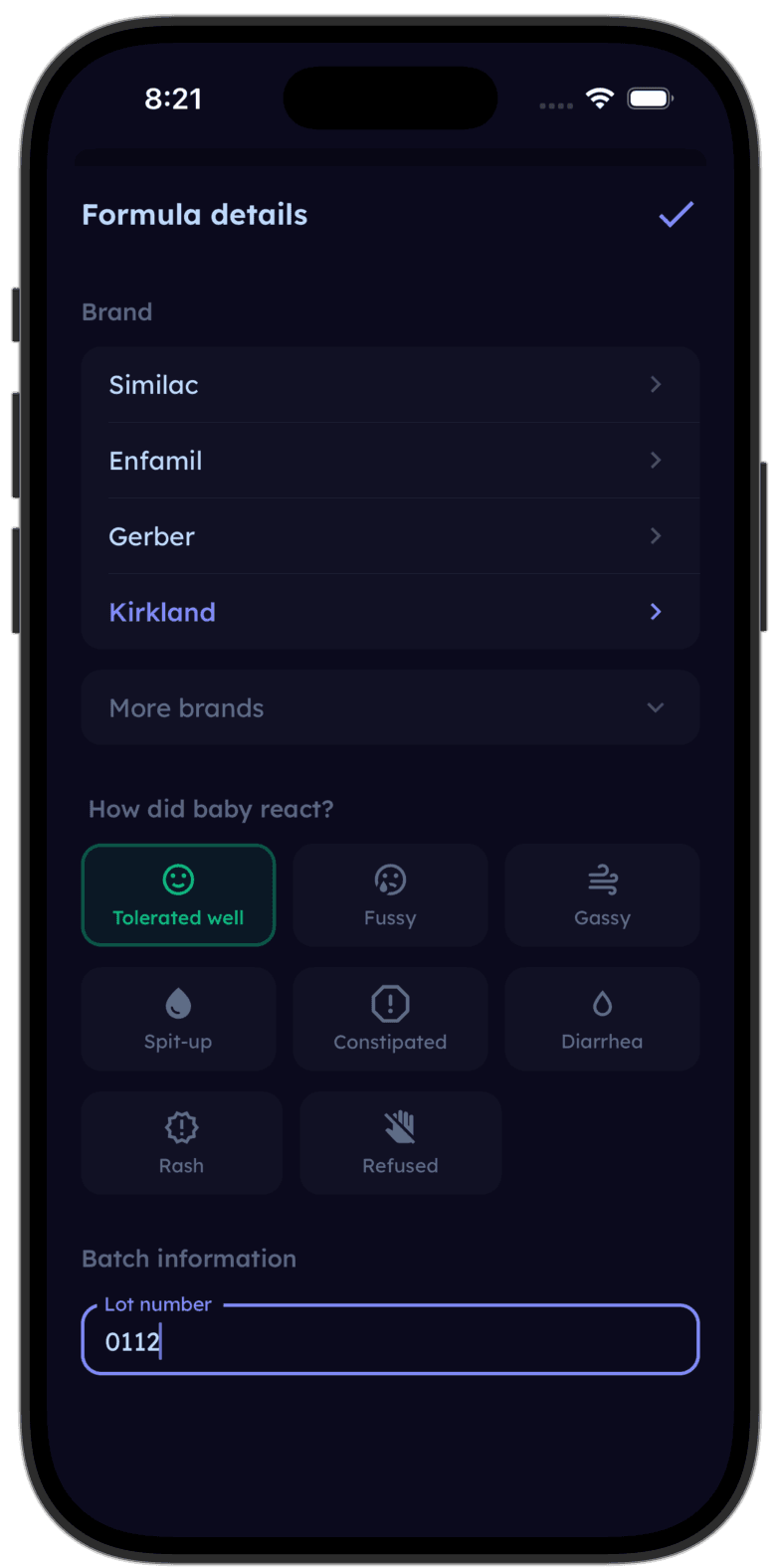
Know exactly what your baby ate — and when — without relying on memory.
Log each powdered formula bottle in a couple of taps. See daily totals, track timing between feeds, and note anything unusual. If your baby ever has symptoms you need to report to your pediatrician, you'll have a precise record — not an approximation.


When to Talk to Your Pediatrician
For most families, powdered formula is safe and practical. But bring up formula type with your pediatrician if:
- Your baby was born premature — especially before 37 weeks — and is transitioning from NICU care to home
- Your baby has any condition affecting their immune system
- Your baby is under 2 months old and you want guidance on whether ready-to-feed is recommended
- You're unsure about water safety in your area (well water, older pipes, or during a boil advisory)
- Your baby has had any unexplained illness with fever, poor feeding, and lethargy after formula feeding
- You have questions about the WHO hot water preparation method vs. manufacturer instructions
Your pediatrician can help you weigh the risk factors specific to your baby and make a recommendation that accounts for both safety and practicality — including cost.
The Bottom Line
Powdered formula is not sterile. That is a fact, not a scare tactic. For the vast majority of healthy, full-term babies, this is not a significant safety concern — the risk of illness from properly prepared powdered formula is extraordinarily low.
What makes the difference is how you prepare it. Clean hands, sterilized equipment, proper water temperature, and timely use of prepared formula are simple steps that reduce an already-tiny risk to near zero.
If your baby is in a higher-risk group, ready-to-feed formula provides an extra layer of protection that is worth the cost. For everyone else, follow the preparation guidelines, keep your bottles clean, and log your feeds — knowing what your baby ate and when gives you a baseline that's genuinely useful if anything changes.
For a step-by-step process to check whether your specific formula has been recalled, see our formula recall check guide, or run your brand or lot number through our formula recall search right now. You can also sign up for free recall alerts to get emailed automatically when your formula brands are recalled.
Related Guides
-
Cronobacter and Formula — What parents need to know
-
How to Read a Formula Label — Understanding ingredients that matter
-
2026 Formula Recalls — What parents need to know right now
Sources
- U.S. Food & Drug Administration (FDA) — Powdered Infant Formula: An Overview of Manufacturing and Safety
- World Health Organization (WHO) — Safe Preparation, Storage, and Handling of Powdered Infant Formula: Guidelines, 2007
- American Academy of Pediatrics (AAP) — Infant Feeding and Nutrition Recommendations
- Centers for Disease Control and Prevention (CDC) — Cronobacter and Powdered Infant Formula FAQ, 2023
- Codex Alimentarius Commission — Code of Hygienic Practice for Powdered Formulae for Infants and Young Children, CAC/RCP 66-2008
- Osaili TM, et al. "Cronobacter species in powdered infant formula." Journal of Food Science, 2009.
This guide is for informational purposes only and is not a substitute for professional medical advice. If you have concerns about your baby's formula or health, please consult your pediatrician.
Frequently asked questions
- Is powdered baby formula sterile?
- No. Powdered infant formula is not sterile, and the FDA does not require it to be. Low-level contamination with bacteria like Cronobacter sakazakii or Salmonella is possible, though rare. Ready-to-feed formula is commercially sterile because it undergoes a high-heat treatment process after being sealed.
- Is powdered formula safe for newborns?
- For healthy, full-term newborns, powdered formula is generally safe when prepared correctly. However, the AAP and WHO recommend ready-to-feed formula for premature babies, immunocompromised infants, and babies under 2 months in clinical settings, since these babies are at higher risk from potential bacterial contamination.
- How should I prepare powdered formula to make it safe?
- Wash hands thoroughly, sterilize bottles for babies under 3 months, use water heated to at least 158 degrees F (70 degrees C) per WHO guidelines (or follow manufacturer instructions), use prepared formula within 2 hours at room temperature, and discard leftover formula from a feeding. Refrigerated prepared formula should be used within 24 hours.
- Is ready-to-feed formula safer than powder?
- Ready-to-feed formula is commercially sterile, meaning it contains no live bacteria. Powdered formula is not sterile. For most healthy babies, the practical difference in safety is negligible. For high-risk babies — preemies, immunocompromised, or very young infants — the sterility of ready-to-feed provides a meaningful safety advantage.
- Why is powdered formula not required to be sterile?
- The manufacturing process for powdered formula cannot guarantee complete sterility without compromising the nutritional content. Heat sterilization at the levels needed to eliminate all bacteria would degrade some nutrients. The FDA sets limits on allowable bacteria levels and requires testing, but zero contamination cannot be guaranteed in powder form.