
GUIDE
Lansinoh DiscreetDuo vs. Medela Pump In Style Hands-Free
Published on
Both are wearable double electric pumps that free your hands while you pump. The Lansinoh is quieter, lighter, and more likely to be covered by insurance at zero cost. The Medela brings decades of clinical suction research and a motor built for heavy daily use.
The Lansinoh DiscreetDuo and Medela Pump In Style Hands-Free are two of the most talked-about wearable breast pumps on the market right now. Lansinoh built its reputation on breastfeeding accessories and nipple care, then entered the pump space with a surprisingly polished wearable. Medela has been the hospital standard for years and now offers that same suction technology in a cordless, in-bra form factor. The real question: is Medela's engineering pedigree worth the higher price, or does the DiscreetDuo give you everything you need for less?
Log sessions, output, and feeding patterns
A Breastfeeding Brand Staple Meets the Hospital-Grade Name
The Lansinoh DiscreetDuo and Medela Pump In Style Hands-Free are both wearable, cordless double electric pumps. Both promise the same thing: pump milk without holding anything, without plugging into a wall, and without anyone in the next cubicle knowing what you are doing.
But they come from very different backgrounds. Lansinoh has been making nipple cream, breast pads, and milk storage bags for decades — the DiscreetDuo is their move into serious pump hardware. Medela has been the default breast pump brand in hospitals and lactation offices for years, and the Pump In Style Hands-Free brings that legacy into a wearable package.
Both pumps work well. The question is which set of trade-offs fits your life — noise tolerance, daily pumping volume, budget, and whether your insurance picks up the tab.
For more on building a pumping routine, see our exclusive pumping guide.
| Feature | Lansinoh DiscreetDuo | Medela Pump In Style | What It Means |
|---|---|---|---|
| Manufacturer | Lansinoh Laboratories | Medela | Lansinoh specializes in breastfeeding products. Medela is a 60-year-old Swiss medical device company with hospital-grade roots. |
| Type | Wearable, in-bra, cordless | Wearable, in-bra, cordless | Tie. Both slip inside a nursing bra and operate without tubes or cords. |
| Max suction | ~260 mmHg (9 levels) | ~270 mmHg (adjustable intensity) | Medela is slightly stronger. Both deliver enough suction for the vast majority of pumping parents. |
| Pumping modes | 4 modes (Stimulation, Expression, Massage, Automatic) | 2 modes (Stimulation, Expression) with 2-Phase Expression | Lansinoh offers more modes. Medela's 2-Phase tech is clinically refined but less customizable. |
| Noise level | Under 45 dB — very quiet | ~45 dB — quiet | Lansinoh has a slight edge. Both are quiet enough for most work and home settings. |
| Milk capacity | 6 oz (180 mL) per cup | 5.3 oz (160 mL) per cup | Lansinoh holds more. If you produce high volumes, the extra ounce means fewer mid-session pauses. |
| Battery life | ~100 min (~5–6 sessions) | ~2 hours (~3–4 sessions) | Lansinoh lasts longer per charge. Both charge via USB. |
| Weight per cup | ~190 g (6.7 oz) | ~200 g (7.1 oz) | Lansinoh is a touch lighter. Small difference, but noticeable over long sessions. |
| Flange sizes included | 21 mm and 24 mm | 21 mm and 24 mm | Tie. Both include two sizes so you can test fit without buying extras. |
| Parts to clean | 4 parts per cup | 5 parts per cup | Lansinoh has one fewer part. Multiplied across daily sessions, that saves real time. |
| Insurance coverage | Increasingly covered; many Medicaid plans included | Widely covered; one of the most common insurance-eligible pumps | Both have solid coverage. Medela has the longer track record with insurers. |
| Closed system | Yes — backflow protector | Yes — backflow protector | Tie. Both prevent milk from reaching the motor. Hygienic and safe for shared or resale use. |
Suction: Refined Science vs. More Modes
The Medela Pump In Style has a slight suction edge on paper — about 270 mmHg versus the Lansinoh's 260 mmHg. But raw suction numbers only tell part of the story, and most parents never pump at maximum anyway.
What separates these two pumps is how they handle the pumping cycle. Medela's 2-Phase Expression technology has been developed through years of clinical lactation research. It starts with fast, light pulses to trigger letdown, then shifts to slower, deeper pulls to extract milk. The rhythm is designed to mimic how a baby actually nurses.
Lansinoh takes a different approach — more modes and more manual control. The DiscreetDuo offers four modes: Stimulation, Expression, Massage, and Automatic. That Automatic mode is genuinely useful. It handles the stimulation-to-expression transition for you, so you are not fumbling with buttons mid-letdown. The Massage mode provides a gentler pattern that some parents find helps with stubborn letdowns or engorgement.
If you like set-it-and-forget-it pumping, the Lansinoh's Automatic mode is appealing. If you trust a clinically calibrated rhythm and prefer fewer decisions, Medela's approach works well too.
Noise: The DiscreetDuo Lives Up to Its Name
Lansinoh clearly put engineering work into keeping the DiscreetDuo quiet. It runs under 45 dB, which is about the volume of a quiet library. The name is not just marketing — this thing is genuinely discreet.
The Medela Pump In Style runs at roughly 45 dB as well, though several real-world reviews note it can be a touch louder on higher suction levels. The difference is small but perceptible in a quiet room.
If you pump at a desk in an open office, during video calls, or while your baby sleeps in the next room, noise matters more than you might expect. Both pumps are far quieter than the old plug-in models with tubing, but the Lansinoh has a slight practical edge when silence counts.
Neither pump is truly silent. A close coworker will probably notice. But at these noise levels, most people will just assume it is a phone vibrating in a bag.
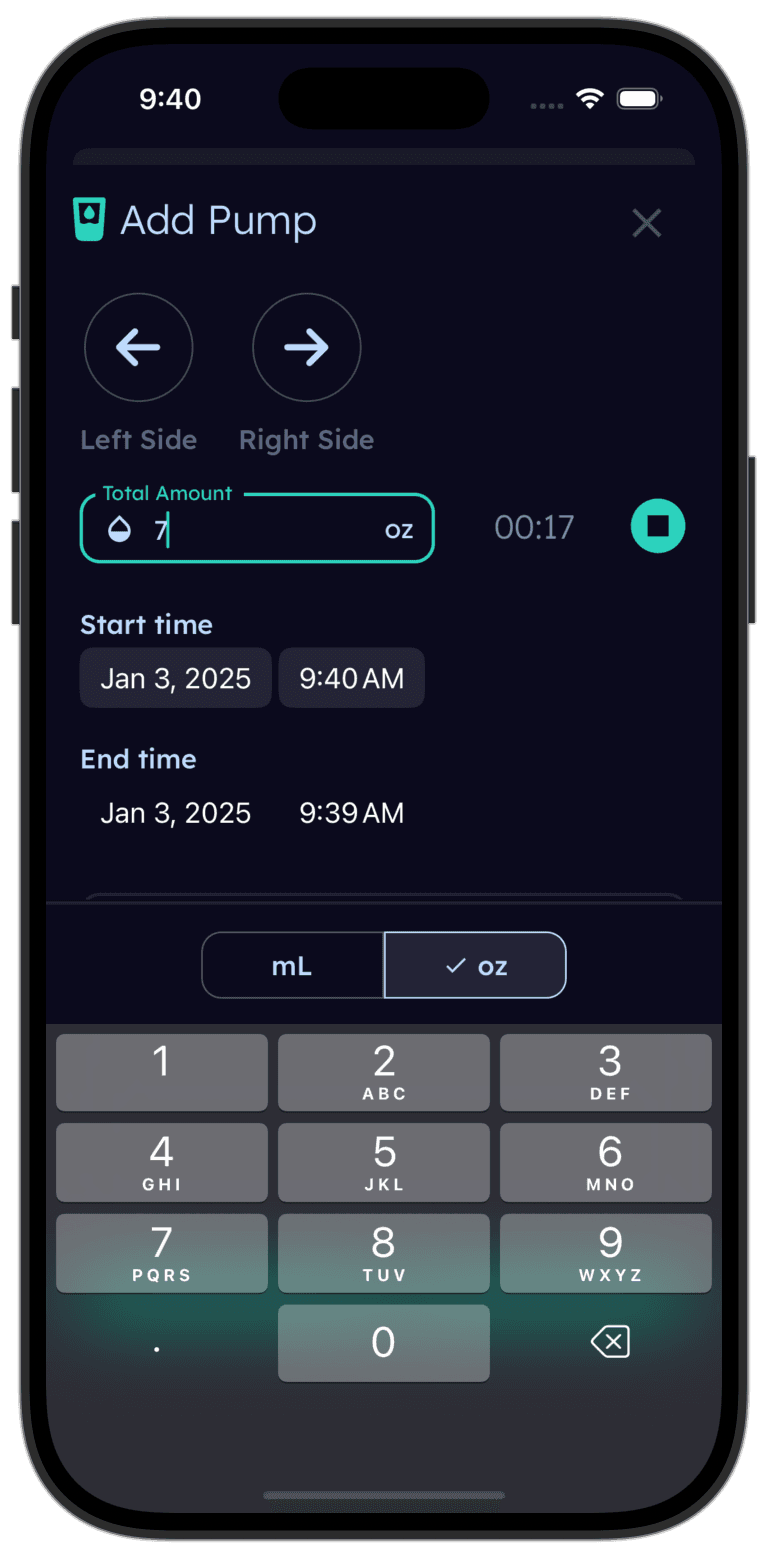
Tinylog tracks pumping sessions so you can spot supply trends.
Log each pump with duration and volume, see daily and weekly output totals, and bring the data to your lactation consultant. Works with any pump brand.


Capacity, Battery, and Daily Convenience
You are going to use this pump several times a day for months. The small daily conveniences compound into real quality-of-life differences.
Milk capacity: The Lansinoh holds 6 oz (180 mL) per cup. The Medela holds 5.3 oz (160 mL) per cup. That extra 0.7 oz matters if you are a higher-volume producer. Nobody wants to stop mid-session to empty a cup, especially if you finally got a good letdown going.
Battery life: The Lansinoh gets about 100 minutes per charge, roughly 5–6 sessions. The Medela gets about 2 hours, but the higher power draw means roughly 3–4 sessions in practice. If you pump frequently away from an outlet, the Lansinoh gives you more sessions between charges.
Cleanup: The Lansinoh has 4 parts to wash per cup. The Medela has 5 parts. One fewer part per side, twice a day minimum, seven days a week. Over a month, that is roughly 60 fewer individual pieces to rinse and dry. It sounds trivial until you are standing at the sink at midnight for the third time that day.
Weight: The Lansinoh is about 10 grams lighter per cup. Not a dramatic difference, but every gram counts when these things are sitting in your bra for 20-30 minutes at a time.
Durability: Where Medela Earns Its Price
This is the area where the Medela Pump In Style genuinely separates itself. The motor inside the Pump In Style is built to handle sustained, heavy use. Parents who exclusively pump — six, seven, eight sessions a day for a year — consistently report that the Medela maintains its suction strength over time.
The Lansinoh DiscreetDuo holds up well under moderate use. Pumping three to four times a day, it should serve you reliably through your pumping journey. But some heavier users have noted that suction can start to feel slightly weaker after several months of intensive daily use.
If you are supplementing with formula and pumping a couple of times a day, either pump will last just fine. If you are building your entire feeding plan around pumped milk and need the motor to hold steady across thousands of sessions, the Medela's build quality gives you more confidence.
| Product | Typical Price | Est. Cost Per Session | Insurance Note |
|---|---|---|---|
| Lansinoh DiscreetDuo (pair) | $140–$160 | ~$0.23–$0.27 | Often covered at $0 through insurance |
| Medela Pump In Style Hands-Free (pair) | $280–$350 | ~$0.47–$0.58 | Widely covered; check with your plan |
| Replacement parts (Lansinoh, per set) | $15–$22 | Every 2-3 months | ~$6–$11/mo ongoing |
| Replacement parts (Medela, per set) | $18–$28 | Every 2-3 months | ~$7–$14/mo ongoing |
Price and Insurance: The Factor That Usually Decides It
At retail, the Lansinoh DiscreetDuo costs roughly $140–$160 for a pair. The Medela Pump In Style Hands-Free runs $280–$350. That is a significant gap if you are paying out of pocket.
But here is the thing — most parents do not pay retail for a breast pump. Under the ACA, most insurance plans cover at least one breast pump. And both of these models have decent insurance availability.
The Medela Pump In Style has the broadest insurance footprint. It has been in durable medical equipment catalogs for years, and most major insurers include it. The Lansinoh DiscreetDuo is newer to the insurance game but is increasingly covered, including by many Medicaid plans.
What to do:
- Call your insurance or check with a pump-through-insurance service like Aeroflow or Edgepark. Find out which models your plan covers at no cost.
- If both are covered, take the one that fits your priorities. Need durability for EP? Medela. Want quieter operation and more modes? Lansinoh.
- If neither is covered, the Lansinoh at $150 delivers a lot of pump for the money. The Medela at $300+ is harder to justify out of pocket unless you are committed to exclusive pumping.
- Both pumps are HSA/FSA eligible regardless of insurance coverage.
Choose the Lansinoh DiscreetDuo If
- Noise is a priority — you pump at work, on calls, or near a sleeping baby
- You want four pumping modes including Automatic phase switching
- You prefer fewer parts to clean after every session
- You want a larger 6 oz collection cup so you can pump longer without stopping
- You are paying out of pocket and want strong features at a lower price than the Medela
- Your insurance covers the DiscreetDuo at no cost — making the decision simple
Choose the Medela Pump In Style If
- You plan to exclusively pump and need a motor built for 6-8 daily sessions over many months
- You trust Medela's clinically researched 2-Phase Expression suction pattern
- Your insurance covers the Pump In Style — removing the price barrier entirely
- You want the brand most lactation consultants already know and recommend
- Motor durability matters more to you than extra pumping modes
Where to Buy
If you want a quieter pump with more modes and a lower price tag, the Lansinoh DiscreetDuo (~$150 for a pair, often $0 through insurance) is a well-rounded pick. Four pumping modes, sub-45 dB noise, larger cups, and fewer parts to clean make it a strong daily driver — especially if your insurance covers it fully.
If you want the pump that lactation consultants have trusted for years, built with a motor that handles heavy daily use without fading, the Medela Pump In Style Hands-Free (~$300 retail, widely covered by insurance) is the workhorse choice. Medela's 2-Phase Expression technology and proven durability make it the go-to for exclusive pumpers.
Our honest take: check your insurance first. If one of these is covered at $0, that makes the decision a lot easier. If you are paying out of pocket and pumping part-time, the Lansinoh gives you more features per dollar. If you are pumping full-time and need a tank, the Medela is built for it.
Tinylog earns a small commission on purchases made through these links, at no cost to you.
Tip: check promo.new before purchasing. It's hit or miss depending on the product, but when it hits, you'll be glad you checked.
The Bottom Line
The Lansinoh DiscreetDuo and the Medela Pump In Style Hands-Free are both capable wearable breast pumps that free your hands and ditch the cords. The differences are meaningful but not dramatic:
Lansinoh DiscreetDuo edges out on noise level (under 45 dB), pumping modes (4 vs. 2), milk capacity (6 oz vs. 5.3 oz), battery life per charge, fewer parts to clean, lower weight, and retail price.
Medela Pump In Style edges out on motor durability for heavy use, suction strength, clinically researched pumping rhythm, brand recognition with lactation professionals, and breadth of insurance coverage.
For most families, the deciding factor comes down to insurance coverage and how many times a day you pump. A covered Medela at $0 is hard to pass up if you are an exclusive pumper. A covered Lansinoh at $0 is the better deal if you value quiet operation and daily convenience. And if you are paying cash, the Lansinoh at half the price delivers a lot of value.
If you are tracking pump sessions to monitor supply — which is especially useful in the early weeks — Tinylog makes it simple to log output and spot trends over time.
Related Guides
- Exclusive Pumping — How to build and maintain supply when you pump full-time
- Pumping Schedule for Working Parents — Realistic schedules for the office, hybrid, and remote work
- How Much Milk Should You Get When Pumping? — Output expectations by stage
- Breast Milk Storage — How long milk lasts at every temperature
Sources
- Lansinoh.com. "Lansinoh DiscreetDuo Wearable Breast Pump — Product Specifications." 2026.
- Medela.com. "Pump In Style with MaxFlow Hands-Free Breast Pump — Product Information." 2026.
- Consumer Reports. "Best Wearable Breast Pumps of 2026." consumerreports.org.
- Wirecutter (NYT). "The Best Breast Pumps." nytimes.com/wirecutter, 2026.
- The Bump. "Lansinoh Discreet Duo Review — Tested by a Mom of Two." thebump.com, 2025.
- Exclusive Pumping. "Medela Pump In Style Review." exclusivepumping.com, 2025.
- ACA Breast Pump Coverage Guide. healthcare.gov, 2026.
This guide is for informational purposes only and is not medical advice. Breast pump choice depends on your individual anatomy, supply needs, and pumping goals. If you experience pain, low output, or nipple damage with any pump, consult a board-certified lactation consultant (IBCLC).
Frequently asked questions
- Is the Lansinoh DiscreetDuo or Medela Pump In Style stronger?
- The Medela Pump In Style has slightly higher maximum suction at approximately 270 mmHg compared to the Lansinoh DiscreetDuo at about 260 mmHg. However, the difference is small and most parents pump at mid-range settings. Flange fit matters far more than raw suction numbers for actual milk output.
- Which wearable breast pump is quieter, the Lansinoh or the Medela?
- The Lansinoh DiscreetDuo operates under 45 dB, making it one of the quietest wearable pumps available. The Medela Pump In Style runs at approximately 45 dB as well, though some users report it is slightly louder in practice. Both are far quieter than traditional plug-in pumps.
- Does insurance cover the Lansinoh DiscreetDuo or Medela Pump In Style?
- Both are commonly covered by insurance under the ACA. The Medela Pump In Style has the broadest insurance coverage because of its long-standing relationship with medical equipment suppliers. The Lansinoh DiscreetDuo is increasingly covered by many plans including Medicaid. Check with Aeroflow or your insurer for your specific options.
- Which pump is better for exclusive pumping?
- The Medela Pump In Style is generally the stronger pick for exclusive pumping. Its motor is designed to handle 6-8 sessions per day over many months without losing suction. The Lansinoh DiscreetDuo works well for moderate daily use but heavy exclusive pumpers may notice wear over time.
- How many parts do you have to clean with each pump?
- The Lansinoh DiscreetDuo has four parts to wash per cup, while the Medela Pump In Style has five parts per cup. Fewer parts means less time at the sink — a small win that adds up across hundreds of wash cycles.
- Can I use either pump while lying down?
- Neither pump works well while lying flat. Both use open collection cups, so you need to stay mostly upright to prevent spills. You can recline slightly, but fully lying down will cause milk to leak from the cup. If you need to pump in bed, consider transferring to sealed storage bags more frequently.