GUIDE

Exclusive Pumping

You are breastfeeding. You're just using a different delivery method. EP is a massive commitment that deserves its own guide — not a footnote in a nursing article.

If you're exclusively pumping — by choice, by necessity, or by circumstance — this guide is specifically for you. Not an afterthought. Not a 'if you're pumping, see a lactation consultant' sidebar.

EP Is Breastfeeding. Period.

Let's get this out of the way: if you're exclusively pumping, you are breastfeeding your baby. You're producing breast milk with your body and feeding it to your child. The delivery method is a bottle instead of a breast. The milk is the same.

EP often happens because of circumstances — a NICU stay, a baby who couldn't latch, tongue tie that made nursing impossible, nipple damage that was too severe to continue direct nursing. Sometimes it's a deliberate choice. Sometimes it's both. The reason doesn't matter. What matters is that you're doing something genuinely difficult, and you deserve a guide that treats EP as a complete feeding approach, not a lesser version of "real" breastfeeding.

This guide is written specifically for exclusive pumpers. Not tacked onto a nursing guide. Not a two-paragraph sidebar. The full thing.

EP Schedule: First 12 Weeks (Establishing Supply)
6:00 AM
Session#1
Duration20-25 min
NotesMorning session — usually highest output. Don't skip this one.
8:30 AM
Session#2
Duration15-20 min
NotesSecond morning pump
11:00 AM
Session#3
Duration15-20 min
NotesMid-morning
1:30 PM
Session#4
Duration15-20 min
NotesAfter lunch
4:00 PM
Session#5
Duration15-20 min
NotesAfternoon — output typically lower
6:30 PM
Session#6
Duration15-20 min
NotesEvening pump
9:00 PM
Session#7
Duration15-20 min
NotesBefore bed
1:00 AM
Session#8
Duration15-20 min
NotesMiddle of the night — painful to get up for, critical for supply
8 sessions is the minimum target for the first 12 weeks. More is fine if you can manage it. The schedule is flexible — adjust times to your life, but keep the intervals roughly equal.
EP Schedule: After 12 Weeks (Established Supply)
6:00 AM
Session#1
Duration20-25 min
NotesMorning — highest output session
10:00 AM
Session#2
Duration15-20 min
NotesMid-morning
2:00 PM
Session#3
Duration15-20 min
NotesAfternoon
6:00 PM
Session#4
Duration15-20 min
NotesEvening
10:00 PM
Session#5
Duration20-25 min
NotesBefore bed — last session of the day
Dropping from 8 to 5 sessions should happen gradually — one session at a time, waiting 5-7 days between drops to see how supply responds.
Supply Targets by Stage
Week 1-2
Sessions per Day8-10
Expected Daily OutputBuilding — 10-20 oz total
NotesYour supply is ramping up. Output will increase daily. Don't compare to established pumpers yet.
Week 3-6
Sessions per Day8-10
Expected Daily Output20-30 oz total
NotesSupply is establishing. Most significant gains happen here with consistent pumping.
Week 6-12
Sessions per Day7-8
Expected Daily Output25-35 oz total
NotesSupply calibrating. You may start experimenting with dropping one session.
3-6 months
Sessions per Day5-7
Expected Daily Output25-35 oz total
NotesMany EPers can reduce sessions while maintaining output. Drop slowly — one at a time.
6-12 months
Sessions per Day4-5
Expected Daily OutputVaries — may decrease as solids increase
NotesSolids begin supplementing nutrition. Some parents start weaning from pump; others continue.
25-35 oz daily is a full supply for most babies from 1-6 months. Some babies need more. Track daily totals rather than per-session output.

The Real Challenges of EP

The mental load is enormous

EPing means planning your entire day around pump sessions. You're tracking output, managing bottle prep, doing pump part cleaning multiple times daily, and fitting actual life in between. This is objectively harder than either nursing or formula feeding in terms of logistics. Acknowledge that. You're not being dramatic — it's genuinely a lot.

No direct feedback loop

Nursing parents can feel letdown, see baby swallow, and feel breasts soften. EPers see numbers on a bottle. The lack of physical feedback can feel disconnecting. If this bothers you, try holding baby during some pump sessions, or bottle-feed with skin-to-skin contact.

Pump parts cleaning — the never-ending cycle

You will clean pump parts more times than you thought possible. Streamline this: use the fridge hack (sealed bag between sessions, wash once daily), buy multiple sets of flanges, get a dedicated pump parts basin, or use microwave sterilizer bags for quick sanitizing.

Night pumping is brutal but important

The 1-3 AM pump session is the one everyone wants to drop first, and it's also the one that does the most for supply (prolactin peaks overnight). In the first 12 weeks, try to keep at least one overnight session. After 12 weeks with established supply, many EPers successfully drop the night pump.

Supply can be more fragile

Without the biological feedback from direct nursing (skin-to-skin, baby's saliva signaling, etc.), pump-maintained supply can be more sensitive to missed sessions. Consistency matters more for EPers than for nursing parents. Protect your sessions.

Isolation and lack of support

EP falls into a gap: the breastfeeding community sometimes doesn't include you because you're not nursing, and the formula community doesn't include you because you're giving breast milk. Online EP communities (r/ExclusivelyPumping, EP Facebook groups) can be a lifeline. You are breastfeeding. You belong.

Flange Fit: The Most Underrated Part of Pumping

Size matters — a lot

The flanges that come with your pump are probably not the right size. Most pumps come with 24mm or 28mm flanges, and many people need smaller (15-21mm). Your nipple should move freely in the tunnel without rubbing the sides. If it rubs, if you have pain, or if you see a white ring at the base of your nipple after pumping — your flanges don't fit.

Measure your nipple (not areola)

Measure the diameter of your nipple at the base (where it meets the areola) and add 1-3mm. That's your target flange size. Many pump companies have sizing guides, or an IBCLC can measure you. You may need different sizes for each breast.

Silicone inserts can fine-tune fit

If you're between standard flange sizes, silicone inserts (like Beaugen cushions or Pumpin' Pals) can reduce the effective diameter and improve comfort. They also make the rigid plastic flanges feel much gentler.

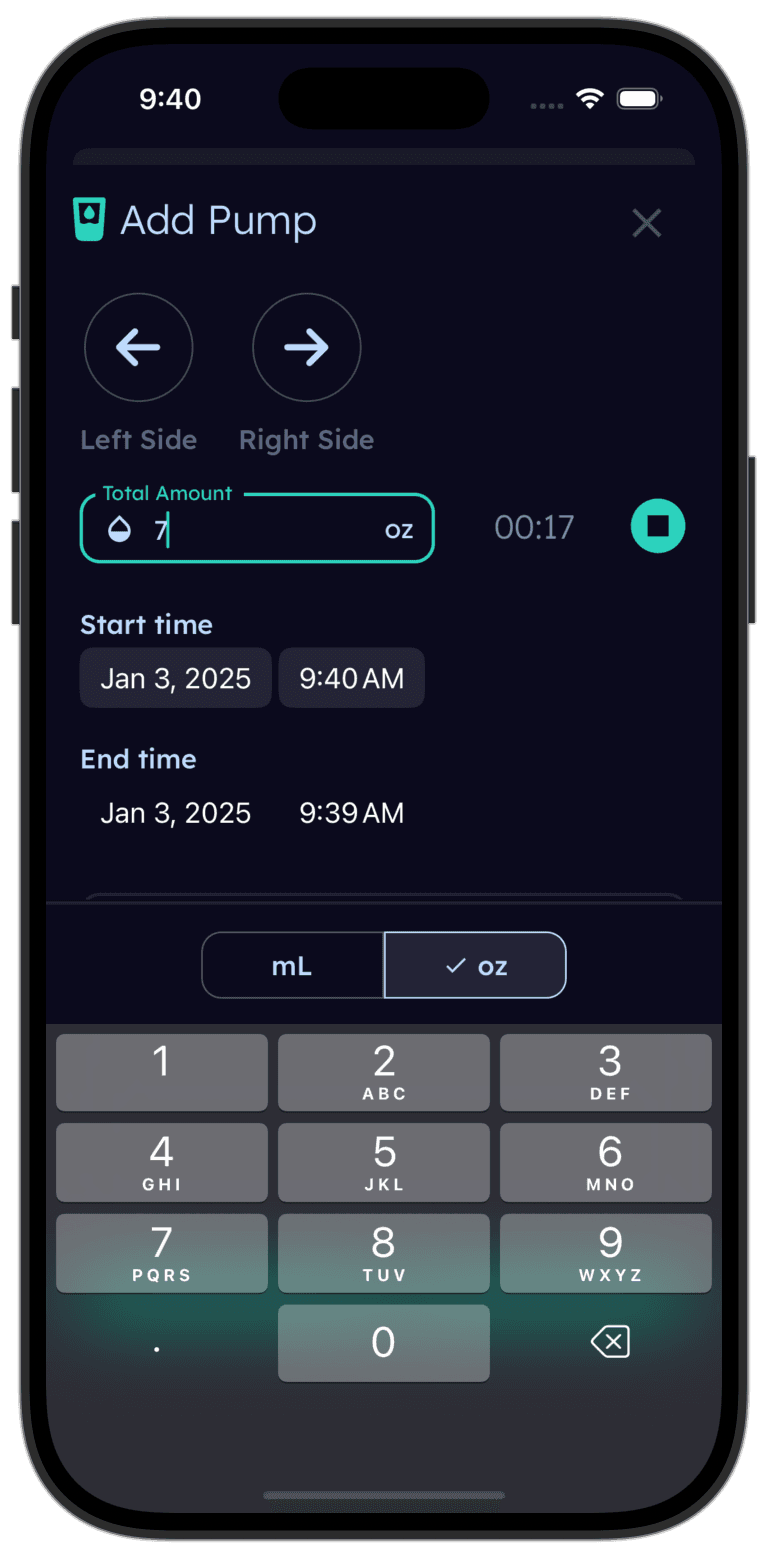
tinylog pump tracker with session output and daily totals for exclusive pumping

EP means tracking pump sessions, output per session, and daily totals. That data is your supply management dashboard — and it's what tells you when dropping a session is safe.

tinylog logs pump output per session and tracks daily volume over time. See whether you're trending up, stable, or dipping — before a small dip becomes a supply problem.

Download on the App StoreGet It On Google Play

Dropping Pump Sessions: How and When

The holy grail of EP is dropping sessions while maintaining output. Here's how to do it safely:

Wait until at least 12 weeks. Your supply needs to be well-established before you start removing sessions. Dropping too early risks a supply decline that's hard to reverse.

Drop one session at a time. Eliminate the session where you produce the least (usually a mid-afternoon one). Wait 5-7 days to see how your daily total responds. If it holds steady, you can consider dropping another.

Never drop the morning pump first. This is your highest-output session thanks to overnight prolactin. Protect it until you're actively weaning from the pump entirely.

The night pump is high-impact but droppable. After 12 weeks with strong supply, many EPers successfully drop the middle-of-the-night session. Your supply may dip slightly for a few days, then stabilize. If the dip is too steep, add it back.

Monitor daily totals, not session totals. When you drop a session, other sessions often increase slightly to compensate. A 2 oz drop from losing a session may be partially offset by 0.5 oz gains across remaining sessions. Watch the 24-hour total.

For a detailed weaning-from-pump guide, see our weaning from the pump guide.

What the Evidence Actually Says

"Exclusive pumping doesn't maintain supply as well as nursing." There's limited research specifically on EP supply maintenance. Clinical experience suggests supply CAN be maintained long-term with consistent pumping, but it may require more vigilance because pumps lack the biological feedback loop of direct nursing (baby's saliva, skin-to-skin hormonal signals). More frequent sessions may be needed compared to direct nursing.

"Pumped milk isn't as good as milk from the breast." The milk itself is nutritionally equivalent. Some research suggests that direct breastfeeding transfers small amounts of baby's saliva back through the nipple, potentially customizing milk composition in real-time. But this effect, while fascinating, doesn't make pumped milk "worse" — it's still breast milk with all its nutritional and immunological benefits.

"EPers should just switch to formula — it's easier." That's a personal decision. EP is harder logistically than either nursing or formula feeding. But some parents choose it because they want their baby to have breast milk, and this is how they can provide it. The difficulty doesn't make it irrational — it makes it a sacrifice, and that's their call.

When to Get Help and What Kind

See an IBCLC if: you want help with pump optimization, flange sizing, a supply-building plan, or troubleshooting declining output. Yes, IBCLCs work with EPers — pumping IS their domain.

See your pediatrician if: baby isn't gaining well on expressed milk, or if you need guidance on how much to offer per bottle at each age.

Connect with EP communities: Reddit's r/ExclusivelyPumping, Facebook EP groups, and the exclusive pumping accounts on Instagram are some of the best peer support resources. These communities understand the unique challenges in a way that general breastfeeding communities sometimes don't.

For return-to-work pump scheduling, see our working parents pumping schedule. To understand what output is normal, check how much milk should I be pumping, and for supply boosts, try power pumping.

Related Guides

Sources

  • Kent, J. C., et al. (2006). Volume and frequency of breastfeedings and fat content of breast milk throughout the day. Pediatrics, 117(3).
  • Morton, J., et al. (2009). Combining hand techniques with electric pumping increases milk production in mothers of preterm infants. Journal of Perinatology, 29(11).
  • American Academy of Pediatrics (AAP). (2022). Breastfeeding and the Use of Human Milk. Pediatrics, 150(1).
  • Prime, D. K., et al. (2012). Simultaneous breast expression in breastfeeding women is more efficacious than sequential breast expression. Breastfeeding Medicine, 7(6).
  • Centers for Disease Control and Prevention. (2024). Proper Storage and Preparation of Breast Milk.
  • Academy of Breastfeeding Medicine. (2017). ABM Clinical Protocol #8: Human Milk Storage Information for Home Use.

Medical Disclaimer

This guide is for informational purposes only and is not a substitute for professional medical advice. If you're experiencing breastfeeding difficulties, consider consulting an IBCLC (International Board Certified Lactation Consultant) or your pediatrician.

Get this EP guide in your inbox.
We'll email you this comprehensive guide — schedules, supply targets, and sanity preservation tips.
Track every pump session and daily totals — EPers live and die by the data.
Download tinylog free — log output per session, track daily volume, and see supply trends over time.
Download on the App StoreGet It On Google Play