GUIDE

Pumping at Work

Most working parents maintain supply by pumping 2-3 times during an 8-hour workday, roughly matching the feeds baby would have had. It's doable — but it takes planning.

Nobody tells you that returning to work while breastfeeding is basically adding a second part-time job. Here's how to make the logistics manageable.

The Working-Parent Pump Juggle

Returning to work while breastfeeding is not a single challenge — it's a logistics puzzle wrapped in an emotional adjustment wrapped in sleep deprivation. You need to pump frequently enough to maintain supply, store the milk correctly, navigate a workplace that may or may not be supportive, and then somehow also do your actual job.

The good news: millions of parents do this successfully. The key is having a plan before your first day back — not figuring it out in real time while your breasts are aching and you have a meeting in 10 minutes.

Sample Pumping Schedule for an 8-Hour Workday
6:00 AM
ActivityNurse baby
DetailsMorning nursing — prolactin is highest, great for supply
7:30 AM
ActivityPump (optional)
DetailsQuick pump after morning nurse to add to stash — skip this if supply is just meeting demand
9:30-10:00 AM
ActivityPump at work #1
DetailsFirst work pump session, ~15-20 minutes. Try to match when baby would normally eat.
12:30-1:00 PM
ActivityPump at work #2
DetailsSecond session, often combined with lunch break. Eat while pumping — you'll need the calories.
3:30-4:00 PM
ActivityPump at work #3
DetailsThird session. If you only fit 2 sessions, drop this one — but try to keep 3 for the first month back.
5:30-6:00 PM
ActivityNurse baby
DetailsReunite and nurse. Many babies want to cluster feed in the evening after being apart all day.
8:00 PM
ActivityNurse baby
DetailsBedtime nurse
11:00 PM
ActivityNurse or pump
DetailsDream feed or pump before bed — optional but helps maintain overnight supply
Night
ActivityNurse on demand
DetailsNight nursing maintains supply. Some working parents keep night feeds specifically for this.
Adjust times to your actual work schedule. The principle is: pump at roughly the same intervals baby would have been feeding — usually every 3 hours.

Building Your Stash (Without Going Overboard)

You need less stash than you think

The internet shows freezers full of milk. You don't need that. You need roughly one day's worth of bottles (12-20 oz depending on baby's age) to start. After that, what you pump today becomes tomorrow's bottles. It's a revolving system, not a stockpile.

Start building 2-3 weeks before work

Add one pump session per day, usually after the first morning feed when output is highest. Freeze what you collect. In 2-3 weeks, you'll have a comfortable buffer without the stress of marathon pumping.

Freeze in small amounts

Freeze in 2-3 oz portions rather than big bags. Smaller portions thaw faster, waste less if baby doesn't finish, and are easier to combine to make a bottle. Label with date — use oldest first.

Follow storage guidelines

Room temperature: 4 hours. Refrigerator: 4 days. Freezer: 6-12 months. Thawed milk: 24 hours in the fridge. See our breast milk storage guide for the full breakdown.

For complete storage rules, see our breast milk storage guidelines.

Making It Work at the Workplace

Protect your pump times like meetings

Block pump sessions on your calendar. Treat them as non-negotiable. The meeting that runs over into your pump time is the meeting you leave. This feels awkward at first but becomes routine fast.

Get a good pump bag setup

A dedicated pump bag with everything you need: pump, flanges, bottles, cooler with ice packs, breast pads, nursing cover (if you want one), phone charger, and snacks. Set it up once and just grab it daily. A wearable pump can be a game-changer for flexibility if your budget allows.

Clean-as-you-go or fridge hack

You can store pump parts in a sealed bag in the fridge between sessions and wash once at the end of the day (CDC guidance supports this). Alternatively, bring multiple sets of flanges. Do not let cleaning logistics be the reason you skip a session.

Communicate early with your manager

Before returning, tell your manager you'll need pump breaks. Most are fine with it — they just need to know. Frame it practically: 'I'll need 15-20 minutes 2-3 times a day, and I'll block it on my calendar.' The PUMP Act makes this a legal right, but approaching it collaboratively works better than leading with legislation.

Protecting Your Supply While Working

  • Never skip two pump sessions in a row — one occasional miss is recoverable; two sends a supply signal
  • If you can't pump on time, pump as soon as possible — a delayed session is better than a skipped one
  • Maintain night nursing if possible — those overnight feeds do heavy lifting for supply
  • Weekend nursing helps rebuild what workday pumping might not fully replace
  • If supply dips, add a pump session (early morning or before bed) for a few days to recover
  • Hand express for a few minutes after pumping to fully drain — this signals higher demand

Supply maintenance is about consistency, not perfection. One bad pump day won't ruin your supply. A pattern of skipped sessions will.

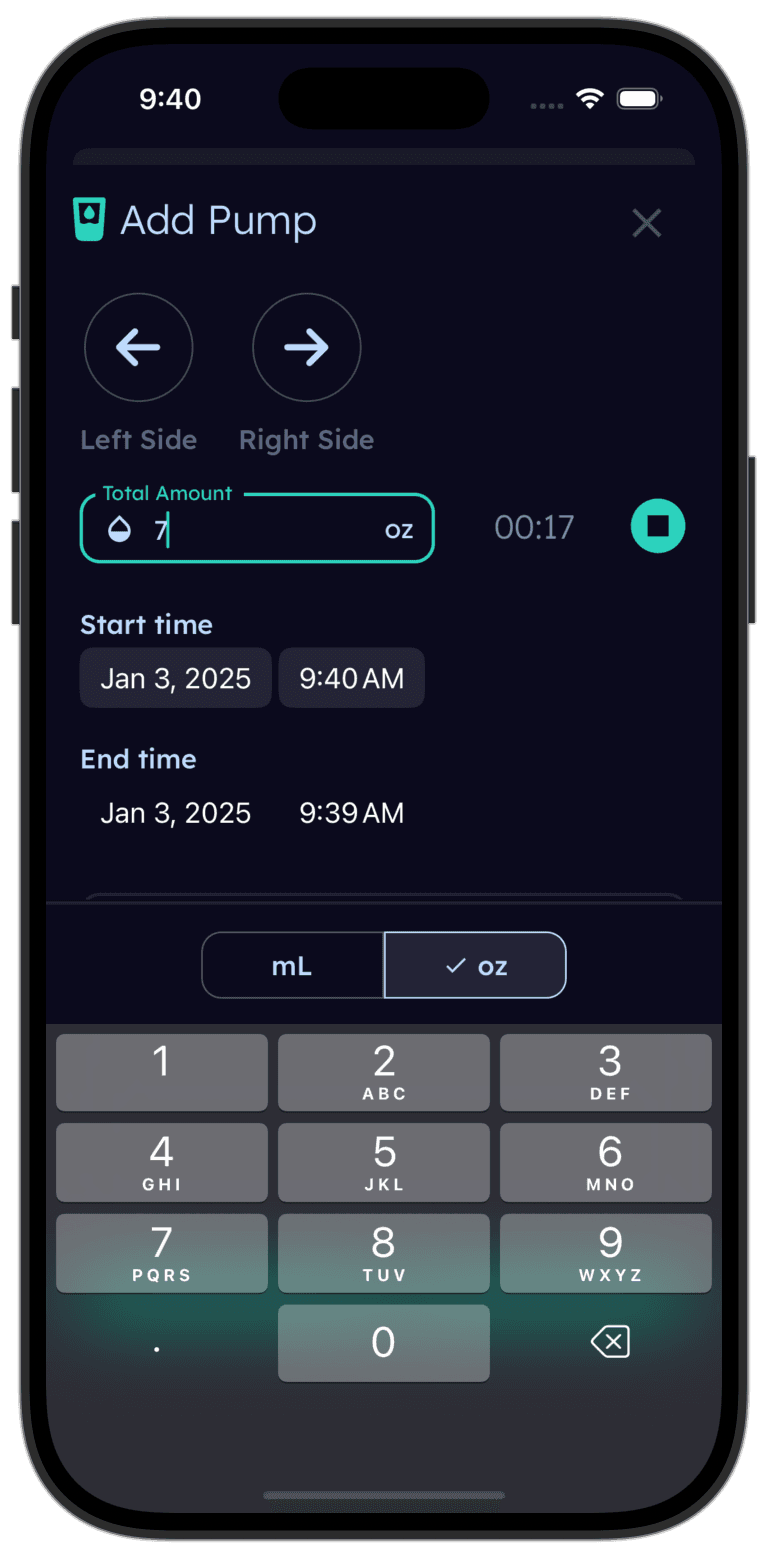
tinylog tracking pump sessions at work and nursing sessions at home

Pumping at work and nursing at home means two different contexts — but one baby. Seeing both in one timeline is how you know the full picture.

tinylog tracks nursing sessions and pump output in one place. See total daily intake, spot supply trends, and know exactly what to send to daycare tomorrow.

Download on the App StoreGet It On Google Play

Your Legal Rights

In the United States, the PUMP for Nursing Mothers Act (2022) — an expansion of the Break Time for Nursing Mothers provision — requires most employers to provide:

  • Reasonable break time to pump for one year after your child's birth
  • A private space that is not a bathroom, shielded from view, and free from intrusion
  • These protections now cover both hourly and salaried employees

Many states have additional protections that go further. Some require paid break time, access to a refrigerator for milk storage, or extend protections beyond one year.

If your employer is not providing appropriate accommodations, document your requests in writing. Resources like the US Department of Labor and your state's labor department can help.

What the Evidence Actually Says

"You need a huge freezer stash before returning to work." This creates unnecessary stress. You need about one day's worth to start. After that, today's pumped milk is tomorrow's daycare bottles. Building a modest buffer (3-5 days' worth) is practical insurance, but the Instagram freezer full of milk bags is unnecessary for most parents.

"Pumping 3 times at work is the minimum to maintain supply." Two to three times is the general recommendation for an 8-hour day. Some parents maintain supply with 2 sessions if they also nurse frequently at home and overnight. The total number of milk removals per 24 hours matters more than the specific work sessions.

"Your supply will inevitably drop when you go back to work." Not inevitably. Studies show that supply maintenance depends on total daily milk removal frequency. If work pumping + home nursing equals 7-8+ removals per day, most parents maintain adequate supply. Supply drops happen when pumping sessions get skipped consistently.

When to Get Help and What Kind

See an IBCLC before returning to work if: you want help creating a pumping plan, need flange sizing, or want to troubleshoot pump output. A pre-return consultation is one of the most valuable things you can do.

See an IBCLC after returning if: supply is dropping despite consistent pumping, pump output has decreased significantly, or baby is struggling with the breast-to-bottle transition.

Know your workplace resources: Many companies have lactation rooms, pump lending programs, or employee resource groups for new parents. Ask HR before assuming nothing exists.

If you're exclusively pumping, our exclusive pumping guide has detailed schedules. To understand normal output, see how much milk should I be pumping, and try power pumping if supply dips after returning to work.


Related Guides

Sources

  • American Academy of Pediatrics (AAP). (2022). Breastfeeding and the Use of Human Milk. Pediatrics, 150(1).
  • US Department of Labor. (2023). PUMP for Nursing Mothers Act — Fact Sheet.
  • Kent, J. C., et al. (2006). Volume and frequency of breastfeedings and fat content of breast milk throughout the day. Pediatrics, 117(3).
  • Centers for Disease Control and Prevention. (2024). Proper Storage and Preparation of Breast Milk.
  • Academy of Breastfeeding Medicine. (2017). ABM Clinical Protocol #8: Human Milk Storage Information for Home Use.
  • Ortiz, J., et al. (2004). Duration of breast milk expression among working mothers enrolled in an employer-sponsored lactation program. Pediatric Nursing, 30(2).

Medical Disclaimer

This guide is for informational purposes only and is not a substitute for professional medical advice. If you're experiencing breastfeeding difficulties, consider consulting an IBCLC (International Board Certified Lactation Consultant) or your pediatrician.

Get this pumping schedule in your inbox.
We'll email you this guide so you can plan your pumping schedule before the back-to-work chaos begins.
Track pump sessions at work and nursing at home — one timeline.
Download tinylog free — see your full feeding picture across both environments.
Download on the App StoreGet It On Google Play