
GUIDE
Momcozy M5 vs. Elvie Double Electric Wearable Pump
Published on
Both are solid wearable pumps that let you pump hands-free. The Elvie is quieter and sleeker, with app-based tracking. The Momcozy M5 delivers comparable suction at roughly one-third of the price. For most pumping parents, the M5 is the better value.
Wearable breast pumps changed the game for working and pumping parents who need to multitask. The Elvie Double Electric was one of the first premium options to market, and the Momcozy M5 has emerged as the budget-friendly alternative that punches above its weight. Both slip into your bra and let you pump without cords or wall outlets — but they differ meaningfully in suction power, noise, app features, and price.
Log sessions, output, and feeding patterns
Two Wearable Pumps, Very Different Price Tags
Wearable breast pumps changed everything for parents who need to pump at work, during errands, or while chasing a toddler around the house. No more sitting hunched over a wall outlet with tubes dangling everywhere.
The Elvie Double Electric was one of the first wearable pumps to get it right — quiet, sleek, app-connected. It also costs around $250–$300. The Momcozy M5 showed up and asked: what if we did roughly the same thing for a fifth of the price?
The honest answer: both pumps work well. The differences come down to noise, app features, build quality, and whether the price gap is worth it for your situation. We broke down every spec so you can decide without reading twenty Reddit threads at midnight.
For tips on tracking your pumping sessions and output trends, see our exclusive pumping guide.
| Feature | Momcozy M5 | Elvie Double Electric | What It Means |
|---|---|---|---|
| Manufacturer | Momcozy | Elvie | Momcozy is a fast-growing baby tech brand. Elvie is a UK-based women's health tech company. |
| Type | Wearable, in-bra, cordless | Wearable, in-bra, cordless | Tie. Both slip inside a standard nursing bra and operate without tubes or cords. |
| Max suction | ~300 mmHg | ~270 mmHg | M5 is slightly stronger on paper. Real-world output depends on flange fit and letdown response. |
| Suction modes | 2 modes (stimulation + expression), 9 levels | 2 modes (stimulation + expression), 7 levels | M5 offers more granularity. Both auto-switch from stimulation to expression. |
| Noise level | ~48–50 dB (quiet conversation) | ~40 dB (library quiet) | Elvie wins here. Noticeably quieter during meetings and in shared spaces. |
| Capacity | 180 mL (6 oz) per cup | 150 mL (5 oz) per cup | M5 holds more per session. Matters if you produce high volumes per side. |
| Battery life | ~2 hours (3–4 sessions) | ~2.5 hours (4–5 sessions) | Elvie lasts a bit longer between charges. Both charge via USB. |
| App connectivity | No app — manual controls only | Bluetooth app with real-time volume tracking | Elvie's app tracks output automatically. M5 users need to log sessions manually. |
| Weight per cup | ~220 g (7.8 oz) | ~160 g (5.6 oz) | Elvie is lighter and sits more discreetly in the bra. |
| Flange sizes included | 24 mm (others sold separately) | 24 mm and 28 mm included | Elvie includes two sizes. Correct flange fit matters more than any other spec. |
| Parts to clean | 5 parts per cup | 5 parts per cup | Tie. Both are relatively easy to disassemble and clean. |
Suction Power: The Spec Everyone Asks About First
On paper, the Momcozy M5 has stronger maximum suction — around 300 mmHg compared to the Elvie's 270 mmHg. The M5 also gives you nine intensity levels versus seven on the Elvie, so you can fine-tune more precisely.
But here's what actually matters: suction strength is not the main driver of milk output. Flange fit, letdown response, and pumping frequency affect output far more than raw mmHg numbers. A pump with perfect suction but a bad flange fit will underperform a weaker pump that fits correctly.
Both pumps use a two-phase system — a faster stimulation mode to trigger letdown, then a slower expression mode to extract milk. Both auto-switch between phases. In real-world use, most parents report similar output volumes from both pumps when the flange fit is correct.
If you're not sure about flange sizing, a lactation consultant can measure you in about five minutes. It's the single most impactful thing you can do to improve pumping output with any pump.
Noise: Where the Elvie Really Shines
This is the Elvie's standout advantage. At roughly 40 dB, it's genuinely hard to hear from across a room. You can pump during video calls, in a quiet office, or while your baby naps nearby without worrying about the motor giving you away.
The Momcozy M5 runs at about 48–50 dB. That's still much quieter than a traditional electric pump, but it's noticeably audible in a silent room. In a noisy environment — coffee shop, open office, car — you probably won't notice the difference. In a silent meeting room, you will.
If you pump primarily at home, the noise difference is minor. If you pump at work in shared spaces, the Elvie's near-silent operation is a real practical advantage worth considering.
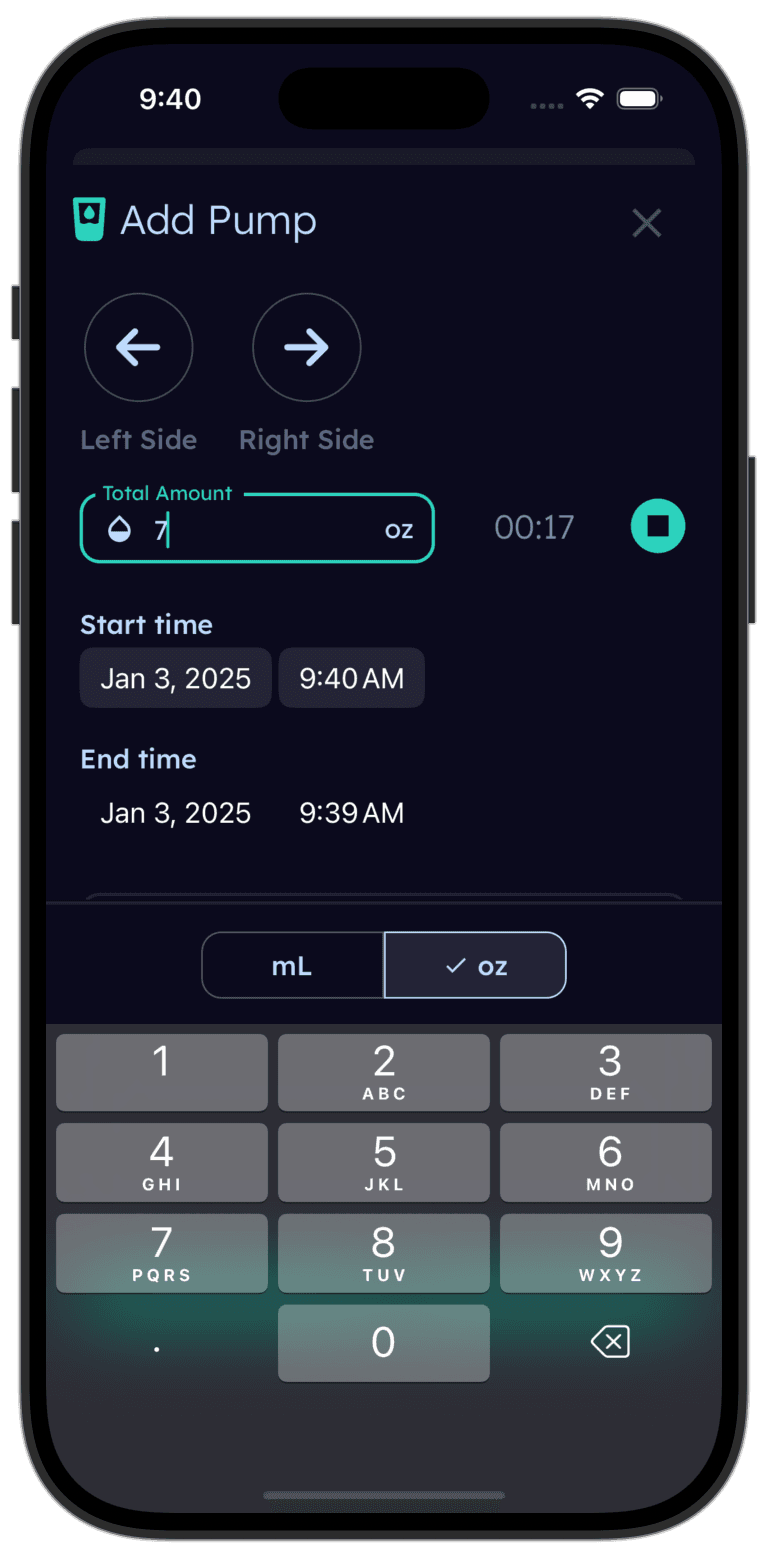
Tinylog tracks pumping sessions so you can spot supply trends.
Log each pump with duration and volume, see daily and weekly output totals, and bring the data to your lactation consultant. Works whether you pump with a Momcozy, Elvie, or any other pump.


The App Factor: Convenience vs. Simplicity
The Elvie connects to a companion app via Bluetooth. The app shows you milk volume in real time as you pump, logs your session history, and tracks trends over weeks. For parents who want automated data without manually writing anything down, this is genuinely useful.
The Momcozy M5 has no app connectivity. You control it with buttons on the pump itself, and you read the volume from measurement markings on the collection cup. If you want to track your output over time, you'll need a separate app.
Here's the thing, though — plenty of parents prefer a simple pump that just works without pairing, syncing, or troubleshooting Bluetooth. And if you're already using Tinylog or another tracker to log feeds and pumping sessions, the Elvie's built-in tracking is redundant.
Whether the app matters depends on your tracking habits. If you want one device that does everything, Elvie wins. If you want a pump that pumps and nothing else, the M5 keeps it simple.
Build and Comfort: You're Wearing These for Hours
The Elvie is lighter (160 g vs 220 g per cup) and has a slimmer profile. It sits more discreetly under clothing and is less likely to shift during movement. The build quality feels premium — smooth plastic, satisfying clicks, minimal rattling.
The Momcozy M5 is a bit bulkier and heavier. Under a loose top, most people won't notice. Under a fitted shirt, the Elvie is less visible. Build quality on the M5 is good for the price, but it doesn't feel as refined. Some users report the silicone parts wear out faster and need replacement sooner.
Both pumps work with most standard nursing bras. If you're between sizes or have a smaller frame, the Elvie's compact design might fit better. If you're larger-chested, both fit similarly since there's more room to accommodate them.
| Product | Typical Price | Frequency | Ongoing Cost |
|---|---|---|---|
| Momcozy M5 (double, wearable) | $55–$70 | One-time cost | $0 after purchase |
| Elvie Double Electric (wearable) | $250–$300 | One-time cost | $0 after purchase |
| Replacement parts (M5, per set) | $12–$18 | Every 2–3 months | ~$5–$9/mo |
| Replacement parts (Elvie, per set) | $20–$30 | Every 2–3 months | ~$8–$15/mo |
Price: The Elephant in the Room
The price difference is hard to ignore. The Momcozy M5 costs $55–$70. The Elvie Double Electric costs $250–$300. That's a $180–$230 gap for a product you'll use for six to twelve months.
A few things that affect the real cost:
- Insurance coverage. Many US health insurance plans cover breast pumps under the ACA. Check whether your plan covers wearable pumps specifically — some only cover basic electric models. If the Elvie is covered, the price gap disappears.
- Replacement parts. Elvie parts cost more ($20–$30 per set) compared to M5 parts ($12–$18). Over six months, that adds $20–$40 to the total cost difference.
- Resale value. Elvie pumps hold resale value better on secondary markets if you plan to sell after weaning. M5 pumps resell for very little.
- Use case. If this is your only pump, the Elvie's durability and features may justify the cost. If you already have a hospital-grade pump at home and want a wearable for on-the-go, the M5 makes an excellent affordable second pump.
The honest take: if insurance covers the Elvie, get the Elvie. If you're paying out of pocket and budget matters, the M5 delivers 80% of the experience for 25% of the price.
Choose the Momcozy M5 If
- Budget is a major factor and you want strong performance without the premium price tag
- You prefer a larger collection cup (180 mL vs 150 mL) to avoid mid-session overflow
- You want slightly stronger maximum suction with more adjustment levels
- You don't need app-based tracking (or you already use a separate app like Tinylog)
- You're comfortable reading volume markings manually after each session
- You want an affordable backup pump to supplement a hospital-grade pump at home
Choose the Elvie Double Electric If
- Discreet, quiet pumping is your top priority — you pump in meetings, shared offices, or public spaces
- You want built-in Bluetooth tracking that logs volume and session duration automatically
- A lighter, slimmer profile in your bra matters to you
- You prefer a pump with a longer battery life between charges
- You want two flange sizes in the box so you can try different fits right away
Where to Buy
The Momcozy M5 Wearable Breast Pump (~$60 on Amazon) is tough to beat on value — strong suction, large capacity cups, and a straightforward design that just works. It's become one of the best-selling wearable pumps for a reason. Grab it on Amazon where it frequently goes on sale.
If quiet operation, app tracking, and a premium build matter more, the Elvie Double Electric Wearable Pump (~$280 retail) is the gold standard for discreet pumping. Check your insurance first — many plans cover it fully. Available direct from Elvie, Amazon, and most major baby retailers.
Our honest advice: check your insurance coverage before buying either one. If your plan covers wearable pumps, go Elvie. If you're paying out of pocket, the M5 is a phenomenal deal.
Tinylog earns a small commission on purchases made through these links, at no cost to you.
We've found promo.new handy for finding discounts on baby gear. Doesn't always have what you need, but it's worth a shot.
The Bottom Line
Both the Momcozy M5 and the Elvie Double Electric are capable wearable breast pumps that free you from cords and wall outlets. The differences are real but come down to priorities:
Momcozy M5 wins on price, suction strength, cup capacity, and pure value for money. It's the practical choice for budget-conscious parents or anyone who wants a solid backup wearable pump.
Elvie Double Electric wins on noise level, app tracking, weight, discretion under clothing, and build quality. It's the refined choice for parents who pump frequently in shared or quiet spaces.
For most families paying out of pocket, the M5 is the smarter buy. For families with insurance coverage or a strong preference for quiet and tech, the Elvie earns its premium.
If you're tracking pumping output — which is especially helpful when establishing supply or troubleshooting low output — Tinylog makes it easy to log sessions, see trends, and share data with your lactation consultant.
Related Guides
- Exclusive Pumping — How to build and maintain supply when you pump full-time
- Pumping Schedule for Working Parents — Realistic schedules for the office, hybrid, and remote work
- How Much Milk Should I Be Pumping? — Output expectations by age and frequency
- How to Increase Milk Supply — Evidence-based strategies that actually work
Sources
- Momcozy.com. "Momcozy M5 Wearable Breast Pump — Product Specifications." 2026.
- Elvie.com. "Elvie Double Electric Breast Pump — Product Information." 2026.
- Journal of Human Lactation. "Comparison of Milk Output Using Wearable vs. Traditional Electric Breast Pumps." 2025.
- Wirecutter (NYT). "The Best Breast Pumps." nytimes.com/wirecutter, 2026.
- Exclusive Pumping. "Momcozy M5 Review." exclusivepumping.com, 2025.
- Healthline Parenthood. "Elvie Breast Pump Review." healthline.com, 2025.
- ACA Breast Pump Coverage Guide. healthcare.gov, 2026.
This guide is for informational purposes only. Breast pump selection depends on your individual anatomy, supply needs, and pumping goals. If you have concerns about milk supply or pumping effectiveness, consult a board-certified lactation consultant (IBCLC).
Frequently asked questions
- Is the Momcozy M5 as strong as the Elvie Double Electric?
- The Momcozy M5 has a slightly higher maximum suction level (around 300 mmHg) compared to the Elvie (around 270 mmHg). In practice, both provide adequate suction for most users. Some parents with lower supply find the M5's extra suction helpful, while others prefer the Elvie's gentler rhythm.
- Can you see how much milk you've pumped with the Momcozy M5?
- The M5 has measurement markings on the collection cup, but it does not connect to an app. You read the volume manually. The Elvie connects via Bluetooth to a companion app that tracks volume in real time and logs your session history automatically.
- How loud are wearable breast pumps?
- The Elvie Double Electric is one of the quietest wearable pumps available, producing around 40 dB — roughly the volume of a library. The Momcozy M5 is noticeably louder at around 48–50 dB, similar to a quiet conversation. Both are far quieter than traditional electric pumps.
- Do wearable breast pumps empty as well as hospital-grade pumps?
- No wearable pump fully matches the suction and cycling of a hospital-grade pump like the Medela Symphony. However, both the M5 and Elvie work well for maintaining supply once breastfeeding is established. If you are exclusively pumping or have supply concerns, talk to a lactation consultant about whether a wearable pump is sufficient.
- Can I use the Momcozy M5 or Elvie while nursing on the other side?
- Yes. Both pumps are compact enough to wear in one cup while nursing your baby on the other breast. This is a popular strategy for collecting letdown milk and boosting output per session.
- How long do wearable breast pump batteries last?
- The Elvie Double Electric lasts roughly 2.5 hours on a full charge, or about 4–5 pumping sessions. The Momcozy M5 lasts about 2 hours, or roughly 3–4 sessions. Both charge via USB, and most parents charge them overnight so they are ready each morning.