
GUIDE
Momcozy S12 Pro vs. Willow Go
Published on
The Momcozy S12 Pro is the budget-friendly workhorse. The Willow Go is the premium spill-proof pick. Both free your hands — but for very different price tags.
Wearable breast pumps changed the game for pumping parents. No more sitting tethered to a wall outlet with tubes dangling everywhere. But with so many options now, choosing between a $70 pump and a $270 pump is a real decision. We broke down everything that actually matters.
Log sessions, volume, and time
Two Wearable Pumps, Very Different Price Tags
Wearable breast pumps are one of those products where the price range is wild. You can spend $70 or $300 and both boxes say "hands-free wearable breast pump" on the label. So what are you actually getting for that extra $200?
The Momcozy S12 Pro is the best-selling budget wearable pump on the market. It's all over social media, it works well enough for most people, and it costs less than a nice dinner out. The Willow Go is a premium spill-proof system with app tracking, quieter motors, and a sealed bag collection system that lets you pump while genuinely doing other things.
We compared suction, capacity, noise, portability, ongoing costs, and real-world usability so you can figure out which one actually fits your life — and your budget.
For more on pumping output and what to expect, see our how much milk when pumping guide.
| Feature | Momcozy S12 Pro | Willow Go | What It Means |
|---|---|---|---|
| Price (MSRP) | ~$70 | ~$270 | The Momcozy is roughly a quarter of the price. That gap is hard to ignore. |
| Milk collection | Open cup (pours into bottles after) | Sealed spill-proof bags | Willow's bags mean you can move freely without spilling. Momcozy requires staying relatively upright. |
| Capacity | 6 oz per cup | 4 oz per bag | Momcozy holds more per session. Willow bags fill up faster if you're a high-output pumper. |
| Suction strength | Up to ~270 mmHg (9 levels) | Up to ~300 mmHg (10 levels) | Willow is slightly stronger. Both are weaker than most plug-in hospital-grade pumps. |
| Battery life | ~3–4 sessions per charge | ~4–5 sessions per charge | Willow lasts a bit longer between charges. Both are USB-C rechargeable. |
| Noise level | Quiet — soft hum | Very quiet — barely audible | Willow is slightly more discreet. Neither will disturb a meeting, but Momcozy is noticeable in a silent room. |
| App connectivity | No app | Willow app (tracks sessions, volume) | Willow's app auto-logs sessions. With Momcozy, you'll want a separate tracker. |
| Flange sizes included | 24mm (plus inserts for 17mm, 19mm, 21mm) | 21mm and 24mm | Momcozy includes more size options in the box. Getting the right flange fit matters a lot for comfort. |
| Weight per cup | ~8 oz | ~10 oz | Both are light enough to wear in a bra. The Willow is slightly heavier because of the sealed system. |
| Cleaning | 5 parts to wash per cup | 3 parts to wash (bags are disposable) | Fewer parts to wash with Willow, but you're buying disposable bags. Pick your tradeoff. |
| Insurance coverage | Rarely covered | Sometimes covered — check your plan | Willow has better insurance coverage. If your plan covers it, the price gap shrinks dramatically. |
The Spill Factor: Open Cup vs. Sealed Bags
This is the single biggest functional difference between these two pumps, and it affects everything about how you use them.
The Momcozy S12 Pro uses an open-cup design. Milk collects in a cup inside the wearable unit, and you pour it into a bottle or bag when you're done. This works great if you're sitting at a desk, reclining on the couch, or anywhere you can stay mostly upright. Lean too far forward and you risk spilling freshly pumped milk — which, if you've ever lost an ounce of breast milk, you know is genuinely devastating.
The Willow Go pumps directly into proprietary sealed bags. The milk goes straight into a locked pouch, and you can bend over, pick up your baby, or walk around the grocery store without worrying. For parents who need to pump while actively parenting another child, this is a meaningful upgrade.
The tradeoff? Those bags cost money. Roughly $0.50–$0.75 per bag, and you'll use 4–8 per day if you're pumping regularly. That adds up fast.
Suction and Output: Does More Expensive Mean More Milk?
Here's the honest answer: for most parents, output is similar between these two pumps. The Willow Go has slightly stronger maximum suction (~300 mmHg vs. ~270 mmHg), but suction strength alone doesn't determine how much milk you get. Flange fit, letdown response, session timing, and your individual physiology all matter more.
Where the Willow Go does have an edge is consistency. The motor maintains a more even rhythm across suction levels, and some parents report faster letdowns with the Willow. The Momcozy S12 Pro can feel a bit inconsistent on higher settings — the suction pattern gets less rhythmic.
Neither pump replaces a hospital-grade plug-in pump for raw output. If you're an exclusive pumper doing 8+ sessions a day, most lactation consultants recommend using a strong plug-in pump as your primary and a wearable as your mobile backup.
One more thing: flange size matters more than pump brand. A poorly fitted flange on a $300 pump will produce less milk than a well-fitted flange on a $70 pump. Measure before you buy, and don't assume the included sizes will work for you.
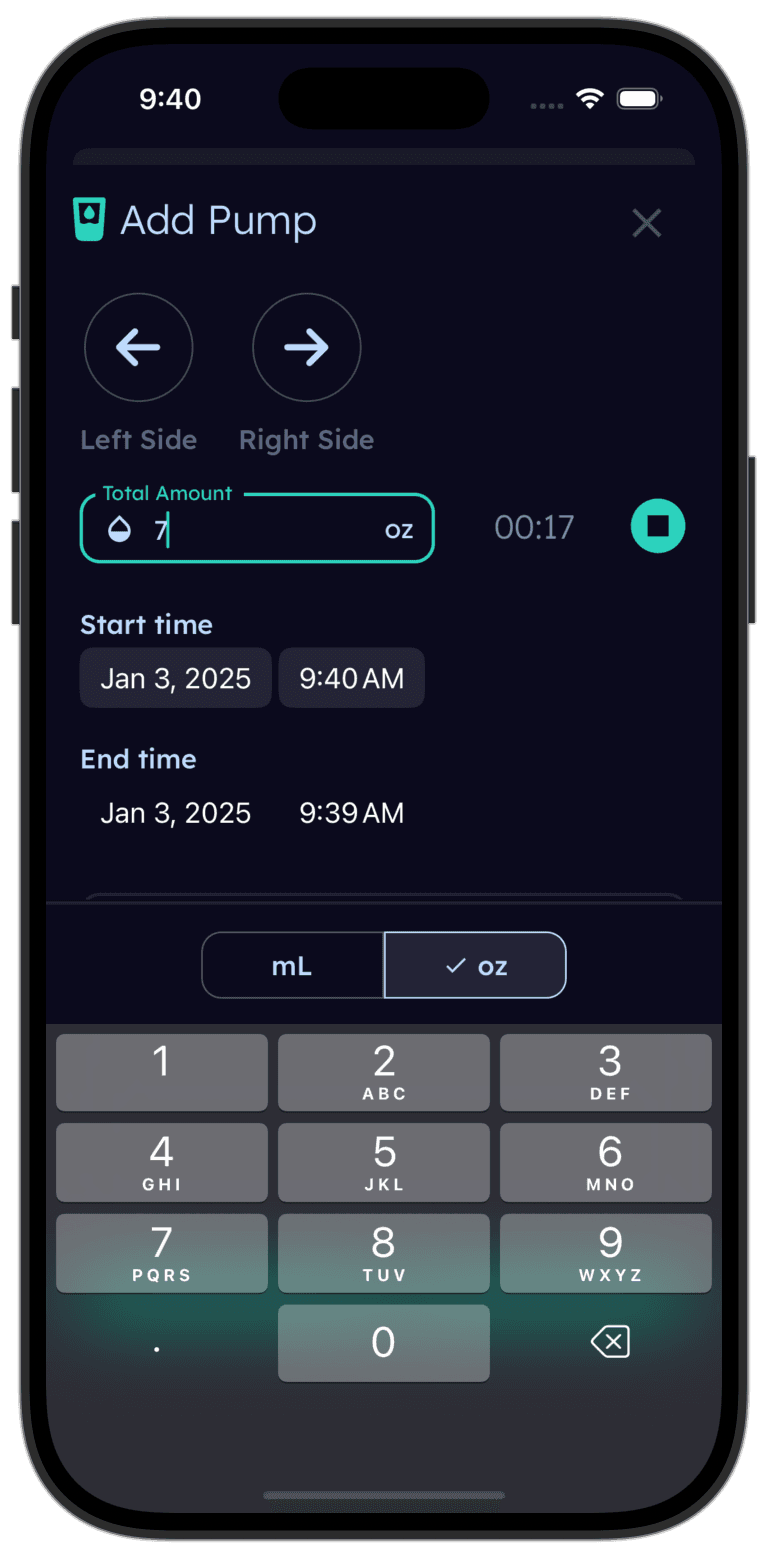
Pumping 6 times a day and losing track of which side you did last? Yeah, we've been there.
Log pump sessions in a few taps — time, volume, side. Spot supply trends over days and weeks without a spreadsheet.


The Hidden Cost: Bags, Parts, and Replacements
The sticker price tells you half the story. Here's what pumping actually costs over time.
The Momcozy S12 Pro has almost zero ongoing costs. You wash the parts, you reuse them, done. Replacement parts (duckbill valves, flanges) run $5–$15 and last months. If you pump for a year, your total cost stays close to that original $70.
The Willow Go has significant ongoing costs because of the proprietary bag system. At 4–6 bags per day and $0.50–$0.75 per bag, you're looking at $60–$135 per month in bags alone. Over a year of pumping, bag costs can exceed the price of the pump itself.
Some parents reuse Willow bags by washing and air-drying them. Willow doesn't recommend this, and bags can lose their seal after a few uses. But plenty of parents do it to cut costs.
| Product | Upfront Price | Monthly Ongoing Cost | Estimated First-Year Cost |
|---|---|---|---|
| Momcozy S12 Pro (pair) | $60–$80 | ~$0 ongoing | ~$60–$80 |
| Willow Go (pair) | $250–$300 | ~$30–$50 (bags) | ~$600–$900 |
| Willow Go with insurance | $0–$50 out of pocket | ~$30–$50 (bags) | ~$360–$650 |
Noise: Can You Pump on a Work Call?
Both pumps are marketed as "quiet," and both are reasonably discreet. But there's a noticeable difference.
The Willow Go is the quieter of the two. On lower settings, it's barely audible from a few feet away. You can realistically pump during a video call with your camera on and no one will notice (assuming your top covers the cups, obviously).
The Momcozy S12 Pro is quiet by breast pump standards but makes a soft rhythmic hum that's audible in a quiet room. On a work call, you'd probably want to mute yourself when not speaking. It's not loud — but it's not silent either.
If stealth pumping is a priority for your work situation, the Willow has the edge here.
One thing worth mentioning: both pumps get louder as suction increases. If you keep both on medium settings, the noise difference between them shrinks. On maximum suction, the Momcozy is noticeably more audible.
Choose the Momcozy S12 Pro If
- You're on a budget and want a solid wearable pump without spending $300
- You pump mostly at home or at a desk where staying upright isn't a problem
- You want the larger 6 oz capacity for longer sessions
- You don't want to deal with buying proprietary bags every month
- You already have a strong plug-in pump and need a portable backup
- You're not sure wearable pumping is for you and want to try it without a big investment
Choose the Willow Go If
- You need true hands-free pumping while moving around — bending, lifting, chasing a toddler
- Spill-proof collection is a must (you pump during commutes, walks, or active work)
- You want app-based session tracking built into the pump
- Your insurance covers the Willow Go (check before buying)
- You value quieter operation and slightly stronger suction
- You'd rather toss a bag than wash five pump parts at midnight
Where to Buy
The Momcozy S12 Pro (~$70 for a pair) is the best value wearable pump on the market right now. It does what it says, it's easy to use, and it doesn't cost a fortune. If you're pumping mostly while sitting and want a reliable hands-free option without a big commitment, this is the one.
If you need true spill-proof mobility and don't mind the ongoing bag costs, the Willow Go (~$270 for a pair) is the premium pick. Check your insurance first — if it's covered, this becomes a much easier decision. The sealed bag system and quieter motor make it genuinely better for active, on-the-go pumping.
Our honest take: start with the Momcozy if you're not sure about wearable pumping. If you find yourself wishing you could move around more freely while pumping, upgrade to the Willow later. The $70 experiment is a lot less painful than a $270 one. And if the Momcozy does everything you need? You just saved yourself $200.
Tinylog earns a small commission on purchases made through these links, at no cost to you.
Before you buy, it's worth checking promo.new for a deal. It doesn't cover everything, but we've had good luck with it.
The Bottom Line
These two pumps serve different needs at very different price points.
Momcozy S12 Pro wins on value, capacity, low ongoing costs, and being a great entry point into wearable pumping. It's the right call for parents who pump at a desk, on the couch, or anywhere they can stay mostly upright.
Willow Go wins on spill-proof portability, quieter operation, app tracking, and slightly stronger suction. It's the right call for parents who need to pump while genuinely moving around — commuting, chasing a toddler, or working an active job.
For most families, the Momcozy S12 Pro at one-quarter the price is the smarter starting point. If your insurance covers the Willow Go, that changes the math entirely.
If you're tracking pump sessions to monitor supply — which is genuinely useful in the early weeks — Tinylog makes it easy to log output and spot trends over time.
Related Guides
- Exclusive Pumping — Schedules, output expectations, and tips for making it work
- How Much Milk When Pumping — What's normal output by age and session
- Pumping Schedule for Working Parents — How to fit pumping into a workday
- Breast Milk Storage — How long milk lasts at room temp, in the fridge, and frozen
Sources
- Momcozy.com. "Momcozy S12 Pro Wearable Breast Pump — Product Specifications." 2026.
- Willow. "Willow Go Wearable Breast Pump — Product Information." onewillow.com, 2026.
- Mommyhood101. "Best Wearable Breast Pumps of 2026, Tested & Reviewed." mommyhood101.com.
- Exclusive Pumping. "Momcozy S12 Pro Review." exclusivepumping.com, 2025.
- The Pumping Mommy. "Willow Go vs. Momcozy: Real Output Comparison." thepumpingmommy.com, 2025.
- BabyGearLab. "Best Breast Pumps of 2026." babygearlab.com.
This guide is for informational purposes only and does not constitute medical advice. Consult a lactation consultant or your healthcare provider for personalized pumping guidance.
Frequently asked questions
- Is the Momcozy S12 Pro strong enough for exclusive pumping?
- The Momcozy S12 Pro has a maximum suction of about 270 mmHg, which is adequate for most pumping sessions. However, exclusive pumpers who need hospital-grade suction may find it falls short during longer sessions. Many exclusive pumpers use the S12 Pro for on-the-go convenience and a stronger plug-in pump at home.
- Does the Willow Go really not spill?
- The Willow Go pumps directly into proprietary spill-proof bags that lock in place. You can lean, bend over, and move around without worrying about losing milk. It is not truly 100% spill-proof — occasionally a bag can unseat — but it is far more spill-resistant than any open-cup wearable pump.
- Can I use the Momcozy S12 Pro with my nursing bra?
- Yes. The Momcozy S12 Pro fits inside most nursing bras. It works best with bras that have some stretch and structure. Some parents buy a hands-free pumping bra one size up to get a more comfortable fit with the pump cups inserted.
- How loud are wearable breast pumps?
- The Momcozy S12 Pro is relatively quiet — comparable to a soft hum. The Willow Go is slightly quieter. Neither is silent. Both are discreet enough for a Zoom call or an office with the door closed, but someone sitting right next to you will hear a faint rhythmic sound.
- Can I use generic bags with the Willow Go?
- No. The Willow Go requires Willow-branded spill-proof bags, which cost roughly $0.50–$0.75 per bag. This is one of the biggest ongoing costs with the Willow system. Some parents reuse bags a few times after washing, but Willow does not officially recommend reuse.
- Which wearable pump has better suction?
- The Willow Go offers slightly stronger effective suction and a more consistent pumping rhythm. The Momcozy S12 Pro has decent suction for its price but can lose consistency on higher settings. For most parents with an established supply, both produce similar output per session.