GUIDE

On-Demand Feeding vs. Scheduled Feeding

On-demand feeding is recommended for newborns and young infants. As babies grow, a natural rhythm emerges that resembles a schedule. Most families end up somewhere in between.

The real question isn't which one to pick — it's when your baby is ready to shift from one toward the other.

Discover your baby's natural pattern

Track feeds and see the rhythm emerge

Responsive feeding is all about teaching parents how to recognize cues from their child that they are hungry or full — especially during infancy — and how to respond in a developmentally appropriate and productive way.
Dr. Ian PaulDr. Ian Paul, MD, MSc, Professor of Pediatrics and Public Health Sciences, Penn State College of Medicine

The False Binary of Feeding Timing

Like most parenting debates, the on-demand vs. scheduled feeding argument presents a false binary. In practice, nearly every family lands somewhere in between — and that's exactly where the research suggests you should be.

On-demand feeding (also called responsive feeding or cue-based feeding) means watching your baby for hunger signals and feeding when they appear, regardless of when the last feed happened. During intense periods like cluster feeding, this can mean nursing every 30-45 minutes for hours. The WHO, AAP, and every major pediatric organization recommend this approach, particularly for newborns. The logic is straightforward: newborns have tiny stomachs (5-7 mL at birth, growing to about 150 mL by one month), and they need to eat frequently. Imposing a schedule on a newborn risks underfeeding.

Scheduled feeding means setting intervals between feeds — typically every 2.5-3.5 hours — and feeding at those times. This approach is more common with formula-fed babies, partly because formula is slower to digest (giving natural longer intervals) and partly because bottle volumes are measurable and predictable. A 2010 study in the European Journal of Clinical Nutrition found that scheduled-fed infants had slightly lower cognitive scores at age 8 compared to demand-fed infants, though the study had significant confounders. It's worth knowing about, but it's not definitive.


On-Demand vs. Scheduled Feeding
Core principle
On-Demand FeedingFeed when baby shows hunger cues. Baby determines timing and duration.
Scheduled FeedingFeed at predetermined intervals (e.g., every 3 hours). Parent sets the timing.
Best suited for
On-Demand FeedingNewborns (0-6 weeks), breastfed babies of any age, and babies with weight gain concerns.
Scheduled FeedingOlder infants (3+ months) with established growth. Often used with formula-fed babies.
Supply support (breastfeeding)
On-Demand FeedingOptimal for milk supply. Frequent, baby-led feeds stimulate production through demand-response.
Scheduled FeedingMay under-stimulate supply if intervals are too long, especially in the first 6 weeks.
Parent predictability
On-Demand FeedingLow predictability early on. Feeds can feel random and constant, especially during cluster feeding.
Scheduled FeedingHigher predictability. Parents can plan activities around feed times.
Baby weight gain
On-Demand FeedingGenerally supports strong weight gain because baby eats whenever hungry.
Scheduled FeedingWorks well once growth trajectory is established. Risk of underfeeding if schedule ignores hunger.
Sleep impact
On-Demand FeedingFeeds can be frequent and irregular, especially at night. No stretching between feeds.
Scheduled FeedingCan help extend night sleep as baby learns to go longer between feeds (after appropriate age).
Research support
On-Demand FeedingWHO and AAP recommend responsive/demand feeding for all infants, especially newborns.
Scheduled FeedingLess research support as a standalone strategy. Works best as a flexible framework, not rigid timing.
Most families transition naturally from demand feeding to a flexible routine over the first 3-4 months.

On-Demand Feeding Advantages

  • Recommended by WHO and AAP — the evidence-based default for infant feeding
  • Supports optimal milk supply in breastfeeding mothers through the demand-response loop
  • Ensures baby gets adequate nutrition by never overriding hunger cues
  • Supports healthy appetite self-regulation — baby learns to eat when hungry and stop when full
  • Responsive caregiving builds secure attachment and trust

These advantages are strongest in the newborn period and for breastfeeding mothers.

On-Demand Feeding Challenges

  • Unpredictable — especially in the first 6 weeks when feeds can feel constant and chaotic
  • Harder for parents to plan around, particularly with older children or work commitments
  • Can be difficult to distinguish hunger cues from other needs (tired, gassy, overstimulated)
  • Cluster feeding periods can be mentally and physically exhausting
  • Other caregivers may struggle without a clear guideline for when to feed

The chaos of demand feeding is real, but it typically settles into a pattern by 2-3 months.

Scheduled Feeding Advantages

  • Provides structure and predictability to the day — parents can plan activities and rest
  • Can help establish day-night patterns and encourage longer sleep stretches
  • Easier for multiple caregivers (daycare, grandparents) to follow consistently
  • Reduces the constant 'is the baby hungry?' guessing game
  • Works well for formula-fed babies whose slower digestion naturally spaces feeds

Scheduling works best as a flexible framework rather than rigid clock-based timing.

Scheduled Feeding Challenges

  • Risk of underfeeding if baby's hunger cues are ignored in favor of the clock
  • Not recommended for newborns — small stomachs need frequent filling
  • Can negatively impact breastfeeding supply if feeds are too infrequent in the early weeks
  • Growth spurts require temporary schedule flexibility — rigid adherence can be problematic
  • May override baby's natural appetite regulation if feeds are forced or withheld based on timing alone

The key risk is rigidity. Flexible scheduling that respects hunger cues avoids most of these issues.

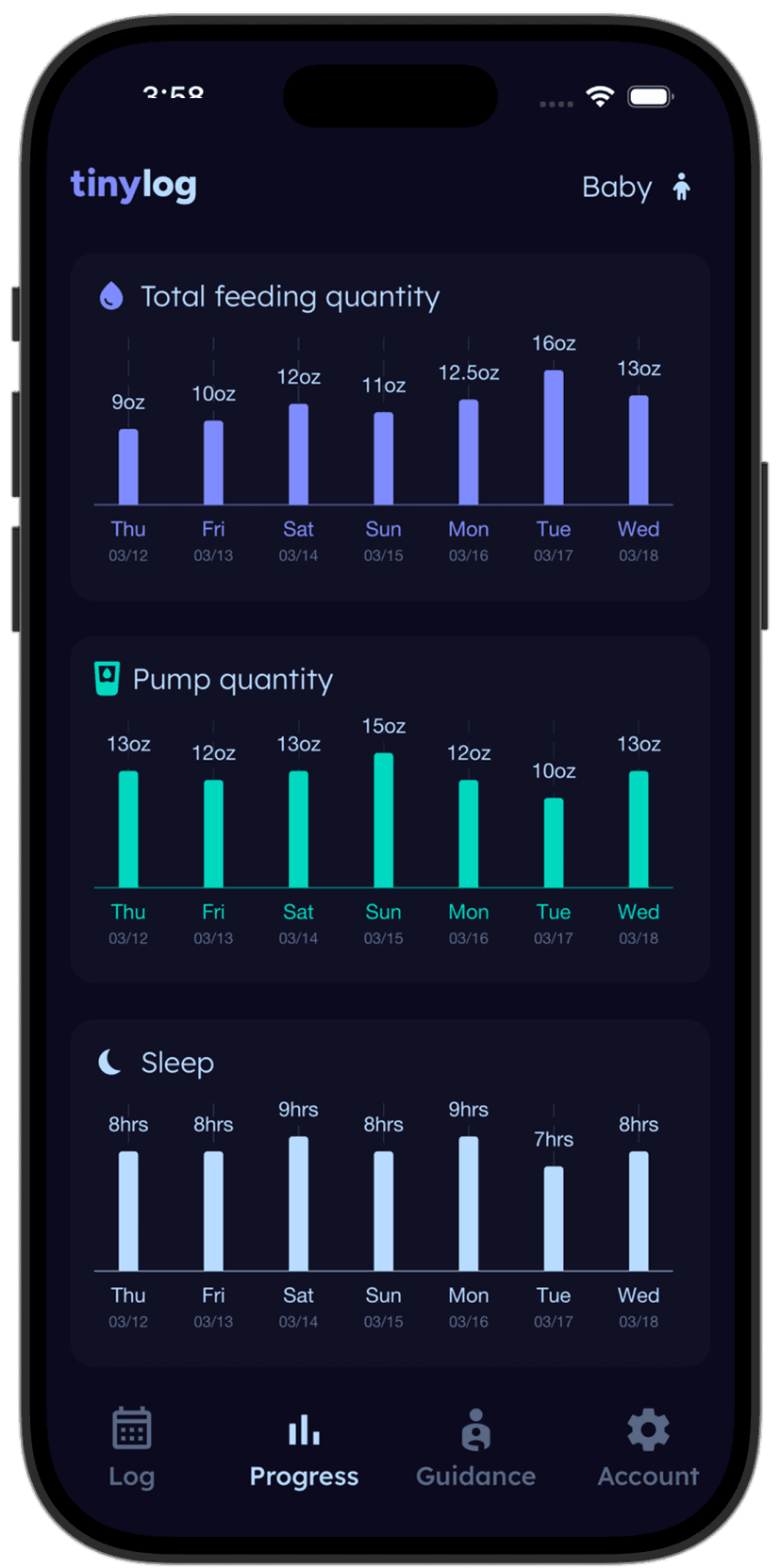
Tinylog trends view showing feeding frequency patterns

Your baby already has a pattern. Tracking reveals it.

Tinylog logs every feed with timestamp and duration, then shows you trends over days and weeks. Instead of guessing when baby might be hungry next, look at the data — your baby's natural rhythm becomes obvious when you can see it visually.

Download on the App StoreGet It On Google Play

The Natural Transition: How Demand Becomes Routine

Here's what actually happens in most families: the first 4-6 weeks feel chaotic. Feeds come at unpredictable intervals. Cluster feeding in the evening can mean hour after hour of nursing. You can't plan anything because you don't know when the next feed will be.

Then, around 6-8 weeks, something shifts. Without you doing anything deliberate, feeds start spacing out. A pattern emerges. Maybe your baby consistently wants to eat around 7 AM, 10 AM, 1 PM, and so on. You didn't impose this schedule — it emerged from your baby's developing circadian rhythm and growing stomach capacity.

By 3-4 months, most babies have a recognizable feeding pattern that you could describe as a "schedule" even though you never sat down and created one. This is the sweet spot: a predictable routine that's driven by your baby's biology, not a book or a clock. If you've been tracking feeds, you can see this pattern clearly in the data — and that's when feeding feels a lot less chaotic.

How to Approach Feeding Timing at Each Stage

0-6 weeks: Feed on demand, always. Your baby's stomach is tiny and growing, your milk supply (if breastfeeding) is being established, and feeding frequency is the primary way both problems get solved. Our newborn feeding schedule guide covers what to expect in these early weeks. Track feeds to monitor frequency and ensure baby is eating at least 8-12 times per 24 hours.

6 weeks to 3 months: Continue responding to hunger cues, but start observing the emerging pattern. You may notice natural intervals forming. Don't force a schedule, but you can start gently encouraging one — for example, if baby tends to eat at 3-hour intervals but sometimes fusses at 2 hours, try a quick soothe before feeding to see if it's hunger or something else.

3-6 months: Most babies have a recognizable routine by now. You can plan your day around it. But stay flexible during growth spurts, illness, and developmental leaps. The "schedule" is a baseline, not a rule.

Tips That Apply Either Way

Let the data reveal the pattern

Instead of imposing a schedule from the outside, track your feeds for 1-2 weeks and look for the natural rhythm. Most babies older than 6-8 weeks show a surprisingly consistent pattern when you plot the data. That emerging pattern is your baby's preferred schedule — you didn't create it, you discovered it.

Watch the baby, not the clock

Even when you're following a schedule, hunger cues should always override timing. If your baby shows clear hunger signs 30 minutes before the 'scheduled' feed, feed the baby. A schedule is a guideline, not a law. The goal is predictability, not rigidity.

Expect the schedule to change

Growth spurts, developmental leaps, illness, and teething all temporarily disrupt patterns. A baby who was eating every 3 hours may suddenly demand feeds every 90 minutes for a few days. This is normal. Let the baby lead, and the pattern will re-establish.

Related Guides

Sources

  • World Health Organization. (2023). Infant and Young Child Feeding — Model Chapter for Medical Students and Health Professionals.
  • American Academy of Pediatrics. (2012). Breastfeeding and the Use of Human Milk. Pediatrics, 129(3), e827-e841.
  • Iacovou, M., & Sevilla, A. (2013). Infant Feeding: The Effects of Scheduled vs. On-Demand Feeding on Mothers' Wellbeing and Children's Cognitive Development. European Journal of Public Health, 23(1), 13-19.
  • DiSantis, K. I., et al. (2011). Do Infants Fed Directly from the Breast Have Improved Appetite Regulation and Slower Growth During Early Childhood? International Journal of Behavioral Nutrition and Physical Activity, 8, 89.

This guide is for informational purposes only and is not a substitute for professional medical advice. Consult your pediatrician for guidance specific to your baby.

Get this comparison in your inbox.
Save this guide so you can revisit it as your baby's feeding pattern naturally evolves.
Your baby's natural rhythm is already there — tracking reveals it.
Use Tinylog to log feeds and watch a pattern emerge from the data.
Download on the App StoreGet It On Google Play