
GUIDE
Philips Avent Natural vs. Lansinoh Anti-Colic Bottles
Published on
Both are solid choices for breastfed and formula-fed babies. Lansinoh stands out for its NaturalWave nipple designed to mimic breastfeeding. Philips Avent Natural offers a wider nipple base and a built-in anti-colic AirFree vent option. Cost is comparable.
Philips Avent Natural and Lansinoh Anti-Colic are two of the most recommended baby bottles for parents who want to reduce colic symptoms and support breast-to-bottle transitions. Both use slow-flow nipples and anti-colic venting, but they take different design approaches. The right pick depends on your baby's latch, feeding style, and how much you value easy cleanup.
Log bottles, nursing sessions, and pumping
Two Popular Bottles With Different Strengths
Philips Avent Natural and Lansinoh Anti-Colic are both widely recommended by parents, pediatricians, and lactation consultants — but they solve different problems.
Lansinoh was built from the ground up for breastfeeding families. The NaturalWave nipple was clinically tested to support the same sucking motion babies use at the breast, making it a top pick when nipple confusion is a concern.
Philips Avent Natural is a versatile all-rounder. The wide, breast-shaped nipple works well for most babies, and the optional AirFree vent gives parents a powerful anti-colic upgrade without switching bottle brands entirely.
The honest truth: most babies will take either bottle just fine. But if you are dealing with specific challenges — a baby refusing the bottle after breastfeeding, or a colicky baby swallowing too much air — the differences between these two start to matter.
For more on how much your baby should be eating, see our baby feeding chart.
| Feature | Philips Avent Natural | Lansinoh Anti-Colic | What It Means |
|---|---|---|---|
| Manufacturer | Philips (Avent line) | Lansinoh Laboratories | Philips is a global electronics giant; Lansinoh specializes exclusively in breastfeeding products. |
| Nipple shape | Wide, breast-shaped with Natural Response flex | NaturalWave nipple — clinically tested to mimic breastfeeding | Both mimic the breast. Lansinoh's NaturalWave has more clinical backing for reducing nipple confusion. |
| Anti-colic system | Nipple valve (standard); AirFree vent (optional accessory) | Bottom-vented air system built into bottle design | Different approaches. Lansinoh's built-in vent is simpler. Avent's AirFree vent is more effective but adds a part. |
| Number of parts | 3 parts (4 with AirFree vent) | 3 parts only | Lansinoh wins on simplicity. Fewer parts means faster cleanup at 2 AM. |
| Bottle material | Polypropylene (BPA-free) | Polypropylene (BPA-free) | Tie. Both are BPA-free plastic. Both are dishwasher-safe on the top rack. |
| Available sizes | 4 oz, 9 oz, 11 oz | 5 oz, 8 oz | Avent offers more size options, including a larger 11 oz bottle for older babies. |
| Nipple flow rates | Newborn, 1m+, 3m+, 6m+, variable | Slow, Medium, Fast | Avent has more graduated flow options. Lansinoh keeps it simple with three speeds. |
| Breast pump compatibility | Direct fit with Philips Avent breast pumps | Direct fit with Lansinoh breast pumps | Both work seamlessly with their own brand's pumps. Check compatibility if you use a different pump brand. |
| Wide vs. standard neck | Wide neck | Wide neck | Tie. Both use wide-neck designs, making them easy to fill and clean. |
| Dishwasher safe | Yes — top rack | Yes — top rack | Tie. Both hold up well in the dishwasher. |
| Glass option available | Yes — Avent Natural glass bottles | No | Avent wins if you prefer glass. Lansinoh is plastic only. |
The Nipple Difference That Matters Most
The nipple is the single most important part of any baby bottle. It determines whether your baby accepts the bottle, how much air they swallow, and whether switching between breast and bottle causes problems.
Lansinoh's NaturalWave nipple was developed based on research into how babies actually suck at the breast. It flexes, stretches, and compresses in a wave-like motion that mimics the natural rhythm of breastfeeding. In clinical studies, babies who used NaturalWave nipples maintained their breastfeeding latch better than with standard bottle nipples. If you are pumping and bottle-feeding but want to preserve the breastfeeding relationship, this is a meaningful advantage.
Philips Avent Natural's nipple uses a wide, rounded shape with what Philips calls Natural Response technology — the nipple only releases milk when the baby actively drinks, not when the bottle is just tipped. This reduces overfeeding and helps babies control the pace of their feed. It is a well-designed nipple, but it was not specifically engineered around the breastfeeding latch the way Lansinoh's was.
For exclusively formula-fed babies, both nipples work well. For babies going back and forth between breast and bottle, Lansinoh has a real edge.
Anti-Colic: Two Different Approaches
Colic, gas, and fussy feeding are among the top reasons parents switch bottles. Both brands address air intake, but differently.
Lansinoh Anti-Colic bottles use a bottom vent that allows air to enter the back of the bottle without passing through the milk. This means the baby drinks milk — not a milk-and-air mixture. The vent is built into the bottle's base design, so there are no extra parts to assemble or clean.
Philips Avent Natural bottles have a small anti-colic valve integrated into the nipple ring. This works reasonably well for mild fussiness. For babies with more significant gas or colic symptoms, Philips offers the AirFree vent — an internal insert that keeps the nipple filled with milk even when the bottle is held at a low angle. The AirFree vent is highly effective, but it does add a fourth part to clean and assemble.
If your baby is gassy but not severely colicky, either bottle's standard anti-colic feature should help. If you are dealing with serious colic, the Avent AirFree vent or a dedicated anti-colic bottle like Dr. Brown's may be worth considering.
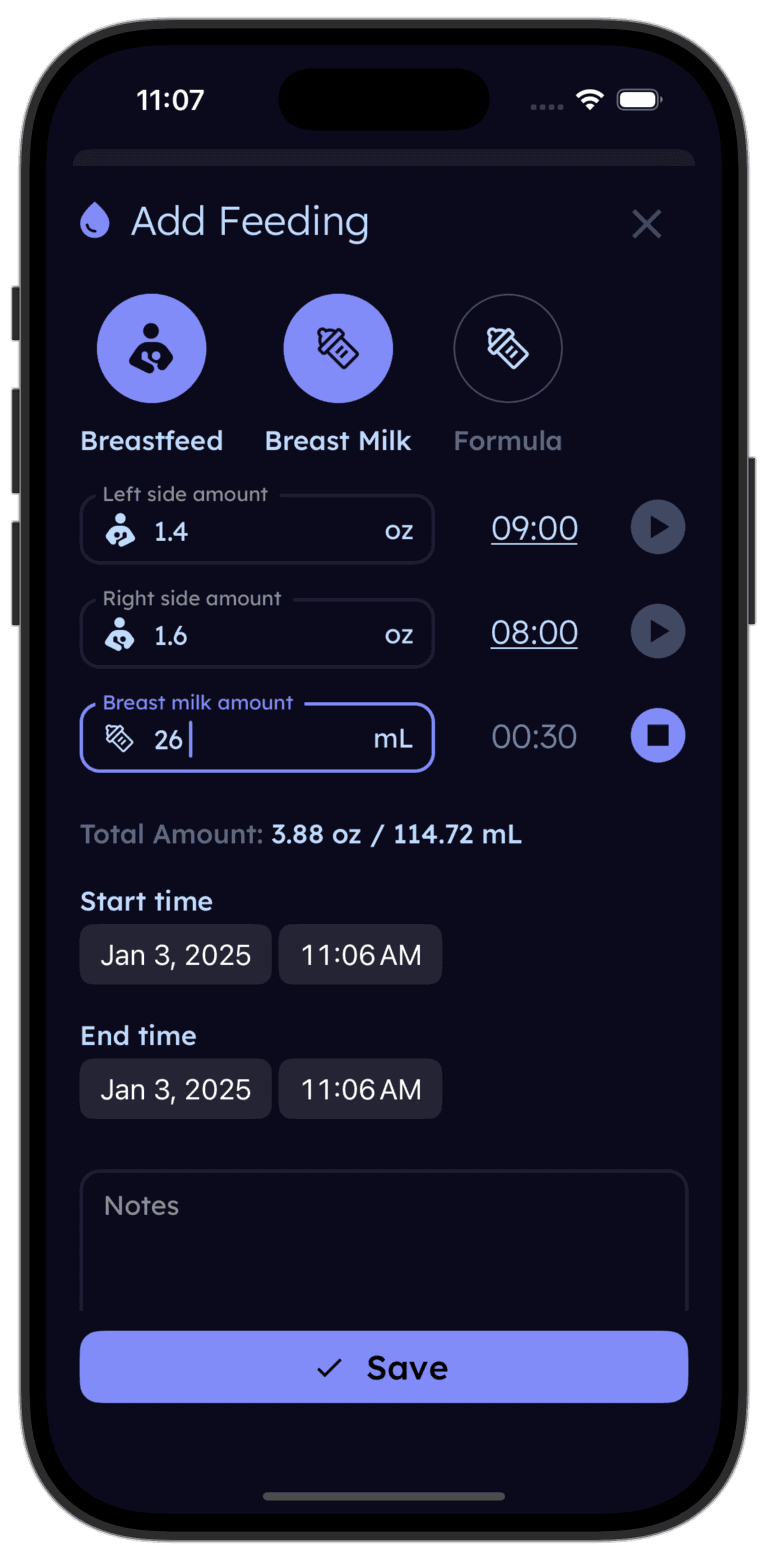
Tinylog tracks feedings so you can spot patterns.
Log bottle feeds and nursing sessions, note spit-up and gas episodes, track intake over days and weeks. Bring the data to your next pediatrician visit.


Cleaning and Daily Use: Simplicity Wins at 3 AM
When you are washing bottles for the fifth time in a day, part count matters more than you think.
Lansinoh keeps it dead simple: bottle, nipple, ring. Three parts. No internal tubes, no vent inserts, no fiddly pieces to lose in the dishwasher. You can hand-wash a Lansinoh bottle in about 30 seconds.
Philips Avent Natural in its standard configuration is almost as simple — bottle, nipple, ring, and the small anti-colic valve disc. If you add the AirFree vent, that is a fourth part. Not a dealbreaker, but it adds up when you are cleaning 6-8 bottles a day.
Both bottles are dishwasher-safe on the top rack. Both have wide necks that are easy to fill with formula or pumped milk. Neither requires a special bottle brush, though a wide-neck brush makes life easier with both.
| Product | Typical Price | Cost Per Bottle | Starter Set Cost |
|---|---|---|---|
| Philips Avent Natural (4 oz, 4-pack) | $24–$30 | ~$6.00–$7.50 | ~$24–$30 |
| Lansinoh Anti-Colic (5 oz, 3-pack) | $12–$16 | ~$4.00–$5.33 | ~$12–$16 |
| Philips Avent Natural (9 oz, 4-pack) | $28–$34 | ~$7.00–$8.50 | ~$28–$34 |
| Lansinoh Anti-Colic (8 oz, 3-pack) | $14–$18 | ~$4.67–$6.00 | ~$14–$18 |
Price: Lansinoh Is the Better Value
Lansinoh bottles are consistently $2-3 cheaper per bottle than Philips Avent Natural. Over a full set of 6-8 bottles, that adds up to $12-24 in savings.
That said, bottles are a relatively small expense compared to formula, diapers, and everything else. A few dollars per bottle is not a reason to choose a bottle that does not work well for your baby.
What actually saves you money with bottles:
- Get the right bottle first. Buying three different brands because your baby rejected the first two costs more than starting with a single well-chosen option.
- Buy replacement nipples, not new bottles. Nipples wear out and need to go up in flow rate. The bottles themselves last until your baby is done with them.
- Watch for registry discounts. Both brands are available on Amazon, Target, and Walmart registries, which offer completion discounts of 10-15%.
- Do not overbuy. Most babies need 4-8 bottles in rotation. Start with a small pack and add more if the bottle works.
Choose Philips Avent Natural If
- You want more nipple flow rate options to match your baby's age and feeding pace
- You prefer having a glass bottle option
- You already use a Philips Avent breast pump
- Your baby has significant colic symptoms and you want the AirFree vent system
- You need larger bottle sizes (up to 11 oz) for older babies
- You like a well-established brand with wide retail availability
Choose Lansinoh Anti-Colic If
- You are breastfeeding and want the easiest breast-to-bottle transition
- Minimizing nipple confusion is your top priority
- You want the fewest possible parts to wash
- You already use a Lansinoh breast pump
- You prefer a lower price point without sacrificing quality
- Your lactation consultant recommended the NaturalWave nipple
Where to Buy
If you want a versatile, widely available bottle with strong anti-colic options, the Philips Avent Natural bottles (~$6-7/bottle in multi-packs) are a reliable choice — breast-shaped nipple, Natural Response technology, and the optional AirFree vent for babies who need extra colic relief. The 4-pack on Amazon or Target is the best starting point.
If you are breastfeeding and want the smoothest breast-to-bottle transition, the Lansinoh Anti-Colic bottles (~$4-5/bottle in multi-packs) are hard to beat — the NaturalWave nipple is clinically tested, there are only three parts to wash, and the price is lower. Many lactation consultants recommend these specifically.
Our honest advice: if you are primarily breastfeeding and introducing a bottle, start with Lansinoh. If you are primarily formula-feeding or want more flexibility, start with Avent. Either way, buy a small pack first.
Tinylog earns a small commission on purchases made through these links, at no cost to you.
We've found promo.new handy for finding discounts on baby gear. Doesn't always have what you need, but it's worth a shot.
The Bottom Line
Both Philips Avent Natural and Lansinoh Anti-Colic are well-designed bottles that parents trust. The differences are real but specific to your situation:
Lansinoh Anti-Colic edges out on breastfeeding compatibility (NaturalWave nipple), simplicity (three parts only), and price (roughly $2-3 less per bottle).
Philips Avent Natural edges out on anti-colic performance (with the AirFree vent), nipple flow options (five rates vs. three), size variety (including 11 oz and glass), and overall versatility.
For breastfeeding families worried about nipple confusion, Lansinoh is the safer bet. For families who want maximum flexibility and the strongest anti-colic system, Avent with the AirFree vent is the better pick.
If you are tracking feeds — which is especially helpful in the early weeks to confirm your baby is eating enough — Tinylog makes it easy to log bottles and nursing sessions and share the data with your pediatrician.
Related Guides
- Dr. Brown's vs. Lansinoh Bottles — Another popular anti-colic bottle matchup
- Dr. Brown's vs. Philips Avent Natural — Comparing two top-selling bottle brands
- Baby Feeding Chart — How much your baby should eat by age
- Combination Feeding — How to mix breastfeeding and formula
Sources
- Lansinoh.com. "Lansinoh Anti-Colic Baby Bottles — Product Information." 2026.
- Philips.com. "Philips Avent Natural Baby Bottles — Product Information." 2026.
- Zimmerman, E. and Thompson, K. "Clarifying nipple confusion." Journal of Perinatology, 2015.
- BabyList. "Best Baby Bottles of 2026." babylist.com, 2026.
- WhatToExpect.com. "Best Baby Bottles for Breastfed Babies." whattoexpect.com, 2026.
- Consumer Reports. "Best Baby Bottles From Our Tests." consumerreports.org, 2026.
- Mommyhood101. "The Best Baby Bottles of 2026, Tested & Reviewed." mommyhood101.com.
This guide is for informational purposes only. Bottle choice is a personal preference based on your baby's individual needs. If your baby has persistent feeding difficulties, excessive gas, or refuses bottles entirely, consult your pediatrician or a lactation consultant.
Frequently asked questions
- Are Philips Avent Natural or Lansinoh bottles better for breastfed babies?
- Lansinoh bottles are specifically designed to support breastfeeding with their NaturalWave nipple, which flexes and stretches like the breast. Many lactation consultants recommend them for babies switching between breast and bottle. Philips Avent Natural bottles also have a wide, breast-shaped nipple that works well, but Lansinoh edges out for minimizing nipple confusion.
- Do Philips Avent Natural bottles have anti-colic features?
- The standard Philips Avent Natural bottle has a basic anti-colic valve in the nipple. For stronger anti-colic performance, Philips offers the AirFree vent accessory, which keeps the nipple full of milk even when the bottle is horizontal, reducing air ingestion. This is sold separately or as part of the Avent Natural Response AirFree line.
- Are Lansinoh Anti-Colic bottles easy to clean?
- Yes. Lansinoh bottles have only three parts — bottle, nipple, and ring — making them one of the easiest bottles to clean. There are no internal venting tubes or extra inserts. Philips Avent Natural also has few parts, though the AirFree vent accessory adds one more piece.
- Which bottle is cheaper, Philips Avent Natural or Lansinoh?
- Lansinoh bottles are generally less expensive, averaging $4-5 per bottle. Philips Avent Natural bottles typically cost $6-8 each. Over a full bottle set, the difference can be $10-20, but both are mid-range options.
- Can I switch between Philips Avent Natural and Lansinoh bottles?
- Yes. There is no reason you cannot use both brands. However, nipples are not interchangeable between them due to different sizes and shapes. Some babies develop a preference for one nipple over the other, so it is worth trying both early before committing to a full set.
- Which bottle is better for reducing gas and colic?
- Both bottles reduce air intake, but through different mechanisms. Lansinoh uses a vented bottom that lets air into the bottle without mixing with milk. Philips Avent Natural uses a nipple valve, with the optional AirFree vent providing the most effective air reduction. For severe colic, the Avent AirFree system may have a slight edge, but it adds an extra part to wash.