GUIDE

Pump Output vs. Milk Supply

Your pump is not your baby. Babies are significantly more efficient at extracting milk than any pump, so pump output consistently underestimates actual supply.

If you've been staring at 2 oz in a pump bottle and spiraling about your supply — stop. Here's what that number actually means, and why it's probably not what you think.

The Pump Output Trap

Here's a scenario that plays out thousands of times a day: a breastfeeding parent pumps for the first time. They get 2 oz combined. They Google "how much should I be pumping." They find a forum post from someone who pumps 6 oz per session. They conclude their supply is inadequate. They start power pumping, taking fenugreek, and stressing — all of which can make the problem they didn't actually have worse.

This is the pump output trap. It starts with the assumption that what the pump gets is what you make. That assumption is wrong. And it's causing immense unnecessary anxiety.

Your pump is a machine. Your baby is a highly evolved biological feeding system. The two are not interchangeable, and comparing their efficiency is like comparing a hand drill to a power tool — they're both drilling, but one is dramatically better at it.

Why Pump Output ≠ Milk Supply

Babies are more efficient than pumps

Your baby uses a combination of suction, compression, tongue peristalsis, and jaw movement that no pump replicates. Research by Kent et al. shows that babies can extract significantly more milk than a pump in equivalent time. Your 2 oz pump session might represent 3-4 oz when baby actually nurses.

Pump fit affects output dramatically

If your pump flanges are the wrong size — too big or too small — output drops significantly. Many parents use the flanges that came with their pump without sizing. The nipple should move freely in the tunnel without rubbing the sides or compressing. Getting properly sized can increase output by 30-50% overnight.

Letdown response varies by person

Some parents have a strong letdown response to a pump. Others barely respond to mechanical stimulation. If you don't let down easily for a pump, you'll get less milk — not because you're not making it, but because the pump can't trigger the release. Looking at baby's photo, smelling their blanket, or using a heat pad can help.

Stress tanks output

Cortisol inhibits oxytocin, the hormone that triggers letdown. If you're staring at the bottles willing them to fill, anxious about output, or pumping in an uncomfortable environment (hello, work closet), stress itself becomes the limiting factor. The milk is there — your body just won't release it under stress.

Timing matters enormously

Pump right after nursing? You'll get very little — baby already took what was available. Pump first thing in the morning after a long sleep stretch? You might get 4-5 oz. Pump in the afternoon when prolactin is lowest? Maybe 1.5 oz. The same person, same pump, same day — wildly different numbers.

Pump quality and settings matter

Not all pumps are equal. Hospital-grade pumps typically extract more than personal-use pumps. Within the same pump, finding the right suction level and cycle speed for YOUR body makes a difference. Higher suction ≠ more milk. The right setting is the highest suction that's comfortable — pain actually decreases output.

Realistic Pump Output Benchmarks
Pumping after nursing (established supply)
Expected Output0.5-2 oz total (both breasts)
ContextBaby already ate most of it. This residual output is normal and doesn't reflect supply.
Pumping instead of a feeding (established supply)
Expected Output2-4 oz total per session
ContextRoughly what baby would have taken. Less in afternoon, more in morning.
First morning pump after long sleep stretch
Expected Output3-6 oz total
ContextYour highest-output session. This is NOT your average — don't expect this all day.
Exclusive pumping — daily total (established)
Expected Output25-35 oz per 24 hours
ContextThis is a full supply for most babies. Some babies need a bit more, some less.
Early weeks (before supply is established)
Expected OutputVery little — drops to 1 oz
ContextSupply is still ramping up. Output increases significantly over the first 4-6 weeks.
The Instagram post you saw
Expected Output8-10 oz per session
ContextThose photos show the outliers — the person who overproduces, who hasn't fed in 6 hours, or who has been building supply intensively. This is not typical. Do not compare yourself to this.
These ranges are from lactation research and IBCLC clinical experience. There's wide individual variation — your normal may be different, and that's fine.

Better Indicators of Milk Supply Than Pump Output

  • Baby's weight gain at pediatrician visits (5-7 oz/week in the first 3 months)
  • Wet diaper count (6+ per day after the first week)
  • Baby's behavior — content after most feeds, alert during wake times
  • A weighted feed performed by an IBCLC (the only way to measure actual transfer)
  • Your daily pump TOTAL if exclusively pumping (not per-session output)
  • Stool output in the first 4-6 weeks (3-4 yellow stools per day)

These output-based indicators tell you what your baby is actually getting. Pump output tells you what a machine could extract at that particular moment. Focus on the former.

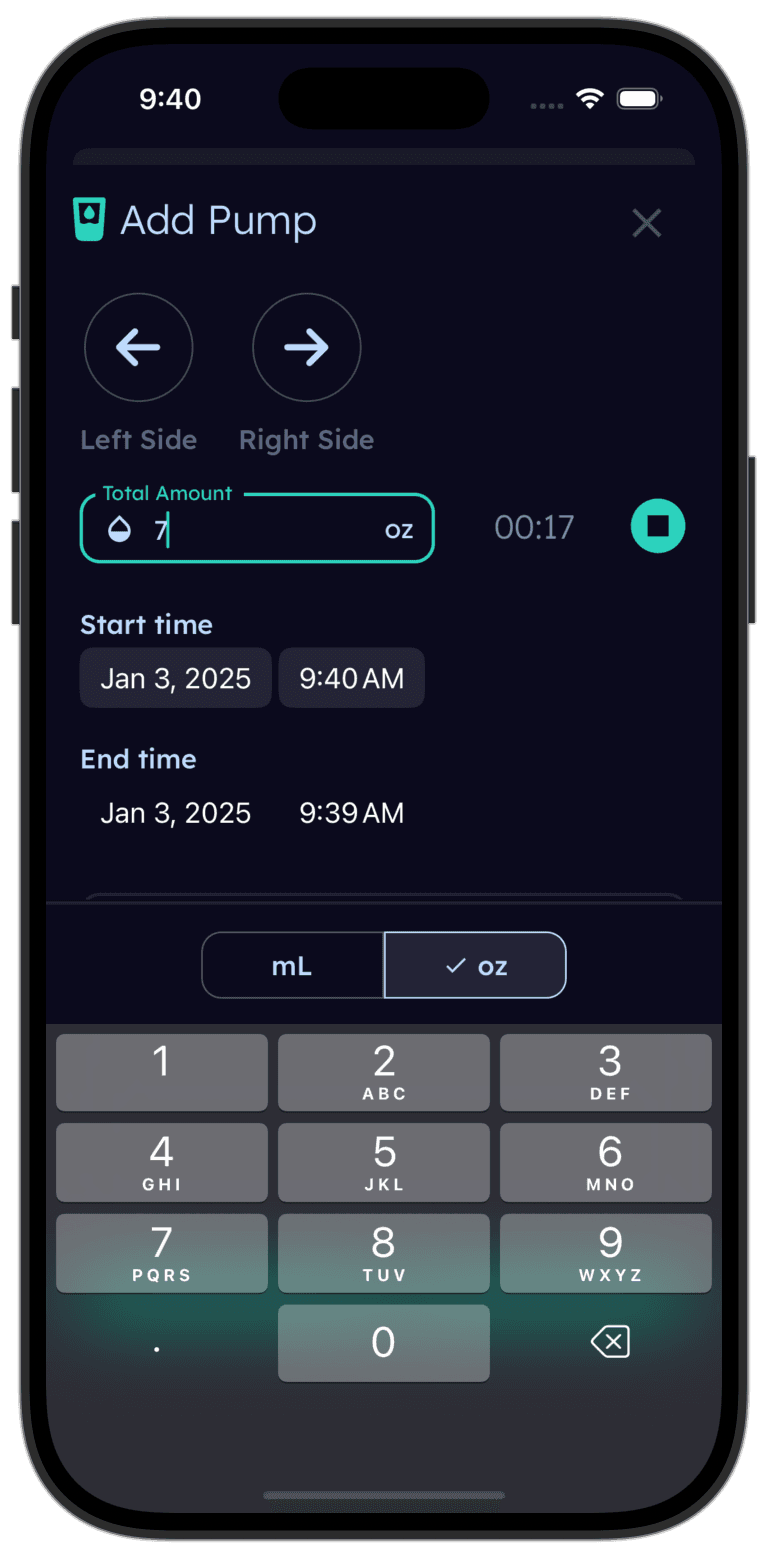
tinylog pump tracker showing session output and daily volume totals

If you pump, track session output AND daily totals — not just one pump. Your morning session might be 4 oz and your afternoon 1.5 oz. That's normal, and the trend matters more than any single number.

tinylog logs pump sessions with output and shows daily totals, so you see the real pattern — not one anxiety-inducing number.

Download on the App StoreGet It On Google Play

How to Actually Improve Pump Output

If you do need to maximize pump output — because you're building a stash for returning to work, exclusively pumping, or trying to increase supply — here are the things that actually make a difference:

Get properly fitted flanges. This is the single most impactful change for most pump users. Your nipple should move freely in the flange tunnel without rubbing. Many people need smaller flanges than what comes in the box. Some need different sizes for each breast. Measure or see an IBCLC for a fitting.

Find your optimal pump settings. Start on stimulation mode until letdown occurs, then switch to expression mode. Increase suction to the highest level that's comfortable — NOT the highest level you can tolerate. Pain decreases output. Some people do better with faster cycles and lower suction; others prefer slower cycles with more suction. Experiment.

Relax (easier said than done). Look at photos of your baby, smell a piece of their clothing, use a warm compress on your breasts before pumping, close your eyes and take deep breaths. Oxytocin release = better letdown = more milk.

Pump consistently. Supply responds to routine. If you pump at the same times daily, your body adjusts to produce more at those times. Erratic pumping sends mixed signals.

For more pumping strategies, see our pumping schedule for working parents and realistic pumping expectations by stage.


What the Evidence Actually Says

"You should be pumping 4-8 oz per session." This expectation is wildly inflated by social media. Kent et al. (2006) found that 24-hour breast milk production in exclusively breastfeeding mothers averaged about 788 ml (26.6 oz), with significant variation (from 478 to 1356 ml). Divided across 8 sessions, that's about 3.3 oz per session on average — and that's what the baby extracts, not the pump.

"If you can't pump enough for daycare bottles, you need to supplement." Maybe, but first check: are your flanges fitted? Have you tried hands-on pumping (massage + pump)? Are you pumping at consistent times? Many parents who "can't pump enough" are dealing with pump inefficiency, not supply insufficiency. Studies show that hands-on pumping technique increases output by an average of 48%.

"Double electric pumps are always better." For most people, yes. But some parents respond better to a manual pump or even hand expression. If a double electric isn't working well for you, it doesn't mean your supply is low — it might mean that pump isn't the right tool for your body.

When to Get Help and What Kind

See an IBCLC if: you're concerned about supply and need a weighted feed (the gold standard for measuring actual transfer), need flange sizing help, or want a comprehensive pump optimization session.

See your pediatrician if: baby isn't gaining weight well. Slow weight gain is the most reliable indicator that intake is truly insufficient — regardless of what the pump says.

Check your pump: If output has suddenly dropped, check that all parts are intact — membranes, valves, tubing, and flanges all wear out and affect performance. Replacing duck valves or membranes can restore output that's declined over time.

Related Guides

Sources

  • Kent, J. C., et al. (2006). Volume and frequency of breastfeedings and fat content of breast milk throughout the day. Pediatrics, 117(3).
  • Morton, J., et al. (2009). Combining hand techniques with electric pumping increases milk production in mothers of preterm infants. Journal of Perinatology, 29(11).
  • Prime, D. K., et al. (2012). Simultaneous breast expression in breastfeeding women is more efficacious than sequential breast expression. Breastfeeding Medicine, 7(6).
  • American Academy of Pediatrics (AAP). (2022). Breastfeeding and the Use of Human Milk. Pediatrics, 150(1).
  • Academy of Breastfeeding Medicine. (2017). ABM Clinical Protocol #3: Supplementary Feedings in the Healthy Term Breastfed Neonate.

Medical Disclaimer

This guide is for informational purposes only and is not a substitute for professional medical advice. If you're experiencing breastfeeding difficulties, consider consulting an IBCLC (International Board Certified Lactation Consultant) or your pediatrician.

Get this pump output guide in your inbox.
We'll send you the realistic output benchmarks so you can stop comparing yourself to Instagram.
Track pump sessions and see real trends — not one-off numbers.
Download tinylog free — log output per session and watch the actual pattern over days and weeks.
Download on the App StoreGet It On Google Play