GUIDE

Strict Routine vs. Flexible Routine

Strict routines provide predictability and help some babies sleep better. Flexible routines follow the baby's cues and adapt to daily life. Most pediatric experts recommend a middle path — consistent patterns with room to adjust based on your baby's signals.

The internet will tell you one approach is clearly right. The evidence says it's more nuanced than that.

Track routines in the app

Log feeds, naps, and patterns

Each baby's sleepy signals might be a little different. Common ones are things like yawning, rubbing their eyes, blinking more often or staring off. Generally, you'll see the activity level decrease when they're starting to get sleepy.
Dr. Kristin BarrettDr. Kristin Barrett, MD, Pediatrician, Cleveland Clinic

The Routine Spectrum

The strict-vs-flexible debate is older than modern parenting books, but it took on new intensity with the rise of schedule-based programs like Babywise and Moms on Call. These programs promise predictability: feeds every 3 hours, naps at set times, baby sleeping through the night by a target date. For exhausted parents desperate for structure, this is appealing.

On the other end, baby-led approaches — endorsed by the AAP's responsive feeding guidelines and the WHO — emphasize following the baby's cues. Feed when hungry. Nap when tired. Trust the baby to communicate their needs. This approach is more aligned with current pediatric research but can feel formless to parents who crave a plan.

The evidence supports neither extreme. A 2017 study in Pediatrics found that responsive feeding (cue-based) in the first 6 months was associated with appropriate weight gain and lower obesity risk, while a 2020 study in Sleep Medicine Reviews found that consistent bedtime routines (a structural element) improved sleep duration and reduced night wakings. For age-specific guidance on what sleep patterns to expect, our baby sleep schedule by age guide covers the full timeline. The takeaway: responsive feeding matters early, consistent sleep routines matter later, and a middle-ground approach serves most families best.

Strict vs. Flexible Routine: Side-by-Side
Schedule basis
Strict RoutineClock-based — feeds and naps at set times
Flexible RoutineCue-based — follows baby's hunger and sleep signals
Predictability for parents
Strict RoutineHigh — you know what happens when
Flexible RoutineModerate — general pattern, specific times vary
Adaptability to baby's needs
Strict RoutineLow — baby must conform to the schedule
Flexible RoutineHigh — schedule adapts to the baby's daily state
Parent stress
Strict RoutineLow when it works; high when baby resists the schedule
Flexible RoutineLow overall; can feel chaotic without a general framework
Works best at age
Strict Routine6+ months when circadian rhythms mature
Flexible Routine0-6 months when baby's needs are variable and frequent
Feeding approach
Strict RoutineFeeds at scheduled intervals (e.g., every 3 hours)
Flexible RoutineFeeds on demand based on hunger cues
Nap timing
Strict RoutineFixed nap times regardless of wake cues
Flexible RoutineBased on wake windows and sleepy signals
Multi-caregiver handoff
Strict RoutineEasy — anyone can follow the written schedule
Flexible RoutineRequires caregiver skill in reading baby's cues
Travel and disruption tolerance
Strict RoutineLow — disruptions throw off the entire day
Flexible RoutineHigh — built-in flexibility absorbs disruptions
Evidence base
Strict RoutinePopularized by books (Babywise, Moms on Call)
Flexible RoutineSupported by AAP and WHO responsive feeding guidelines
Most families land somewhere between these two approaches — a consistent framework with daily flexibility.

Strict Routine Advantages

  • Provides clear structure that reduces decision fatigue for parents
  • Makes planning around the baby's schedule easier for work and appointments
  • Easy for multiple caregivers to follow — the schedule is the guide
  • Some babies thrive on high predictability and clear expectations
  • Bedtime routines at consistent times are associated with better sleep outcomes

Structure becomes more appropriate as babies age. What's too rigid at 6 weeks may work well at 6 months.

Strict Routine Challenges

  • Can cause stress when baby's needs don't align with the clock
  • Risk of underfeeding if baby is hungry before the 'scheduled' feed time
  • Not developmentally appropriate for newborns under 6-8 weeks
  • Ignores individual variation — not all babies fit the same template

The AAP advises against scheduled feeding for newborns — feeding on demand is recommended in the first months.

Flexible Routine Advantages

  • Responds to baby's actual needs rather than an arbitrary schedule
  • Supported by AAP guidelines on responsive feeding in the first year
  • Adapts naturally to growth spurts, illness, and developmental leaps
  • Lower risk of feeding-related stress for both parent and baby
  • Encourages parents to learn their baby's unique cues and patterns

Responsive parenting doesn't mean no structure — it means structure that adapts.

Flexible Routine Challenges

  • Can feel unpredictable, especially for parents who need structure
  • Harder for multiple caregivers to implement without training in cue-reading
  • May delay the development of consistent nap and bedtime patterns
  • Without any framework, days can feel shapeless and exhausting

Adding a loose framework (eat-play-sleep pattern) gives flexible routines enough shape to feel manageable.

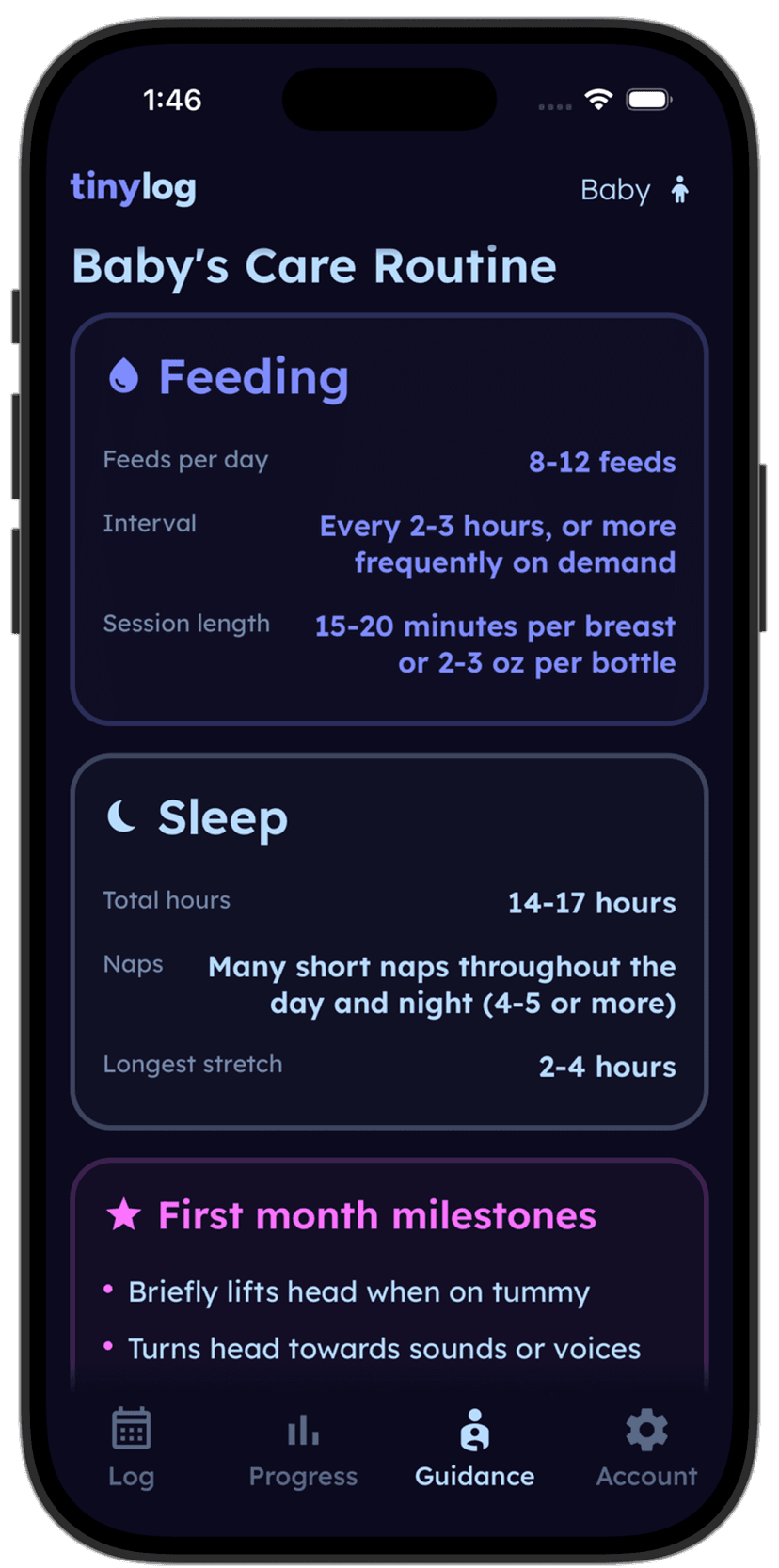
Tinylog care routine screen showing adaptive baby schedule based on real tracking data

AI-powered routines that adapt to your baby.

Tinylog's care routines learn from your baby's actual patterns — not a one-size-fits-all template. Log feeds and naps, and the app suggests optimized timing based on your baby's real data. Structure that adapts.

Download on the App StoreGet It On Google Play

What the Science Actually Says

The research paints a nuanced picture. For feeding in the first 6 months, the evidence clearly favors responsive (cue-based) approaches. The AAP, WHO, and UNICEF all recommend feeding on demand rather than by the clock during this period. Scheduled feeding can lead to underfeeding, excessive weight gain, or inadequate milk supply for breastfeeding mothers.

For sleep, the evidence shifts. A 2009 study published in Sleep found that consistent bedtime routines — doing the same sequence of activities at roughly the same time each evening — reduced time to fall asleep, reduced night wakings, and improved maternal mood. Importantly, it was the consistency of the routine, not the rigidity of the clock time, that mattered.

The practical conclusion: feed responsively (follow cues), build consistent sleep routines (same sequence, roughly similar timing), and let the rest of the day fall into a natural pattern that you refine over time as your baby matures. A baby feeding chart can help you understand how much and how often to feed at each stage without becoming clock-rigid. This isn't a cop-out answer — it's what the evidence actually supports.


How to Decide

Lean toward more structure if you function better with a clear plan, your baby is older than 4-5 months and responding well to predictable timing, or you have multiple caregivers who need a clear guide to follow.

Lean toward more flexibility if your baby is under 4 months, you're breastfeeding on demand, your daily schedule is unpredictable, or your baby consistently resists clock-based timing.

Start flexible and add structure gradually. Most pediatric sleep consultants recommend a cue-based approach in the newborn period that gradually transitions to more predictable timing as the baby's circadian rhythm matures around 3-4 months. You're not choosing a permanent philosophy — you're matching the approach to your baby's current developmental stage. Tracking your baby's activities for a week or two can reveal natural patterns that make building a routine much easier.

Tips That Apply Either Way

Track patterns before you set a schedule

Before deciding on strict or flexible, spend 1-2 weeks logging feeds, naps, and wake times without trying to impose a schedule. You'll see your baby's natural patterns emerge — and you can build a routine around reality rather than a book's generic template.

Use wake windows as your flexible framework

Instead of fixed clock times, use age-appropriate wake windows as your guide. A 3-month-old can handle 75-120 minutes awake. When that window is closing, start the nap routine regardless of what the clock says. This gives you structure without rigidity.

Separate 'routine' from 'schedule'

A routine is a sequence: wake, feed, play, nap. A schedule puts that sequence on a clock. Most babies do well with consistent routines (the sequence stays the same) even if the timing shifts day to day. Focus on the order of events, not the exact time.

Related Guides

Sources

  • Mindell, J. A., et al. (2009). A Nightly Bedtime Routine: Impact on Sleep in Young Children and Maternal Mood. Sleep, 32(5), 599-606.
  • Hodges, E. A., et al. (2013). Development of the Responsiveness to Child Feeding Cues Scale. Appetite, 65, 210-219.
  • Paul, I. M., et al. (2017). Effect of a Responsive Parenting Educational Intervention on Childhood Weight Outcomes. JAMA Pediatrics, 171(8).
  • American Academy of Pediatrics. (2012). Breastfeeding and the Use of Human Milk. Pediatrics, 129(3), e827-e841.

This guide is for informational purposes only and is not a substitute for professional medical advice. Consult your pediatrician for guidance specific to your baby.

Get this comparison in your inbox.
We'll send you this guide so you can find a routine approach that works for your family.
Whether strict or flexible, knowing your baby's patterns helps.
Download Tinylog — AI-powered routines adapt to your baby's actual schedule, not a generic template.
Download on the App StoreGet It On Google Play