GUIDE

Structured Play vs. Free Play for Babies

Babies need both. Free play builds creativity, problem-solving, and self-regulation. Structured play teaches specific skills and strengthens parent-child interaction. The balance shifts as your baby grows.

The best play strategy is simpler than Instagram makes it look: follow your baby's lead, and sometimes lead them.

Track your baby's play and milestones

Log activities and developmental progress

We're recommending that doctors write a prescription for play, because it's so important.
Dr. Michael YogmanDr. Michael Yogman, MD, FAAP, Pediatrician, American Academy of Pediatrics

The Pressure to Over-Schedule

Scroll through parenting Instagram and you'll see elaborate sensory bins, themed play stations, and color-coded activity schedules for 4-month-olds. It can make you feel like you need a curriculum to raise a baby. You don't.

The research on infant play is clear: the most important element isn't the activity — it's the responsiveness of the caregiver. A baby playing with a wooden spoon on the kitchen floor while you narrate what they're doing gets more developmental benefit than an elaborate structured activity done by a disengaged parent. Weisberg et al. (2016) found that "guided play" — where an adult follows the child's interest within a loosely structured activity — outperforms both direct instruction and unstructured free play for learning specific concepts.

What this means in practice: your baby needs some adult-led engagement (tummy time, reading, singing, peek-a-boo) and some time to explore on their own (batting at toys, mouthing objects, crawling around a baby-proofed room). The toys you choose also matter — simple, open-ended toys tend to promote longer, deeper play sessions. The ratio doesn't need to be precise. If your baby is engaged, learning, and connecting with you throughout the day, you're doing it right.

Structured Play vs. Free Play
Definition
Structured PlayAdult-guided activities with a specific purpose or skill focus
Free PlayBaby-led exploration without a set goal or adult direction
What it builds
Structured PlayTargeted skills — cause and effect, imitation, specific motor skills
Free PlayCreativity, problem-solving, self-regulation, sustained attention
Adult role
Structured PlayActive participant — demonstrating, guiding, scaffolding
Free PlaySupervisor — available but not directing. Observe and respond.
Examples (0-6 months)
Structured PlayTummy time exercises, high-contrast card viewing, singing action songs
Free PlayExploring a rattle, staring at shadows, kicking on a play mat
Examples (6-12 months)
Structured PlayStacking blocks together, reading and pointing at pictures, peek-a-boo
Free PlayMouthing toys, crawling to explore a room, banging objects together
Risk if overdone
Structured PlayOverstimulation, reduced intrinsic motivation, schedule rigidity
Free PlayMinimal risk, though some babies need more engagement to develop specific skills
Research support
Structured PlayGuided play enhances learning when adult follows child's interest (Weisberg et al., 2016)
Free PlayFree play is critical for executive function development (Lillard et al., 2013)
The most effective approach combines both — some guided interaction and plenty of baby-led exploration throughout the day.

Structured Play Advantages

  • Introduces specific skills and concepts at developmentally appropriate times
  • Strengthens parent-child interaction through shared activities
  • Provides a framework when parents aren't sure what to do with their baby
  • Guided play (adult follows child's lead within a structured activity) is highly effective for learning
  • Can target developmental areas that need practice, like tummy time or reaching

'Guided play' — where the adult structures the environment but follows the child's lead — gets the best of both worlds.

Structured Play Challenges

  • Can become overly scheduled, leaving no room for baby-led exploration
  • Risk of projecting adult goals onto play rather than following baby's interest
  • Over-structuring can reduce intrinsic motivation and curiosity
  • Social media creates pressure to do elaborate, Pinterest-worthy activities

If an activity isn't working, abandon it. Your baby's interest and engagement matter more than completing what you planned.

Free Play Advantages

  • Develops self-regulation — baby learns to manage attention and frustration independently
  • Builds creativity and problem-solving through trial and error
  • Strengthens sustained attention (the precursor to focus and concentration)
  • Allows baby to follow their own interests and developmental readiness
  • Requires no special toys, materials, or planning — a wooden spoon is a great toy

Free play is not wasted time — it's when some of the most important developmental work happens, particularly for executive function.

Free Play Challenges

  • Some parents feel guilty 'not doing enough' when baby is playing independently
  • Without some structured interaction, opportunities for skill scaffolding may be missed
  • Babies with developmental delays may need more guided practice in specific areas
  • Can be hard to differentiate between content independent play and boredom

Independent play is a skill that develops over time. Start with short periods and build up as your baby's attention span grows.

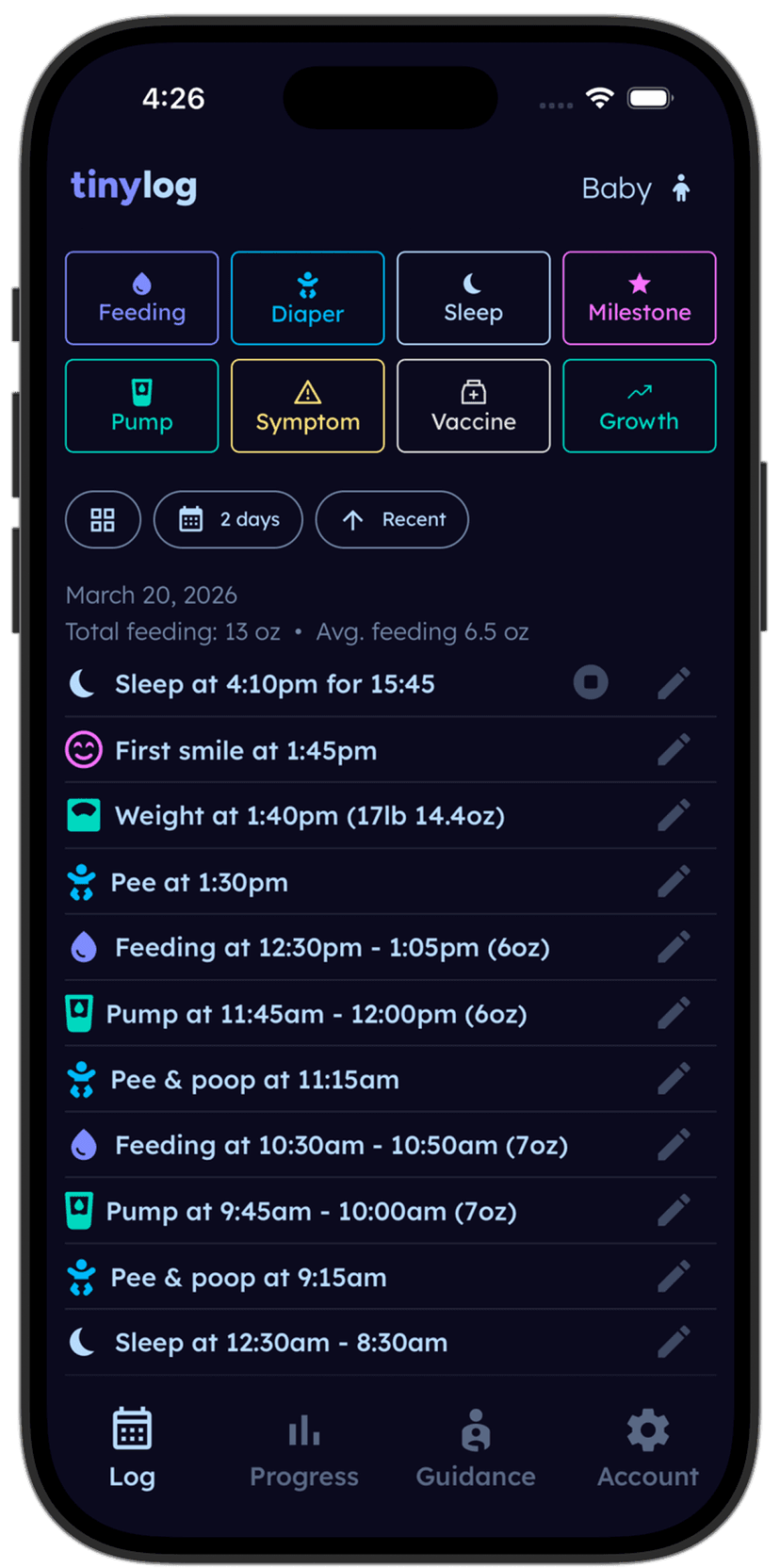
Tinylog activity tracking showing baby's daily play activities

See how play and activities shape your baby's day.

Log play sessions, tummy time, reading, and outdoor time in Tinylog. When you see the full picture of your baby's day, you'll realize you're doing more than you think.

Download on the App StoreGet It On Google Play

Age-Based Play Balance

In the first 3 months, most "play" is actually structured interaction — tummy time, high-contrast visual stimulation, and face-to-face engagement. Babies this age have limited ability to direct their own play, so adult involvement is naturally higher. By the time your baby reaches 3 months, they begin batting at objects and tracking toys with more purpose. But even a newborn staring at their hand is engaging in free play.

From 3-6 months, babies start reaching for and manipulating toys. This is when free play becomes more visible and rewarding. Give them safe objects to explore on a play mat while you watch. Mix in structured activities like reading board books, singing songs, and playing peek-a-boo.

From 6-12 months, free play really takes off. Crawling, sitting, and eventually pulling to stand give babies the mobility to explore their environment. Your role shifts more toward safety supervision and responsive engagement. Structured play at this age often looks like guided exploration — building a small block tower for them to knock down, hiding a toy under a cloth for them to find, reading together.


The Simple Version

Talk to your baby. Get on the floor with them. Read books and narrate your day. Sing songs. But also let them explore on their own, stare at things that fascinate them, and struggle a little with a toy before you help. That mix — some guided, some independent, all responsive — is what healthy play looks like. No Pinterest boards required.

Tips That Apply Either Way

Follow the serve-and-return pattern

The most effective play interaction is 'serve and return' — your baby does something (picks up a block, looks at you, babbles), and you respond (describe it, imitate, react). This back-and-forth is the foundation of healthy brain development, per the Harvard Center on the Developing Child.

Less is more with toys

Research shows that fewer toys leads to longer, more creative play sessions. Too many options overwhelm babies and lead to rapid switching rather than sustained exploration. Rotate 3-4 toys at a time rather than having everything out at once.

Boredom is okay

When your baby fusses after playing with a toy for a while, the instinct is to hand them something new. But a little frustration is how they learn persistence. Give them a moment to figure it out before intervening. You're not neglecting them — you're building resilience.

Related Guides

Sources

  • Weisberg, D. S., Hirsh-Pasek, K., & Golinkoff, R. M. "Guided Play: Where Curricular Goals Meet a Playful Pedagogy." Mind, Brain, and Education, 2013.
  • Lillard, A. S., et al. "The Impact of Pretend Play on Children's Development: A Review of the Evidence." Psychological Bulletin, 2013.
  • Harvard Center on the Developing Child. "Serve and Return." www.developingchild.harvard.edu, 2023.
  • Yogman, M., et al. "The Power of Play: A Pediatric Role in Enhancing Development in Young Children." Pediatrics, 2018.

This guide is for informational purposes only and is not a substitute for professional medical advice. Consult your pediatrician for guidance specific to your baby.

Get this comparison in your inbox.
We'll send you this guide so you can plan a balanced play routine for your baby.
See which activities fill your baby's day.
Log play sessions in Tinylog and make sure your baby is getting a healthy mix of structured and unstructured time.
Download on the App StoreGet It On Google Play