
Supply concerns
Your milk supply doesn't fully cover what your baby needs. This is more common than anyone admits — about 10-15% of parents experience persistent low supply despite doing everything 'right.' Formula fills the gap reliably.
GUIDE
Published on ·Updated on
About 35% of US parents combo feed by 6 months. You're not failing — you're feeding your baby.
Adding formula to breastfeeding is one of the most common feeding decisions parents make. Here's how to do it practically, protect your supply if you want to, and skip the guilt entirely.
Free 2-min quiz. Matched to your baby plus a recall check.
“All infant formulas must meet requirements that ensure optimal nutrition for babies. If your baby's formula is sold in the U.S., it has the nutrients your baby needs.”
 Dr. Matthew Badgett, MD, Pediatrician, Cleveland Clinic
If you are reading this, you are probably adding formula to an existing breastfeeding relationship. Maybe your supply is not quite enough. Maybe you are going back to work. Maybe you just want someone else to be able to feed the baby at 3 AM. Whatever the reason, you do not owe anyone an explanation.
About 35% of US parents are combination feeding by 6 months, according to CDC data. This is not an uncommon or fringe approach — it is one of the most normal feeding patterns in the country. But you would not know that from the way supplementing is talked about, which is usually in hushed, apologetic tones, as though adding formula is a concession.
It is not. It is a feeding decision. This guide covers how to do it practically — which formula to pick, how to protect your supply if you want to, how to manage bottles for a breastfed baby, and how to stop feeling guilty about any of it.
Your milk supply doesn't fully cover what your baby needs. This is more common than anyone admits — about 10-15% of parents experience persistent low supply despite doing everything 'right.' Formula fills the gap reliably.
Pumping at the office is logistically demanding, and not every workplace makes it easy. Some parents supplement with formula during work hours and nurse at home. This is a practical solution, not a compromise.
Your pediatrician recommended supplementation for weight gain, jaundice management, or blood sugar stability. Medical supplementation is sometimes necessary in the first days of life and can continue as long as needed.
You want your partner, a grandparent, or a caregiver to be able to feed the baby. A formula bottle means someone else can take a feeding shift — including the 2 AM one.
The pressure of being the sole food source is affecting your wellbeing. Your mental health matters. A parent who is functioning and present is better for your baby than a parent who is depleted and struggling.
You just want to. That is a complete reason that requires no further justification. Fed is fed.
For a broader look at how to manage breast and bottle together — including sample schedules and logistics — see our combination feeding guide.
Here is the short answer: any standard infant formula.
There is no special formula required for babies who are also breastfed. All standard infant formulas sold in the US meet the same FDA nutritional requirements. Your baby will get adequate nutrition from Similac, Enfamil, Kirkland, store brands, or any other standard formula.
Some brands market a "supplementing formula" specifically. These products are standard infant formulas in different packaging at the same or higher price. The FDA does not have a distinct "supplementing formula" category. It is marketing, not medicine.
If your baby has a diagnosed allergy or intolerance, your pediatrician will guide you to the right specialty formula. But for the vast majority of supplementing situations, standard formula is the answer. Once you've picked one, sign up for free recall alerts so you'll know immediately if your brand is ever recalled.
For a detailed look at what is actually in the formula you are buying, see our guide to reading formula labels.
If you want to maintain your breast milk supply while adding formula, you can. The key principle is simple: your body makes milk based on demand. If you remove demand (by skipping a nursing session without pumping), supply decreases. If you maintain demand (by nursing or pumping at roughly the same frequency), supply holds steady.
If someone else gives a formula bottle at 3 PM, pump at 3 PM (or as close to it as you can). Your body needs the signal that milk is still needed at that time. Skip this consistently and your supply will adjust downward at that hour.
If you're transitioning from exclusive breastfeeding, replace one nursing session at a time and wait 3-5 days before replacing the next. This gives your body time to adjust without engorgement or a sudden supply drop.
Prolactin — the hormone that drives milk production — peaks in the early morning hours. Nursing at wake-up and during overnight feeds does the most to maintain your overall supply, even if daytime feeds are formula.
Offer the breast before offering a bottle. Baby gets breast milk first, then formula tops them off. This keeps breast stimulation up while making sure baby is fully satisfied. Some lactation consultants call this the 'top-off' method.
When you first skip a nursing session, you may get uncomfortably full. Hand express or pump just enough to relieve pressure — do not fully empty, or your body thinks it needs to maintain that production level. The goal is comfort, not maximum output.
Research suggests that nursing at least 3-4 times per day (roughly every 6-8 hours) is generally the minimum to maintain a partial supply. Below that, most parents see a significant decline. But even 1-2 nursing sessions per day can continue to provide immunological benefits.
Important context: it is also completely okay if your supply decreases. If you are supplementing because you want to gradually reduce nursing, a slow decrease in supply is the expected and desired outcome. Supply protection is only relevant if you want to maintain your current level of milk production.
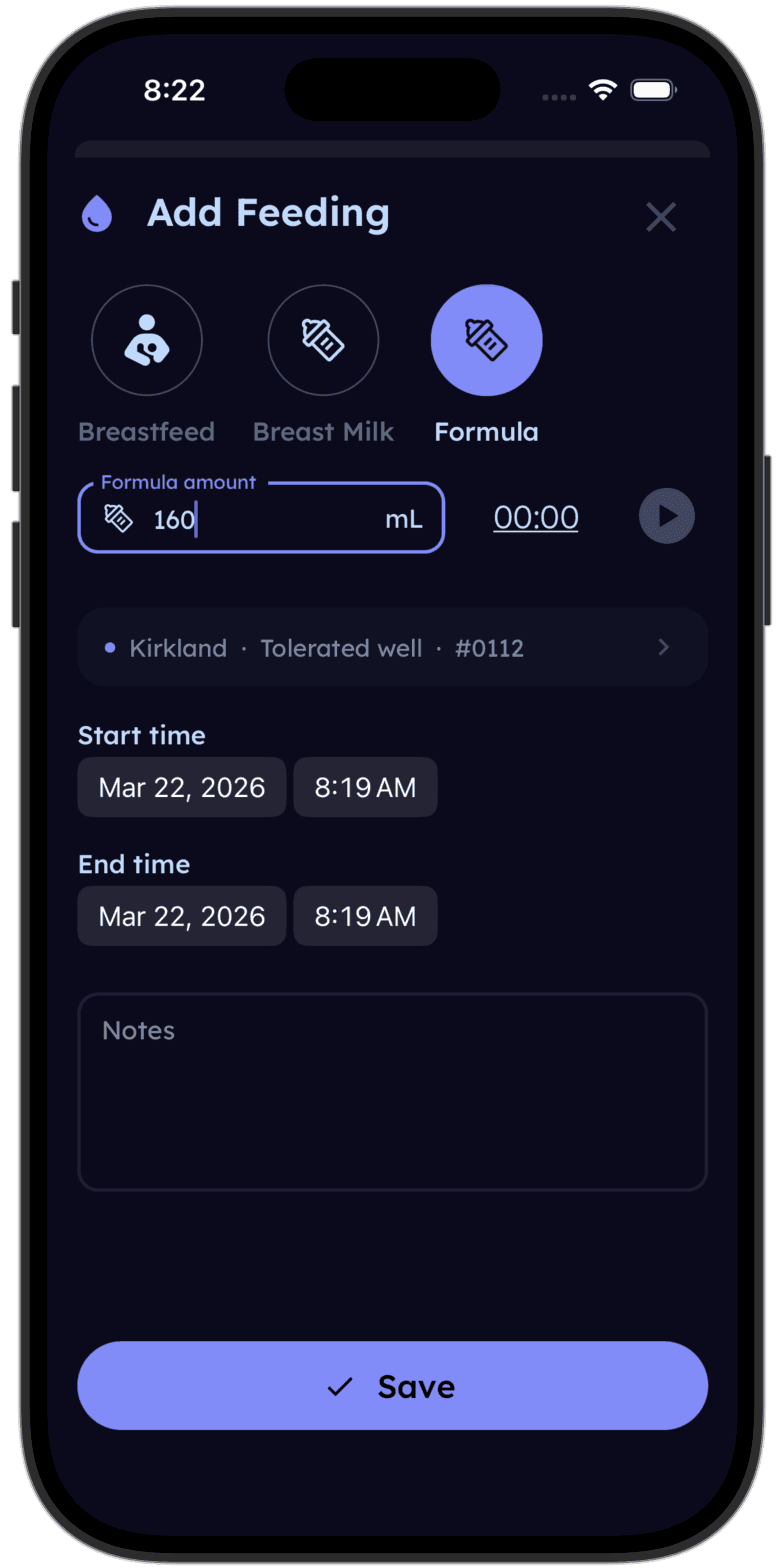
Log nursing sessions and formula bottles in seconds and see the daily total across both. When you're supplementing, it's easy to lose track of whether the combination is actually enough. Seeing it adds up in real time removes the guesswork — and tells you if you need to adjust the ratio.


A bottle warmer is not strictly necessary — warm water in a bowl works fine. But at 2 AM, the Philips Avent warmer (~$35) means you press a button and it is done in three minutes with no hot spots. It uses a water bath, not steam, so it is safe for breast milk nutrients.
Tinylog earns a small commission on purchases made through these links, at no cost to you.
We've found promo.new handy for finding discounts on baby gear. Doesn't always have what you need, but it's worth a shot.
Some brands market formulas specifically for 'supplementing breastfed babies.' These are not a distinct category — they are standard infant formulas with supplementing-specific packaging. Any standard infant formula works. Do not pay a premium for a marketing label.
No formula replicates breast milk. That is not the goal. The goal is adequate nutrition from a safe, FDA-regulated product. All standard infant formulas meet the same nutritional requirements and will adequately nourish your baby alongside breast milk.
About 35% of US parents are combo feeding by the time baby is 6 months old, according to CDC National Immunization Survey data. This is not a failure rate — it is a normal, common feeding pattern that works well for millions of families.
Some babies develop a flow preference (not nipple confusion — the science on that is weak). Using a slow-flow nipple and paced feeding technique significantly reduces this risk. Most breastfed babies who are introduced to bottles continue to nurse without issues.
The formula industry benefits from parental anxiety about supplementing — the more worried you are about "doing it right," the more likely you are to buy a premium product. The breastfeeding industry also benefits from keeping supplementing stigmatized — it sells more lactation consultations and breast pumps. Neither industry is motivated to tell you the simple truth: combo feeding works, it is common, and it does not need to be complicated.
The bottle you choose matters more than the formula brand. A breastfed baby's relationship with a bottle depends largely on the nipple flow rate and the feeding technique you use.
Breastfed babies are used to working for their milk. A fast-flow bottle nipple delivers milk with much less effort, which can make some babies frustrated when they go back to the breast. Level 0 or level 1 nipples most closely mimic the flow rate of breastfeeding.
Hold the bottle more horizontally (not tipped straight down). Let baby draw milk in at their own pace, and pause every ounce or so by tipping the bottle down. This prevents baby from guzzling the entire bottle in 3 minutes and teaches them to pace themselves like they do at the breast.
Watch for fullness cues — turning away, slowing down, releasing the nipple. Do not encourage baby to finish the bottle if they are showing signs of being done. At the breast, babies stop when they are full. The bottle should work the same way.
Some breastfed babies are particular about nipple shape. If baby is refusing the bottle entirely, try a different brand or shape before assuming they will not take a bottle at all. Sometimes a wider base or a different material makes the difference.
You can mix breast milk and formula in the same bottle, but there are practical reasons most lactation consultants recommend against it:
If baby does not finish the bottle, you have to discard the entire thing — including the breast milk. Breast milk is liquid gold (or at least liquid effort), and pouring it down the drain hurts. The better approach is to feed breast milk first, and then offer a separate bottle of formula if baby is still hungry.
If you do choose to mix them together — say, for convenience on the go — always prepare the formula with water first, according to package instructions, and then add breast milk to it. Never use breast milk as the liquid to mix formula powder, as this changes the concentration and can be unsafe.
If these describe your situation, you are doing great. The specific ratio of breast milk to formula matters far less than whether your baby is thriving and you are coping.
There is no single ideal time. The common advice is to wait until breastfeeding is "established" — usually around 3-6 weeks — before introducing bottles. This gives your supply time to calibrate and lets baby get comfortable at the breast.
But sometimes supplementation needs to happen earlier. If your baby has jaundice, low blood sugar, or is not gaining weight in the first days of life, your pediatrician may recommend formula immediately. This is not a failure of breastfeeding — it is appropriate medical care. Early supplementation does not prevent you from establishing breastfeeding later.
If you are starting supplementation later — returning to work at 12 weeks, for example — begin offering occasional bottles 2-3 weeks before you need baby to take them reliably. Some babies accept bottles immediately; others need a warm-up period.
Your pediatrician and a lactation consultant (IBCLC) can both help you find the right supplementing approach for your specific situation. You do not have to figure this out alone.
Supplementing breast milk with formula is a normal, well-established feeding approach used by millions of families. It does not mean breastfeeding has failed. It does not require a special formula. It does not inevitably ruin your milk supply. And it does not need to come with guilt.
Choose any standard formula. Use slow-flow nipples and paced feeding. Pump or nurse at the times you want to protect if keeping your supply matters to you. And track what your baby is actually getting — logging both nursing sessions and formula bottles in Tinylog takes seconds, and seeing the combined daily total is genuinely reassuring when you're not sure if the combo is enough. If you are looking for a place to start, Similac 360 Total Care Baby Formula and Enfamil NeuroPro Baby Formula are two of the most widely available standard formulas and both work equally well for supplementing. Most importantly: you are feeding your baby, you are doing it thoughtfully, and that is exactly what matters.
How Much Formula by Age — A guide by age and weight
Switching Formulas — How to do it safely
This guide is for informational purposes only and is not a substitute for professional medical advice. If you have concerns about your baby's feeding, your milk supply, or your own health, please consult your pediatrician or a board-certified lactation consultant (IBCLC).