
GUIDE
Willow Go vs. Spectra 9 Plus
Published on
The Willow Go is fully wearable and hands-free, fitting inside your bra with no external tubes. The Spectra 9 Plus is a compact traditional pump with hospital-grade suction at a lower price. If mobility is your top priority, go Willow Go. If suction strength and value matter more, go Spectra 9 Plus.
Portable breast pumps have come a long way. The Willow Go and Spectra 9 Plus represent two very different approaches to the same problem — getting milk out of your body when you are not sitting next to a wall outlet. One is a true wearable that disappears into your bra. The other is a lightweight traditional pump that fits in a diaper bag. Both work. The right one depends on your pumping life.
Log sessions, output, and pump settings
Two Very Different Takes on Portable Pumping
The Willow Go and Spectra 9 Plus both call themselves portable breast pumps, but they solve the portability problem in completely different ways.
The Willow Go is a true wearable. Each cup contains its own motor, battery, and milk collection container. You drop them into your nursing bra, press a button, and walk away. No tubes. No dangling bottles. No being tethered to anything.
The Spectra 9 Plus is a traditional double electric pump that happens to be small and battery-powered. It still uses tubing, flanges, and bottles — but the motor unit is about the size of a deck of cards and clips to your waistband.
Both get milk out of your body. But your daily routine, budget, and pumping environment will push you toward one over the other. Here is what actually matters.
We went through the specs, user reviews, and real-world testing data so you can skip the marketing fluff and figure out which one actually fits your life.
For more on how much milk to expect at different stages, check out our baby feeding chart.
| Feature | Willow Go | Spectra 9 Plus | What It Means |
|---|---|---|---|
| Manufacturer | Willow (Onward Medical) | Spectra Baby USA | Both are established breast pump brands with loyal followings. |
| Pump type | True wearable — fits inside bra, no external tubes | Portable traditional — compact unit with tubing and bottles | The Willow Go is hands-free in-bra. The Spectra 9 Plus is portable but still uses a traditional setup. |
| Weight | ~8 oz per cup (worn on body) | ~0.7 lb for the motor unit (plus bottles) | The Willow Go distributes weight on your chest. The Spectra 9 Plus weight is in the motor and bottles. |
| Maximum suction | ~250 mmHg | ~320 mmHg | Spectra has stronger peak suction, which matters if you need more stimulation to trigger letdown. |
| Suction modes | Stimulation + expression (auto-adjusting) | Massage + expression with adjustable cycle and vacuum | Spectra gives you more manual control. Willow handles mode switching automatically. |
| Noise level | ~45–50 dB (quiet conversation) | ~50–55 dB (moderate background noise) | Willow Go is quieter. Both are reasonable, but the Willow is more discreet for meetings or calls. |
| Battery life | ~2.5 hours (roughly 5 sessions) | ~2.5–3 hours continuous | Similar battery life. Both will get you through a workday of pumping sessions on a single charge. |
| Milk collection | Self-contained 5 oz containers (or bags with adapter) | Standard wide-neck bottles | Spectra uses bottles you already own. Willow uses proprietary containers or optional bag adapters. |
| Flange sizes | 21mm and 24mm included; 17mm and 19mm inserts sold separately | 24mm and 28mm included; other sizes available from Spectra or third-party | Both offer multiple sizes. Willow skews smaller. If you need a large flange, Spectra is the safer bet. |
| App connectivity | Yes — Willow app tracks sessions, volume, and pump settings | No app | Willow Go connects to an app for session tracking. The Spectra has no smart features. |
| Closed system | Yes | Yes (backflow protector) | Tie. Both prevent milk from entering the motor, keeping things hygienic. |
The Real Difference: Wearable vs. Portable
This is the thing that matters most, and everything else flows from it.
The Willow Go sits inside your bra. You can walk around, pick up your toddler, fold laundry, take a work call, or drive (yes, people pump while driving). There are no tubes connecting you to anything. The tradeoff is lower maximum suction and proprietary milk containers that add ongoing cost.
The Spectra 9 Plus gives you hospital-grade suction strength in a package you can toss in a bag. You still need to sit relatively still while pumping because you are connected to tubing and holding bottles. But that suction strength means faster emptying for many people, and the standard bottle system means zero proprietary accessories.
If your mental image of "pumping" involves walking around freely while milk collects in your bra — that is the Willow Go. If your mental image involves sitting at your desk with a pumping bra and a hands-free setup but strong, reliable suction — that is the Spectra 9 Plus.
Suction and Output: More Is Not Always Better
The Spectra 9 Plus objectively has stronger suction — around 320 mmHg compared to the Willow Go's 250 mmHg. On paper, that is a meaningful gap.
In practice, most people do not pump anywhere near maximum suction. Comfortable suction levels typically fall between 150–220 mmHg for most nursing parents. At those levels, both pumps perform well.
Where the Spectra's extra power helps is if you have difficulty triggering letdown with lower suction, or if you are an exclusive pumper who needs to empty quickly and completely during limited pump breaks. Faster, more complete emptying supports supply maintenance.
The Willow Go's automatic mode switching is convenient — it detects when you transition from stimulation to expression and adjusts on its own. The Spectra gives you full manual control, which some people prefer because they can fine-tune the cycle speed and vacuum independently.
Neither pump is "better" at getting milk out. They are different tools for different situations.
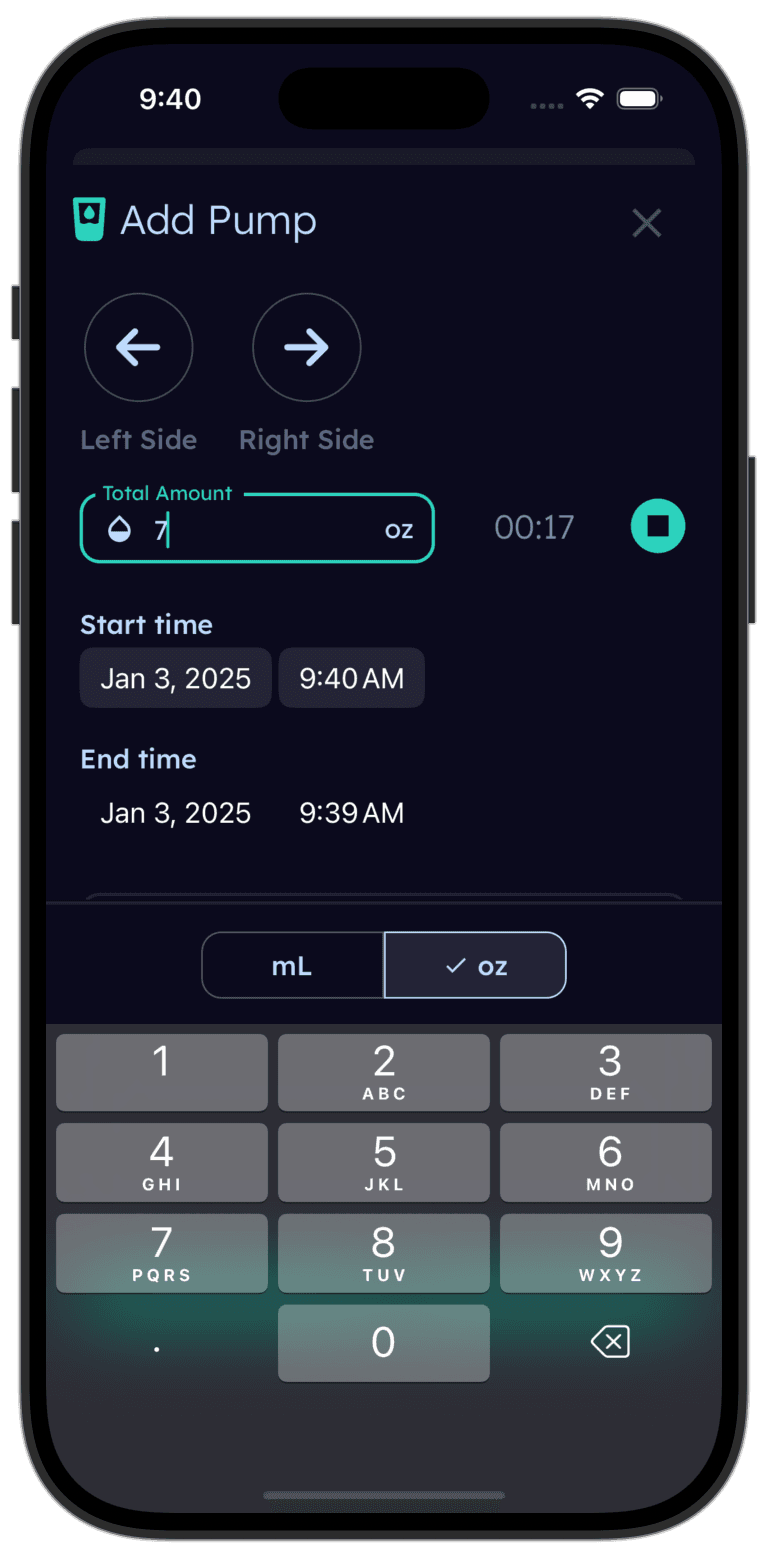
Tinylog tracks pumping sessions so you can spot trends.
Log pump times, output volume, and which settings worked best. See your supply patterns over days and weeks. Bring the data to your lactation consultant.


Noise and Discretion
If you plan to pump during meetings, on calls, or in shared spaces, noise matters.
The Willow Go runs at roughly 45–50 dB. That is about as loud as a quiet conversation or a refrigerator humming. On a video call with a decent microphone, most people will not hear it — especially if you are on mute when not speaking.
The Spectra 9 Plus runs at roughly 50–55 dB. That is noticeably louder — more like moderate background noise. You could pump during a call, but the rhythmic sound might be audible to others.
Five decibels does not sound like much, but decibels are logarithmic. The Spectra is roughly twice as loud as the Willow Go in perceived volume. If stealth pumping is part of your plan, the Willow Go has a clear advantage.
| Product | Typical Price | Ongoing Supply Cost | Monthly Estimate |
|---|---|---|---|
| Willow Go (double electric) | $250–$300 | Proprietary containers: ~$0.50–$1.00 each | Containers + replacement parts: ~$25–$50/mo |
| Spectra 9 Plus (double electric) | $70–$100 | Standard bottles: already owned or ~$8–$15/pack | Replacement valves and membranes: ~$5–$10/mo |
Cost: The Gap Is Bigger Than the Sticker Price
The upfront price difference is significant — the Willow Go runs $250–$300, while the Spectra 9 Plus is $70–$100. But the real cost gap is in ongoing supplies.
The Willow Go uses proprietary milk containers. You can reuse them, but many people buy extras for convenience or use the disposable bag adapter. Replacement flanges and valves are also Willow-specific. Monthly supply costs run roughly $25–$50 depending on your usage.
The Spectra 9 Plus uses standard wide-neck bottles that work with most other pump brands. Replacement valves and membranes are cheap and available everywhere. Monthly supply costs are more like $5–$10.
Over a year of pumping, the total cost difference can be $400–$600. That is real money — especially when you are already spending on diapers, formula, and all the other stuff that piles up in the first year.
If budget is tight, the Spectra 9 Plus delivers strong performance at a fraction of the cost. If the hands-free convenience of the Willow Go would meaningfully change your daily life — letting you pump while working or chasing a toddler — the premium may be worth it.
Choose the Willow Go If
- You need to pump while moving around, working, or caring for other kids
- Discretion matters — you want to pump in meetings or public without anyone noticing
- You hate tubing and want the simplest possible physical setup
- You are willing to pay more upfront for true hands-free convenience
- You like app-based session tracking and want data on your pumping output
- You primarily pump on the go and less often at a desk or home station
Choose the Spectra 9 Plus If
- You want stronger suction and more control over pump settings
- Budget matters — you want a solid pump without spending $250+
- You prefer using standard bottles and parts you can grab at any store
- Insurance coverage is important and you want the easiest approval process
- You already own Spectra-compatible flanges or accessories from a previous pump
- You mostly pump at home or at a desk and don't mind the tubing
Where to Buy
The Willow Go Wearable Breast Pump ($250–$300) is the pick if hands-free mobility is your top priority. Being able to pump while walking around, working, or holding your baby is a genuine quality-of-life upgrade that a traditional pump cannot match. Buy directly from Willow or through Amazon for the best bundle deals.
If you want strong suction and great value, the Spectra 9 Plus Portable Breast Pump ($70–$100) punches well above its price. Hospital-grade suction, rechargeable battery, closed system, and compatibility with standard bottles — all for a third of what the Willow costs. It is one of the most commonly insurance-covered portable pumps, too.
Our honest take: if you mostly pump at home or at a desk, the Spectra 9 Plus is the smarter buy. If you need to pump while doing literally anything else, the Willow Go is worth the investment.
Tinylog earns a small commission on purchases made through these links, at no cost to you.
Before you buy, it's worth checking promo.new for a deal. It doesn't cover everything, but we've had good luck with it.
The Bottom Line
The Willow Go and Spectra 9 Plus are both good pumps solving the same problem from different angles.
Willow Go wins on wearability, discretion, noise level, and true hands-free convenience. It is the pump for people who need to move while they pump.
Spectra 9 Plus wins on suction power, manual control, price, ongoing supply cost, insurance coverage, and parts availability. It is the pump for people who want reliable, strong performance without paying a premium.
For many families, the answer is actually both — a Spectra at home for strong, efficient sessions and a Willow Go for on-the-go flexibility. But if you are picking one, your daily routine is the deciding factor.
If you are tracking pump sessions and output — which is especially helpful when establishing supply or troubleshooting output drops — Tinylog makes it easy to log everything and share the data with your lactation consultant.
You do not need to commit to one pump forever. Many parents start with one and switch later as their routine changes. The best pump is the one that keeps you pumping consistently.
Related Guides
- Baby Feeding Chart — How much your baby should eat by age
- Breastfeeding Positions — Finding a hold that works for you and your baby
- Baby Constipation — What's normal and when to worry
- Cluster Feeding — Why your baby wants to eat nonstop (and when it stops)
Sources
- Willow.com. "Willow Go Wearable Breast Pump — Product Information." 2026.
- SpectraBaby.com. "Spectra 9 Plus Portable Breast Pump — Product Specifications." 2026.
- Mommyhood101. "Best Breast Pumps of 2026, Tested & Reviewed." mommyhood101.com.
- VeryWellFamily. "Wearable Breast Pumps vs. Traditional Pumps: What to Know." verywellfamily.com, 2025.
- The Pumping Mommy. "Willow Go vs. Spectra: Side-by-Side Comparison." thepumpingmommy.com, 2025.
- La Leche League International. "Choosing a Breast Pump." llli.org, 2026.
This guide is for informational purposes only. Breast pump choice is a personal decision based on your body, schedule, and pumping goals. If you have questions about pumping, milk supply, or breast health, consult your lactation consultant or healthcare provider.
Frequently asked questions
- Is the Willow Go or Spectra 9 Plus more powerful?
- The Spectra 9 Plus has stronger maximum suction. It offers up to 320 mmHg of suction compared to the Willow Go's approximately 250 mmHg. For most people this difference is not noticeable during normal use, but if you need strong suction to initiate letdown, the Spectra has the edge.
- Can you wear the Willow Go under a normal shirt?
- Yes. The Willow Go fits inside a standard nursing bra and sits relatively flat against your chest. It does add some bulk — you will not look completely flat-chested — but most people can wear it under a loose top or sweater without it being obvious.
- Does the Spectra 9 Plus have a rechargeable battery?
- Yes. The Spectra 9 Plus has a built-in rechargeable battery that lasts approximately 2.5 to 3 hours of continuous pumping. You can pump without being plugged in, though you will still need to manage tubing and bottles.
- How loud is the Willow Go compared to the Spectra 9 Plus?
- The Willow Go is noticeably quieter than the Spectra 9 Plus. The Willow Go operates at roughly 45–50 dB, similar to a quiet conversation. The Spectra 9 Plus runs at about 50–55 dB. Neither is silent, but the Willow Go is easier to use discreetly on a work call.
- Can you use insurance to cover either pump?
- Many insurance plans cover one breast pump per pregnancy. The Spectra 9 Plus is widely covered by insurance and is one of the most commonly approved portable pumps. The Willow Go has more limited insurance coverage but is gaining acceptance. Check with your insurance provider and an authorized DME supplier for your specific plan.
- Which pump is easier to clean?
- The Spectra 9 Plus uses standard flanges, backflow protectors, valves, and bottles — more total parts but all are widely available and dishwasher-safe. The Willow Go has fewer parts overall since it uses a self-contained milk collection system, but the proprietary containers require specific cleaning. Neither is hard to clean, but the Spectra uses parts you can buy at any baby store.