GUIDE

Is My Baby Feeding Too Much?

In almost all cases, no. You cannot overfeed a breastfed baby. Frequent nursing is how breast milk production works — more demand drives more supply.

If your baby is eating 'constantly' and you're wondering if something is wrong — here's the reassuring answer, with the specific situations where frequent feeding does warrant a closer look.

The Frequency Worry

Somewhere in the haze of new parenthood, you started counting feeds. Eight today. Twelve yesterday. Is that too many? Your friend's baby only eats six times. The internet says every 3 hours. Your baby wants to eat every 90 minutes. Something must be wrong.

Probably not. Breastfed babies eat frequently because that's how breastfeeding works. Breast milk is digested quickly, baby's stomach is small, and frequent feeding is the mechanism by which your supply adjusts to meet demand. A baby who eats 12 times in a day is not being overfed — they're telling your body what they need.

The exception is when frequent feeding is paired with other concerning signs — poor weight gain, inadequate diapers, or a baby who never seems satisfied. Frequency alone, in a baby who is growing well and content between feeds, is just... normal breastfeeding.

Normal Breastfeeding Frequency by Age
Newborn (0-2 weeks)
Normal Frequency8-12+ feeds per 24 hours
Session Length20-45 minutes
What to ExpectFeeding feels constant — and it basically is. Baby is building your supply, learning to coordinate suck-swallow-breathe, and filling a stomach the size of a cherry.
When to Actually WorryFewer than 8 feeds per day, OR baby too sleepy to wake for feeds
2-6 weeks
Normal Frequency8-12 feeds per 24 hours
Session Length15-30 minutes
What to ExpectCluster feeding peaks here — especially in the evenings. Baby may want to eat every 30-60 minutes for several hours. This is normal and temporary.
When to Actually WorryFeeding nonstop for 24+ hours with no breaks, no satisfied periods
6 weeks - 3 months
Normal Frequency7-10 feeds per 24 hours
Session Length10-20 minutes
What to ExpectBaby becomes more efficient at the breast. Feeds get shorter. Some stretches between feeds lengthen, especially at night. Growth spurt phases still cause temporary increases.
When to Actually WorryFeeds consistently over 45 minutes with baby seeming frustrated
3-6 months
Normal Frequency6-8 feeds per 24 hours
Session Length5-15 minutes
What to ExpectBaby may be easily distracted during daytime feeds and make up for it at night. Some babies reverse cycle — eating less during the day and more at night.
When to Actually WorryBaby refusing daytime feeds entirely (reverse cycling is normal but extreme refusal needs evaluation)
6-9 months
Normal Frequency5-8 feeds per 24 hours (plus solids)
Session Length5-15 minutes
What to ExpectSolids are being introduced, but breast milk remains primary nutrition. Nursing sessions may be shorter and more 'snack-like.' Teething can temporarily increase nursing.
When to Actually WorryComplete rejection of solids beyond 8 months, or sudden increase in nursing with no other explanation
9-12 months
Normal Frequency4-6 feeds per 24 hours (plus growing solid food intake)
Session Length5-10 minutes
What to ExpectBreast milk and solids are finding their balance. Some babies self-reduce nursing sessions as solids increase. Others maintain frequent short sessions.
When to Actually WorryDramatic feeding increase with weight loss or other concerning symptoms
Every baby is different. Some breastfed babies eat 6 times a day from early on. Others eat 10+ times a day for months. The range is wide, and the right number is whatever produces adequate diapers, good weight gain, and a generally content baby.

Normal Reasons Babies Feed Frequently

Growth spurts

Babies go through growth spurts at roughly 2-3 weeks, 6 weeks, 3 months, and 6 months (among others). During spurts, they feed more frequently for 2-5 days to signal your body to increase production. It feels like they're eating constantly because they are — temporarily.

Cluster feeding

Especially common in the evenings during the first 6-12 weeks. Baby feeds every 30-60 minutes for several hours, then often sleeps a longer stretch. This is normal supply-building behavior, not a sign of insufficient milk. See our cluster feeding guide for the full picture.

Comfort nursing

Not every trip to the breast is about hunger. Babies nurse for comfort, security, pain relief (teething, illness), and connection. Comfort nursing is biologically normal and doesn't mean baby is overeating — they control their own intake at the breast.

Developmental leaps

During major developmental changes (learning to roll, sit, crawl), babies often want to nurse more. The world is big and overwhelming when your brain is reorganizing itself. The breast is familiar and safe.

Illness or teething

Sick babies often want to nurse more — breast milk provides hydration, comfort, and immune factors when they need it most. Teething causes sore gums, and nursing provides pain relief through counter-pressure and endorphins.

Breast milk digests quickly

Breast milk is digested in approximately 90 minutes — faster than formula. This is a feature, not a bug. Faster digestion means more frequent meals, which means more supply stimulation. The system is working as designed.

For more on cluster feeding specifically, see our cluster feeding guide. For growth spurts, see our growth spurts and constant eating guide.


When Frequent Feeding DOES Warrant a Closer Look

  • Frequent feeding PLUS poor weight gain (less than 5 oz/week in the first 3 months)
  • Fewer than 6 wet diapers per day after the first week
  • Baby never seems satisfied — even immediately after a full feed, they're distressed
  • Feeding sessions consistently over 45 minutes with baby seeming frustrated (not just comfort nursing)
  • No audible swallowing during feeds — baby is sucking but not transferring milk
  • Sudden dramatic increase in feeding with no other explanation (illness, growth spurt)
  • Baby is lethargic between feeds or hard to wake for feeds

It's the combination that matters. Frequent feeding + good weight gain + adequate diapers = normal. Frequent feeding + poor weight gain + few diapers = needs evaluation.

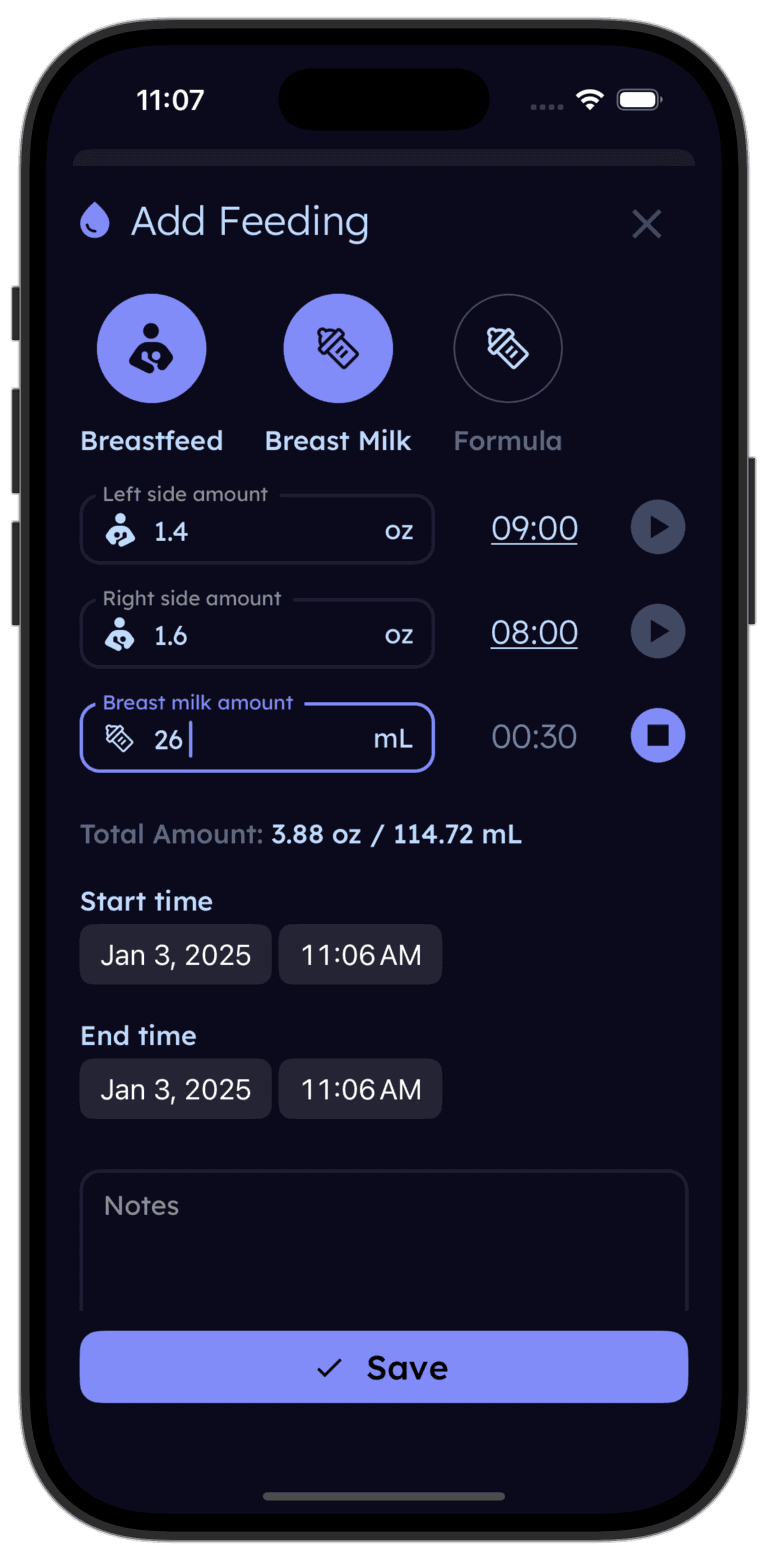
tinylog feeding log showing frequency patterns across the day

Is your baby cluster feeding or feeding constantly? The difference is easier to see in a log than in the blur of a newborn day. One is a few tough hours; the other needs attention.

tinylog surfaces feeding patterns so you can tell your IBCLC or pediatrician exactly what's happening — not a vague 'she eats all the time.'

Download on the App StoreGet It On Google Play

Can You Overfeed a Breastfed Baby?

This is one of the most common parenting anxieties, and the answer is reassuring: you almost certainly cannot overfeed a breastfed baby.

Here's why: at the breast, baby controls the flow. They suck to initiate letdown, pause when they want, and stop when they're full. Unlike a bottle (where milk continues to flow even after baby stops actively sucking), breastfeeding gives the baby complete control over their intake.

Research by Kent et al. (2006) measured breast milk intake across 71 breastfeeding mothers and found that 24-hour intake was remarkably consistent between babies (averaging about 788 ml) despite wide variation in feeding frequency and session length. Babies who nursed more frequently took less per session. Babies who nursed less frequently took more per session. Total intake? About the same.

Your baby's appetite regulation system works. Trust it.

What the Evidence Actually Says

"Breastfed babies who eat too often become overweight." The opposite is suggested by the evidence. Breastfeeding is associated with a modest reduction in childhood obesity risk compared to formula feeding. The self-regulatory nature of breastfeeding — where baby controls intake — is thought to help establish healthy appetite regulation. (Horta et al., 2015)

"If baby wants to eat every hour, you don't have enough milk." This is the single most damaging myth in breastfeeding. Frequent feeding in a baby who is gaining well is not a sign of insufficient supply. It's a sign of normal breastfeeding physiology. Babies feed frequently to maintain supply, for comfort, during growth spurts, and because breast milk digests quickly. Frequent feeding is the system working correctly.

"You should space out feeds so baby learns to eat on a schedule." For breastfed babies, on-demand feeding is recommended by the AAP and WHO. Scheduled feeding can reduce stimulation, decrease supply, and leave baby hungry between arbitrary intervals. Responsive feeding — following baby's cues — supports both adequate nutrition and optimal supply.

When to Get Help and What Kind

See your pediatrician if: frequent feeding is accompanied by poor weight gain, low diaper output, or baby seems lethargic. Weight checks are the definitive way to confirm that frequent feeding is meeting baby's needs.

See an IBCLC if: you suspect a latch or transfer issue (baby feeds for a long time but doesn't seem satisfied), or if you want reassurance about supply. A weighted feed can confirm how much milk baby is actually getting per session.

Talk to yourself kindly: Feeding anxiety is incredibly common in breastfeeding parents. If you're constantly worried about feeding frequency despite normal weight gain and diapers, that anxiety itself deserves attention. Postpartum anxiety is real, and it often fixates on feeding. Talking to a therapist or your provider can help.

For more on whether baby is getting enough, see our is baby getting enough breast milk guide.

Related Guides

Sources

  • Kent, J. C., et al. (2006). Volume and frequency of breastfeedings and fat content of breast milk throughout the day. Pediatrics, 117(3).
  • American Academy of Pediatrics (AAP). (2022). Breastfeeding and the Use of Human Milk. Pediatrics, 150(1).
  • World Health Organization. (2023). Breastfeeding recommendations.
  • Horta, B. L., et al. (2015). Long-term consequences of breastfeeding on cholesterol, obesity, systolic blood pressure and type 2 diabetes. Acta Paediatrica, 104(S467).
  • Dewey, K. G. (2001). Nutrition, growth, and complementary feeding of the breastfed infant. Pediatric Clinics of North America, 48(1).

Medical Disclaimer

This guide is for informational purposes only and is not a substitute for professional medical advice. If you're experiencing breastfeeding difficulties, consider consulting an IBCLC (International Board Certified Lactation Consultant) or your pediatrician.

Get this feeding frequency chart in your inbox.
We'll send you the age-by-age feeding norms so you can check them at any hour.
Track feeds and see the real pattern — is it cluster feeding or actually constant?
Download tinylog free — log feeds and let the data answer the question your anxiety is asking.
Download on the App StoreGet It On Google Play