GUIDE

Cluster Feeding vs. Growth Spurt

Cluster feeding is a behavioral pattern where baby feeds very frequently in a short window, usually evenings. Growth spurts are developmental surges that increase hunger for 2-5 days. They can overlap but aren't the same thing.

Both involve a baby who suddenly wants to eat all the time. Knowing which one you're dealing with helps you respond appropriately.

Log feeding frequency to see the pattern

Track feeds and spot when behavior shifts

The baby makes the milk. Because after your milk comes in, breastfeeding works on the principles of supply and demand.
Dr. Kam LamDr. Kam Lam, MD, Breastfeeding Medicine Physician, Cleveland Clinic

The 'Is My Baby Eating Enough?' Panic

You're five weeks in. Your baby spent the last three evenings nursing every 30-45 minutes for four straight hours. Nothing seems to satisfy them. They latch, eat for 10 minutes, pull off, fuss, and want to latch again 20 minutes later. Your mother-in-law suggests you're not making enough milk. The internet says it's cluster feeding. Or maybe a growth spurt. Or both. You just want to know what's happening and whether you should worry.

The answer, in the vast majority of cases, is that you shouldn't worry — but knowing whether you're dealing with cluster feeding, a growth spurt, or both helps you respond appropriately and saves you from unnecessary anxiety or intervention.

Cluster feeding and growth spurts are related but distinct phenomena. Research on infant feeding patterns (Kent et al., 2006) shows that breastfed babies naturally cluster their feeds — consuming a disproportionate amount of their daily intake in concentrated sessions, often in the evening. Our cluster feeding by age guide details how this pattern evolves as your baby grows. This is normal feeding behavior, not a sign of inadequacy. Growth spurts, on the other hand, are transient periods of rapid growth documented by pediatric growth studies, where caloric demand genuinely increases for a few days.


Cluster Feeding vs. Growth Spurt
What it is
Cluster FeedingBehavioral pattern — baby feeds many times in a concentrated window, usually evenings.
Growth SpurtDevelopmental event — baby's body is growing rapidly and needs more caloric intake to fuel it.
Timing pattern
Cluster FeedingConcentrated in a specific window (typically 4 PM – 10 PM). Rest of the day may be normal.
Growth SpurtIncreased hunger around the clock — all feeds are more frequent, not just evening ones.
Duration
Cluster FeedingThe pattern recurs daily for weeks. Most intense at 2-6 weeks, fades by 3-4 months.
Growth SpurtEach spurt lasts 2-5 days, then feeding returns to baseline.
Common ages
Cluster FeedingStarts in the first week. Most intense at 2-6 weeks. Can recur at any age but less common after 4 months.
Growth Spurt2-3 weeks, 6 weeks, 3 months, 6 months, 9 months — though timing varies between babies.
Baby's behavior
Cluster FeedingFussy, wants to nurse/bottle constantly during the cluster window. May be content the rest of the day.
Growth SpurtGenerally hungrier throughout the day. May also sleep more between growth spurt feeds.
Effect on supply
Cluster FeedingStimulates increased evening/night milk production. The frequent feeds are the mechanism, not a sign of inadequacy.
Growth SpurtTemporarily increases demand, which triggers increased supply. Production catches up within a few days.
Parent response
Cluster FeedingFeed on demand during the cluster. Don't try to stretch intervals. It resolves on its own.
Growth SpurtFeed on demand. Offer extra feeds. Expect increased appetite for 2-5 days, then return to normal.
Both involve increased feeding. The key differences are timing pattern, duration, and scope.

Cluster Feeding — What's Normal

  • A normal, healthy behavior — not a sign of low supply or a problem to fix
  • Helps build and calibrate milk supply, especially evening and nighttime production
  • Often precedes a longer stretch of nighttime sleep — baby is 'tanking up' before bed
  • Consistent daily pattern makes it predictable once you recognize it
  • Resolves naturally with age — peaks at 2-6 weeks, fades by 3-4 months

Cluster feeding is your baby's way of building the milk supply they need. It's not a bug — it's a feature.

Cluster Feeding — What's Hard

  • Physically and mentally exhausting — hours of continuous feeding with a fussy baby
  • Easily misinterpreted as low milk supply, leading to unnecessary supplementation
  • Can cause nipple soreness from extended, frequent nursing sessions
  • Limits what the feeding parent can do during evening hours for weeks
  • Other caregivers may not understand that frequent feeding is normal, adding pressure

The difficulty of cluster feeding is real. Having a plan for those evenings helps — food, water, TV remote, and a supportive partner.

Growth Spurt — What's Normal

  • Temporary — most spurts resolve in 2-5 days with a return to normal feeding patterns
  • A sign that baby is growing and developing on track
  • May coincide with visible developmental progress (new skills, weight gain, length gain)
  • Milk supply naturally increases to meet the temporary demand
  • Baby often sleeps more during and after a growth spurt, giving parents some recovery time

Growth spurts are temporary by nature. Feed on demand and your supply will catch up.

Growth Spurt — What's Hard

  • Can feel alarming if you don't know what's happening — the sudden increase in hunger seems wrong
  • Sleep disruption during the spurt — more night wakings for feeds
  • Can overlap with cluster feeding, making the increased demand feel doubled
  • May temporarily feel like supply isn't keeping up before production catches up
  • Harder to distinguish from other causes of increased feeding (illness, teething, developmental leaps)

The key challenge is patience — waiting out 2-5 days of increased demand without panicking about supply.

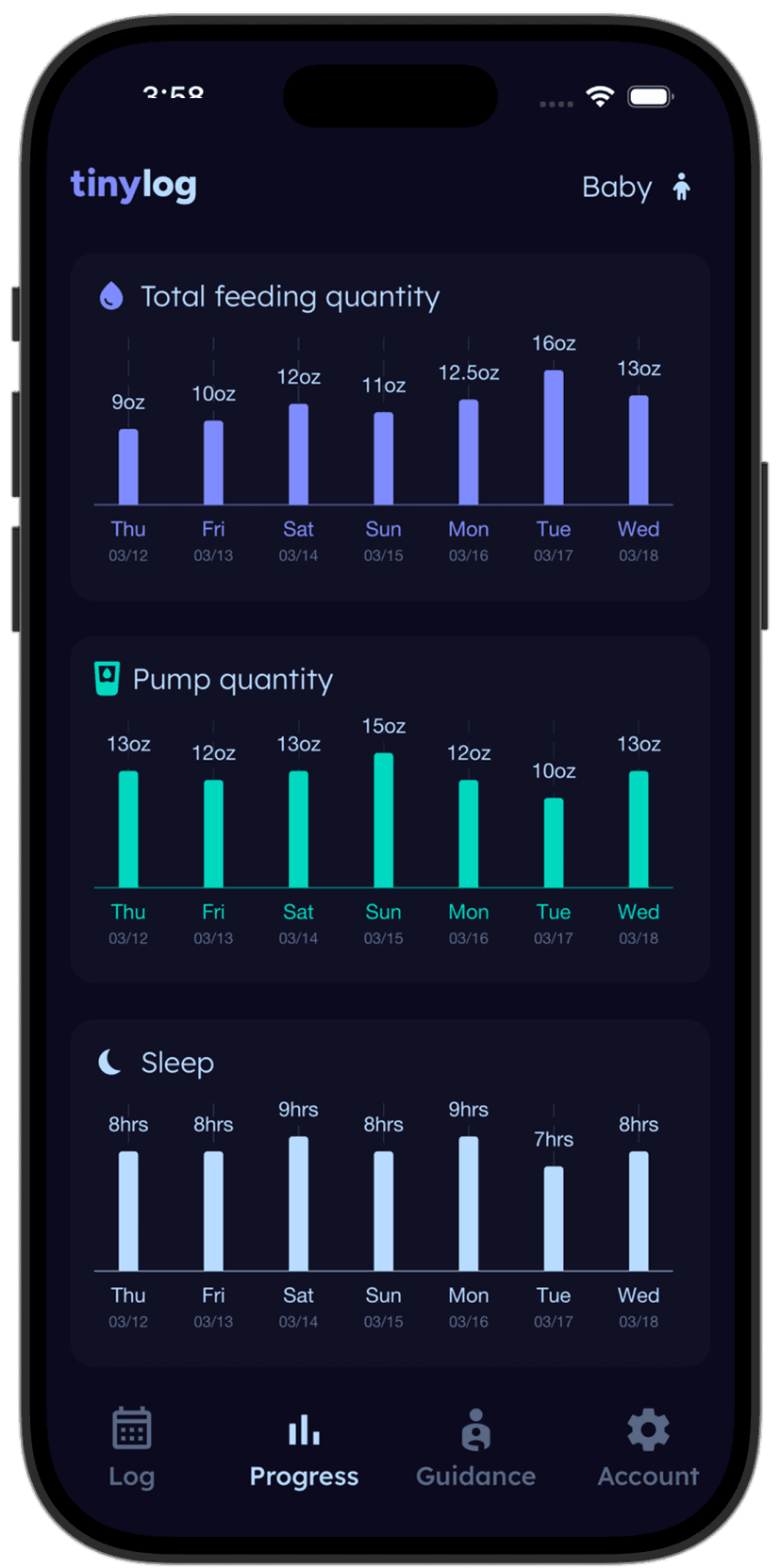
Tinylog trends showing feeding frequency changes over time

When feeds ramp up, the data tells you what's happening.

Log feeds in Tinylog and compare today's frequency to last week's. If you see a spike concentrated in the evening, it's likely cluster feeding. If the whole day's pattern has shifted, you may be in a growth spurt. Either way, you'll have the data to show your pediatrician instead of trying to describe it from memory.

Download on the App StoreGet It On Google Play

How to Tell Them Apart in Real Time

The simplest way to distinguish cluster feeding from a growth spurt is to look at when the increased feeding is happening. Pull up your feed log and ask two questions.

Is the increase concentrated in one part of the day? If baby is feeding normally in the morning and afternoon but going into overdrive from 5 PM to 10 PM, that's cluster feeding. It's a behavioral pattern, not an indication that baby needs more calories overall. The evening cluster actually helps build overnight milk supply and often precedes a longer stretch of nighttime sleep.

Is the increase spread across all feeds throughout the day? If baby is waking more at night, eating more in the morning, wanting extra feeds at midday, AND cluster feeding in the evening, you're likely in a growth spurt. The increased demand is systemic, not localized. Growth spurts typically last 2-5 days and then feeding returns to baseline — sometimes with slightly larger volumes per feed.

When they overlap — which happens frequently, since growth spurts at 2-3 weeks and 6 weeks coincide with peak cluster feeding age — you'll see both patterns simultaneously. The increased overall demand of the spurt sits on top of the concentrated evening cluster. This is the period that breaks the most parenting spirits and triggers the most unnecessary supplementation with formula.

When Increased Feeding Is Actually a Problem

In rare cases, dramatically increased feeding genuinely signals insufficient intake. If you're unsure whether your baby is getting enough, our guide on how to tell if your baby is eating enough walks through the key indicators. The red flags are: fewer than 6 wet diapers per day, failure to regain birth weight by two weeks, significant weight loss between pediatric visits, baby who is lethargic or hard to wake for feeds, or a persistently unsatisfied baby who never seems content after any feed.

If you see these signs alongside increased feeding, contact your pediatrician. But if your baby has good diaper output, is gaining weight, and has periods of contentment between feeds — the increased feeding is almost certainly cluster feeding, a growth spurt, or both. Ride it out.

Tips That Apply Either Way

Log feeds for a few days before deciding anything

If your baby suddenly wants to eat constantly, track every feed for 3-4 days before concluding you have a supply problem. If the increased feeding is concentrated in the evening, it's likely cluster feeding. If it's around the clock, it might be a growth spurt. Either way, the data will show the pattern faster than guessing.

Check wet diapers, not feeding frequency

Wet diapers are the best indicator of adequate intake. If your baby has 6+ wet diapers per day during cluster feeding or a growth spurt, they're getting enough milk — even if it feels like they're nursing nonstop. Don't add formula unless wet diaper counts drop.

This too shall pass — and quickly

Cluster feeding peaks in the first 6 weeks and growth spurts last 2-5 days. When you're in the middle of it, it feels endless. But looking at the data across a week or two, these are temporary blips in an otherwise stable pattern. Knowing that can help you ride it out.

Related Guides

Sources

  • Kent, J. C., et al. (2006). Volume and Frequency of Breastfeedings and Fat Content of Breast Milk Throughout the Day. Pediatrics, 117(3), e387-e395.
  • Hester, S. N., et al. (2012). Is the Macronutrient Intake of Formula-Fed Infants Greater Than Breast-Fed Infants in Early Infancy? Journal of Nutrition and Metabolism, 2012, 891201.
  • World Health Organization. (2006). WHO Child Growth Standards: Length/Height-for-Age, Weight-for-Age, Weight-for-Length, Weight-for-Height and Body Mass Index-for-Age.
  • Dewey, K. G., et al. (1991). Breast Milk Volume and Composition During Late Lactation (7-20 months). Journal of Pediatric Gastroenterology and Nutrition, 13(3), 260-267.

This guide is for informational purposes only and is not a substitute for professional medical advice. Consult your pediatrician for guidance specific to your baby.

Get this comparison in your inbox.
Save this guide so you can reference it the next time your baby's feeding suddenly ramps up.
When feeding frequency suddenly spikes, the data tells you why.
Track feeds in Tinylog to distinguish temporary surges from ongoing patterns.
Download on the App StoreGet It On Google Play