
Know your baby's gestational age
Fenton charts use post-menstrual age, not chronological age. If your baby was born at 28 weeks and is now 4 weeks old, their gestational age is 32 weeks. This is the number that matters for Fenton chart plotting.
GUIDE
Published on
Fenton growth charts are specifically designed for premature babies born before 37 weeks, using gestational age to track growth. WHO charts are built for healthy full-term infants. Using the wrong chart for your preemie can lead to inaccurate growth assessments and unnecessary worry.
If your baby was born early, the growth chart matters even more. Fenton charts exist because preemies grow differently — and they deserve a chart that reflects that.
The only baby tracker app with Fenton charts
“The majority of preterm babies catch up with growth and development, especially with early intervention. Early intervention and monitoring is key to successful progress.”
 Liz Smith, APRN-NP, Neonatal Nurse Practitioner, Lurie Children's Hospital
A baby born at 28 weeks gestation is not the same as a baby born at 40 weeks. This seems obvious, but many baby tracking apps and even some pediatric practices plot premature babies on the same WHO charts designed for full-term infants. The result is predictable and harmful: preemie parents see their baby at the 1st or 2nd percentile, panic sets in, and the growth conversation becomes about catching up to a standard that was never designed for them.
Fenton growth charts, developed by Dr. Tanis Fenton and updated in 2013, solve this problem. They were built from a meta-analysis of nearly 4 million preterm birth records from developed countries. The charts track weight, length, and head circumference from 22 weeks gestation through 50 weeks post-menstrual age, using gestational age rather than birth age as the reference point.
This means a baby born at 30 weeks who is now 34 weeks gestational age gets compared to other babies at 34 weeks — not to full-term newborns who had 6 more weeks of in-utero growth. The percentile you see reflects how your preemie is growing relative to babies at the same developmental stage, which is the only comparison that makes clinical sense. Understanding adjusted age vs. actual age is equally important for interpreting these charts correctly.
| Aspect | Fenton Growth Charts | WHO Growth Charts |
|---|---|---|
| Designed for | Premature babies born before 37 weeks gestation | Healthy full-term breastfed babies |
| Age tracking | Gestational age (post-menstrual age) | Chronological age from birth |
| Coverage range | 22 weeks gestation to 50 weeks post-menstrual age | Birth (full-term) to 5 years |
| Data source | Meta-analysis of 4 million preterm birth records from developed countries | Healthy breastfed babies from 6 countries (Brazil, Ghana, India, Norway, Oman, US) |
| NICU use | Standard in NICUs worldwide for preterm growth monitoring | Not appropriate for NICU preterm monitoring |
| Catch-up growth tracking | Shows expected preemie growth trajectory, including catch-up periods | Does not account for preemie catch-up growth patterns |
| App availability | Tinylog is the only baby tracker app offering Fenton charts | Available in most baby tracker apps and pediatric offices |
Fenton charts are the only clinically appropriate option for monitoring preterm growth before term-equivalent age.
The limited app availability is a significant gap — Tinylog is currently the only baby tracker app offering Fenton charts.
WHO charts become appropriate once your preemie reaches term-equivalent age.
Using WHO charts for preemies before term age gives clinically meaningless percentiles.
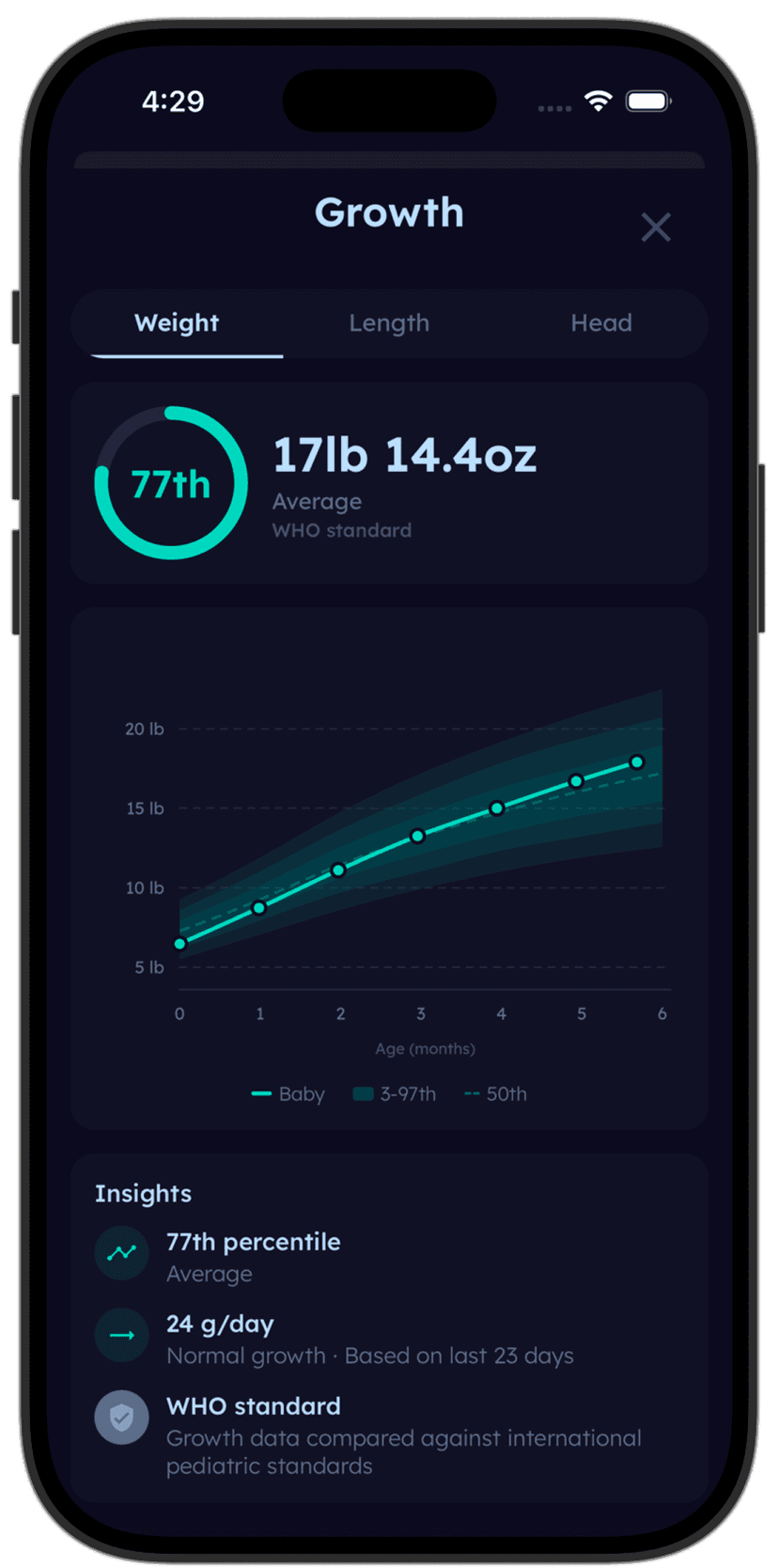
Tinylog is the only baby tracking app that offers Fenton growth charts for premature babies. Plot your preemie's weight, length, and head circumference on charts designed for their gestational age — not full-term standards that don't apply.


The answer is straightforward: use Fenton charts from birth through the NICU stay and early post-discharge period for any baby born before 37 weeks gestation. Switch to WHO charts when your preemie reaches term-equivalent age (around 40 weeks post-menstrual age) or when your pediatrician indicates the transition is appropriate — typically by 50 weeks post-menstrual age when the Fenton and WHO curves align.
After the switch, continue using corrected (adjusted) age for WHO chart plotting until your pediatrician says otherwise — usually until age 2-3 for very preterm babies. This means plotting your baby's measurements at their corrected age, not their chronological age, to account for the weeks of growth they missed in utero. Our preemie feeding chart can help you make sure nutrition supports the growth trajectory you're tracking.
The Fenton charts are designed to make this transition seamless. The 2013 revision specifically aligned the Fenton curves with WHO standards at 50 weeks, so there shouldn't be a jarring percentile jump when you switch. If your baby is at the 40th percentile on Fenton at 50 weeks, they should land near the 40th on WHO charts too.
Fenton charts use post-menstrual age, not chronological age. If your baby was born at 28 weeks and is now 4 weeks old, their gestational age is 32 weeks. This is the number that matters for Fenton chart plotting.
Fenton charts are designed to connect with WHO charts at 50 weeks post-menstrual age. When your NICU team transitions your baby's growth tracking to WHO charts, the percentiles should align smoothly. Ask your pediatrician about the timing of this switch.
Preemie parents often feel helpless between NICU visits. Tracking weight, length, and head circumference on Fenton charts at home gives you visibility into your baby's progress and better questions for your care team.
This guide is for informational purposes only and is not a substitute for professional medical advice. Consult your pediatrician or neonatologist for guidance specific to your premature baby.