
Track at regular intervals
For the most useful growth data, weigh your baby at consistent intervals — every 2-4 weeks in the first few months, monthly after that. Too-frequent weighing (daily or weekly) can create noise that obscures the real trend.
GUIDE
Published on
Weight percentile tells you where your baby ranks at one moment. Growth velocity tells you how fast they're growing over time. Velocity is often more clinically meaningful — a consistent rate matters more than the number.
If your baby 'dropped percentiles,' the velocity is what tells you whether that's a concern or just a normal variation.
Track weight trends and velocity
“A baby's weight is on my mind from the beginning. It's a variable we have a bit more control over.”
 Dr. Minh-Y Canh, DO, Pediatrician, Cleveland Clinic
When your pediatrician says your baby is "at the 40th percentile," that's a weight percentile — it means your baby weighs more than 40% of babies their age and less than 60%. It's a single snapshot on a growth percentile chart. It tells you how your baby compares to other babies right now, but it says nothing about whether that's a change from last month or whether it's heading in a concerning direction.
Growth velocity is different. It's the rate at which your baby is gaining weight (or length) over time. A baby gaining 25 grams per day between 1 and 3 months has a specific velocity. If that drops to 10 grams per day the next month, the velocity has changed — and that change is often more clinically meaningful than the percentile itself.
Here's the thing most parents don't realize: pediatricians care more about velocity than percentile in most situations. A baby who has always been at the 15th percentile and is growing at a steady rate is healthy. A baby who was at the 60th percentile and is now at the 30th — that velocity change is what triggers further evaluation.
| Aspect | Weight Percentile | Growth Velocity |
|---|---|---|
| What it measures | Where your baby ranks compared to other babies of the same age and sex | How fast your baby is gaining weight or length over a time period |
| What it tells you | Relative size — bigger or smaller than peers | Rate of change — speeding up, slowing down, or steady |
| Data needed | One measurement at one point in time | At least two measurements separated by time |
| Clinical significance | Useful for initial assessment and population comparison | More sensitive for detecting early growth faltering or acceleration |
| Normal range | Any consistent percentile from 3rd to 97th can be normal | Varies by age — newborns gain ~30g/day, 6-month-olds ~15-20g/day |
| Red flag | Crossing 2+ major percentile lines in either direction | Velocity dropping below the 5th percentile for age, or sustained deceleration |
Percentiles are a useful starting point, but they're just one piece of the growth picture.
The most common source of parental growth anxiety is fixating on a percentile number without understanding the trend behind it.
The WHO published velocity standards in 2009, providing age-specific expected rates of gain for both weight and length.
Velocity calculations are most reliable when measurements are taken at least 4 weeks apart to smooth out day-to-day variation.
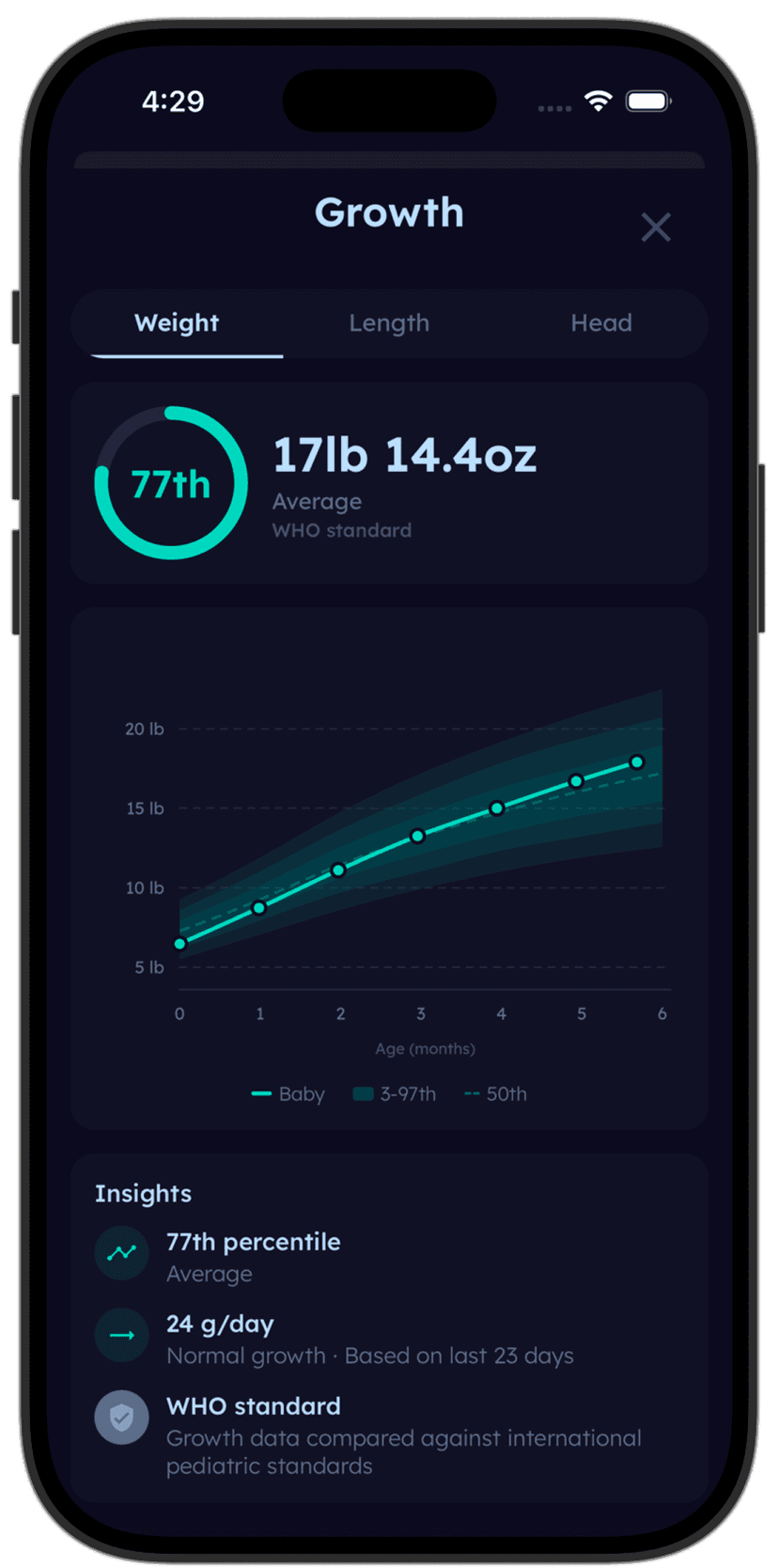
Log weight measurements in Tinylog and watch the curve develop over time. Multiple data points plotted on WHO growth charts show you both where your baby is and where they're heading.


In clinical practice, your pediatrician starts with the percentile as a quick orientation — where is this baby relative to the population? Then they look at the velocity — is this baby's growth rate appropriate for their age, and has it changed?
A baby at the 5th percentile with steady velocity is almost certainly a constitutionally small baby — often with smaller parents. No intervention needed. A baby at the 50th percentile whose velocity has dropped significantly over two visits may need evaluation even though their percentile still looks "normal." Understanding the difference between percentile and velocity is one part of the broader picture — it also helps to understand how growth milestones differ from developmental milestones. The velocity detected a problem before the percentile did.
This is why regular well-child visits matter. Each measurement adds a data point that makes the velocity calculation more accurate and the growth picture clearer. Skipping visits means missing the opportunity to catch trajectory changes early.
If you're tracking your baby's growth at home, focus on consistency rather than the specific number. Plot measurements on a growth chart and look at whether the dots form a smooth, gently rising curve. If they do, your baby's velocity is appropriate — regardless of whether that curve is at the 20th percentile or the 80th.
Raise a concern with your pediatrician if the curve flattens or dips. That visual flattening represents a velocity change, and it's the earliest sign that something might need attention — well before the percentile number shifts enough to look alarming. If your baby has already dropped percentiles, understanding velocity helps you and your doctor determine whether the change is concerning or just normal variation.
For most parents, the practical advice is: know your baby's percentile for context, but watch the trend. The trend is the velocity, and the velocity is what matters.
For the most useful growth data, weigh your baby at consistent intervals — every 2-4 weeks in the first few months, monthly after that. Too-frequent weighing (daily or weekly) can create noise that obscures the real trend.
Different scales can vary by several ounces. For accurate velocity tracking, use the same scale each time — ideally your pediatrician's, or a dedicated infant scale at home.
Whether you're looking at percentile or velocity, a single data point tells you very little. The value is in the pattern over time. Three to four measurements create a curve that's far more informative than any individual number.
This guide is for informational purposes only and is not a substitute for professional medical advice. Consult your pediatrician for guidance specific to your baby.