GUIDE

11 Month Old Sleep Schedule

Eleven months is a genuinely good sleep period — 2 solid naps, predictable nights, and a baby with strong opinions about which stuffed animal sleeps in the crib.

Your baby's schedule is well-established and working. The biggest question: what changes at the birthday? (Answer: not as much as you think.) Here's the full picture.

Eleven Months: The Calm Before the Birthday Storm

Eleven months — you're one month from your baby's first birthday, and sleep-wise, you're in a genuinely good place. The 2-nap schedule is well-established, wake windows are predictable, and nighttime sleep should be fairly consistent. Your baby is becoming a little person with clear preferences, a budding sense of humor, and strong opinions about their sleep environment.

This is one of those ages that doesn't get a lot of attention in sleep guides because there's not much drama happening. The 8-10 month regression is behind you. The 12-month regression hasn't started. If sleep is working, it's working — and the best thing you can do is enjoy it without trying to change anything.

The biggest sleep-related question at 11 months is usually about what's coming: "Do I need to change the schedule at 12 months? Should I drop a nap for the birthday?" The answer to both is no. The birthday is a milestone for you, not for your baby's sleep biology. Keep the 2-nap schedule until your baby genuinely shows readiness for the 2-to-1 transition, which for most babies is between 14 and 18 months.

11 Month Old Sleep at a Glance
Total sleep (24 hrs)
12–14 hours
Nighttime sleep
10–12 hours
Number of naps
2
Nap duration
1–1.5 hours each
Wake windows
3–4 hours
These numbers are similar to 10 months — and that's expected. Sleep needs are very stable at this age.

Sample 11 Month Old Schedule

A realistic daily routine. Adjust based on your baby's wake time.

Sample daily schedule

  1. Wake + milk
  2. Breakfast (solids)
  3. Nap 1 (1–1.5 hrs)
  4. Wake + milk + lunch (solids)
  5. Nap 2 (1–1.5 hrs)
  6. Wake + milk + snack
  7. Dinner (solids)
  8. Bedtime routine + milk
  9. Bedtime

The wake windows matter more than the clock times. At 11 months, the schedule should feel familiar and well-worn. If you're still making frequent adjustments, check that your wake windows match the 3-to-4-hour range.

Wake Windows at 11 Months

Wake windows are 3 to 4 hours — essentially the same as 10 months. First window: 3 to 3.25 hours. Mid-day: 3.5 hours. Last before bed: 3.5 to 4 hours.

At 11 months, your baby's wake tolerance is very consistent. Day-to-day variation is minimal, which makes the schedule predictable. If one wake window needs to be longer (because a nap was short), the others can usually stay the same.

If bedtime is consistently a struggle, check the last wake window. Too short (under 3.5 hours) and your baby isn't tired enough. Too long (over 4 hours) and they're overtired. The sweet spot for most 11-month-olds is around 3.5 to 3.75 hours.

Naps at 11 Months

Two naps, 2 to 3 hours total. This is the last month before the 12-month regression may hit, so naps should be at their most stable and predictable. Morning nap: 1 to 1.5 hours. Afternoon nap: 1 to 1.5 hours.

Both naps serve distinct purposes: the morning nap provides restorative sleep after the overnight period, and the afternoon nap prevents overtiredness before bedtime. Neither should be dropped at this age.

If your baby's total day sleep consistently exceeds 3 hours, it may affect night sleep. Try capping the morning nap at 1.25 hours if the afternoon nap is solid, or vice versa. The goal is to balance day and night sleep so both are high-quality.

Nighttime Sleep at 11 Months

Nighttime sleep should be 10 to 12 hours. Most 11-month-olds can sleep through without eating, though some still have one feed and that's perfectly fine.

This is often one of the most consistent nighttime sleep periods since birth. If night sleep is working well, protect it: keep the sleep environment consistent, maintain the bedtime routine, and avoid introducing new variables (like a new sleep location or major routine change) unless necessary.

Night wakings at this age are usually brief and self-resolving. If your baby calls out once and then settles, they're just transitioning between sleep cycles. If wakings are frequent and they seem distressed, check for teething (molars may be approaching), illness, or an emerging developmental leap.

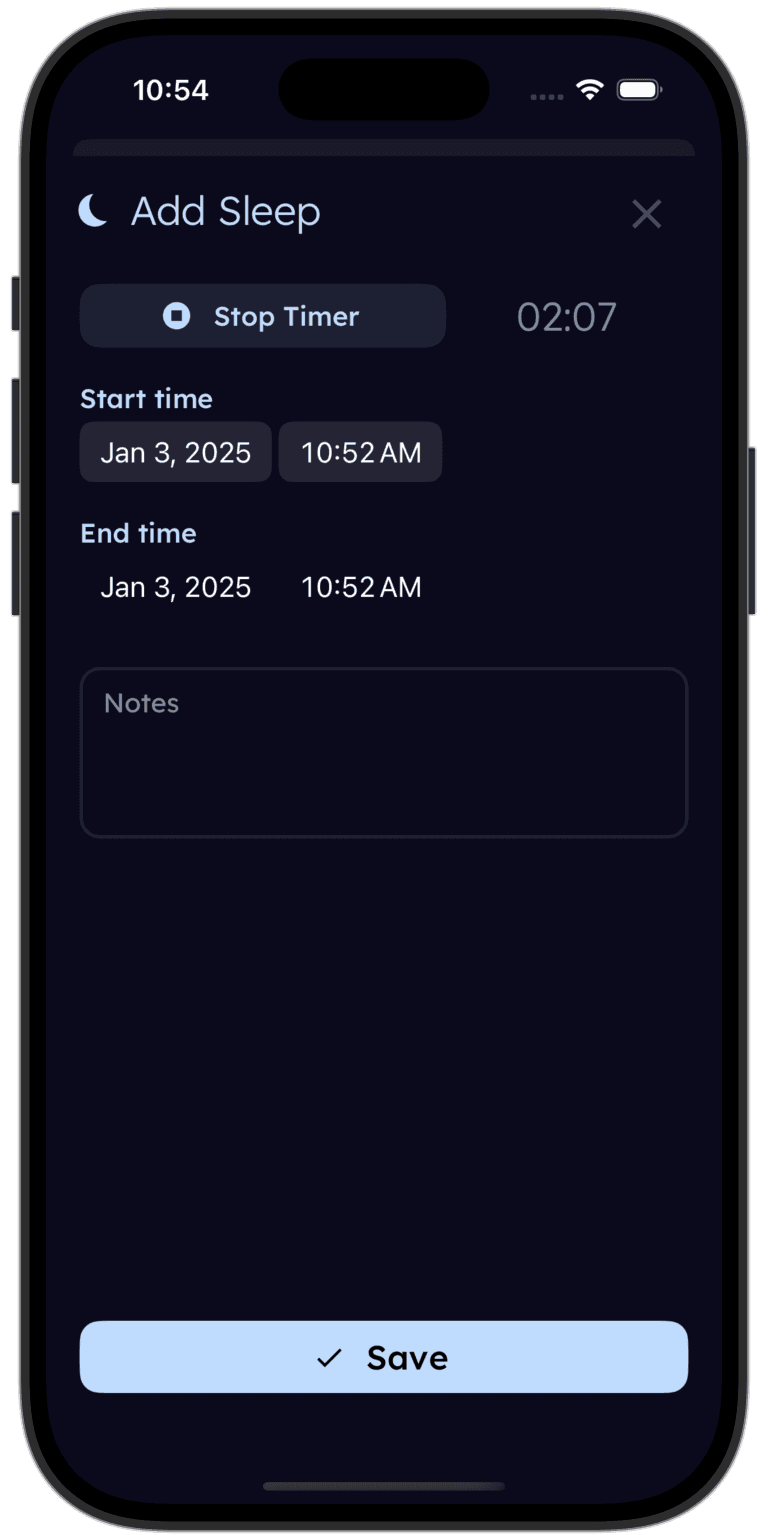
tinylog showing 11 month old consistent sleep schedule

Almost a year of data — your baby's sleep story is written in it.

If you've been tracking, you can look back and see the journey: the newborn chaos, the 4-month regression, the nap transition, and the beautiful 2-nap rhythm you have now. That context helps when the next change comes.

Download on the App StoreGet It On Google Play

What's Happening Developmentally

Your 11-month-old may be walking, cruising confidently, or taking their first independent steps. First words are appearing ("mama," "dada," "ball," "dog"), and their understanding of language is far more advanced than their speech. They follow simple instructions, point to things they want, and may shake their head "no" with great enthusiasm.

Walking (or near-walking) can temporarily disrupt sleep, just as crawling did at 8 months. Your baby may practice standing, walking along the crib rail, or even attempting to climb. This motor compulsion peaks for 1 to 2 weeks and then subsides once the skill is mastered.

Your baby's emerging sense of humor — laughing at silly faces, playing peek-a-boo, imitating funny sounds — is a sign of sophisticated cognitive development. They're beginning to understand social dynamics, and this shows up at bedtime: they may try to make you laugh instead of settling down. Keep the bedtime routine predictable and calm, even when they're being adorable.


Common Problems at 11 Months

Pre-walking sleep disruption

If your baby is close to walking (taking steps while holding furniture, standing unsupported for seconds), they may practice in the crib — pulling up, cruising the rails, even attempting to let go. This is the same motor-compulsion pattern you saw with crawling at 8 months, and it resolves the same way: once walking is mastered, the nighttime practice stops. Plenty of walking practice during the day accelerates this.

Separation anxiety at daycare drop-off affecting naps

If your baby attends daycare, you may notice that naps at home are better than naps at daycare (or vice versa). At 11 months, separation anxiety can flare at drop-off, and the emotional stress may affect nap quality. This is normal and generally improves as your baby becomes more comfortable with their caregivers. Consistency helps — the same drop-off routine every day builds predictability.

Resisting the second nap (again)

Another round of afternoon nap resistance may appear. Just like at 10 months, this is not a signal to drop to 1 nap. Your baby is asserting independence, testing boundaries, and is more interested in the world than in sleeping. Keep offering the nap at the same time. If they don't sleep after 20 minutes, get them up and move bedtime earlier.

What No One Tells You About Sleep at 11 Months

The 12-month regression is coming — and it's driven by walking

If your baby is already walking at 11 months, you might see the 12-month regression hit early. It's the same pattern as crawling at 8 months: a major motor milestone consumes the brain's processing power, making sleep more active and disrupted. The best preparation: keep your schedule and routines rock-solid now so you have a stable baseline to return to.

An 11-month-old who sleeps well is the best foundation for the toddler years

If sleep is working right now, don't change anything just because a birthday is approaching. The schedule, the bedtime routine, the sleep environment — these are your foundation. The toddler years will bring regressions, nap transitions, and bedtime negotiations. A strong sleep foundation makes all of those easier to navigate. Protect what's working.

When to Talk to Your Pediatrician

  • Your baby shows no interest in pulling to stand or isn't bearing weight on legs
  • They're not responding to their name or simple words by 11 months
  • Sleep disruption is severe with no identifiable cause
  • Snoring or breathing pauses during sleep
  • You're concerned about any aspect of development or growth
  • Night wakings are accompanied by inconsolable crying that seems pain-related

The 12-month well visit is coming up — write down any sleep questions to bring along.

Related Guides

Sources

American Academy of Pediatrics (AAP). (2022). Healthy Sleep Habits: How Many Hours Does Your Child Need?
Mindell, J. A., et al. (2016). Development of infant and toddler sleep patterns. Journal of Sleep Research, 25(5), 508–516.
Galland, B. C., et al. (2012). Normal sleep patterns in infants and children: A systematic review. Sleep Medicine Reviews, 16(3), 213–222.
World Health Organization. (2006). WHO Motor Development Study: Windows of Achievement for Six Gross Motor Development Milestones.
Baby Sleep Information Source (BASIS), Durham University. Normal Infant Sleep Development. https://www.basisonline.org.uk

Medical Disclaimer

This guide is for informational purposes only and is not a substitute for professional medical advice. Always follow safe sleep guidelines (baby on their back, on a firm surface, in their own sleep space). Consult your pediatrician with any concerns about your baby's sleep.

Want this guide in your inbox?
We'll send you this guide so you can keep the rhythm going.
Almost a year of sleep data — see how far you've come.
Download ${appName} free — track the schedule that's finally working.
Download on the App StoreGet It On Google Play