
Whatever you choose, track sleep stretches
Logging when your baby sleeps and wakes — regardless of where — gives you real data on what's working. Two weeks of logs will tell you more than two months of guessing.
GUIDE
Published on
The AAP recommends a separate sleep surface in the parents' room for the first six months. Many families co-sleep anyway — and risk reduction strategies exist for both setups.
This is one of the most polarizing topics in infant sleep. Here's the honest breakdown.
Log naps and night sleep
“It's a nice alternative to bed-sharing. It maintains the closeness that can make life easier for parents, while letting your baby sleep in a safer space that fits their needs.”
 Dr. Heidi Szugye, DO, IBCLC, Pediatrician, Cleveland Clinic
Co-sleeping vs. crib sleeping generates more heat than almost any other parenting topic. One side cites SIDS statistics and AAP guidelines. The other cites anthropological norms and breastfeeding research. Both sides have legitimate points, and both sides sometimes overstate their case.
Here's the reality: the AAP recommends that babies sleep on a separate, firm surface in the parents' room for at least the first six months. This is the lowest-risk configuration — and it's worth understanding the full room-sharing vs. separate room tradeoffs before deciding. But globally, the majority of infants co-sleep — and in countries like Japan, where bed-sharing rates are high but smoking rates are low and futons are firm, SIDS rates are among the world's lowest.
The risk of bed-sharing is not uniform. It depends heavily on specific conditions: whether the parent smokes, has consumed alcohol, is breastfeeding, and what the sleep surface looks like. A 2013 meta-analysis by Carpenter et al. in BMJ Open found that bed-sharing risk was dramatically higher when combined with parental smoking or alcohol use, but much lower in breastfeeding, non-smoking families on firm surfaces. This doesn't make bed-sharing risk-free — but it makes the conversation more nuanced than "never do it."
| Aspect | Co-Sleeping / Bed-Sharing | Crib Sleeping |
|---|---|---|
| Safety position | AAP recommends against bed-sharing. Risk is lowest when Safe Sleep Seven conditions are met. | AAP-recommended sleep surface. Lowest risk when placed in parents' room for first 6 months. |
| Breastfeeding support | Easier night feeds — no getting out of bed. Associated with longer breastfeeding duration. | Requires parent to get up for each feed. May lead to earlier weaning if night feeds feel burdensome. |
| Parent sleep quality | Parents report more disrupted sleep but less effort per wake-up. Lighter sleep is common. | Parents sleep deeper between wake-ups but must fully wake to respond. May feel more rested overall. |
| Baby sleep stretches | More frequent but shorter wake-ups. Babies may feed briefly and resettle faster. | Fewer wake-ups on average, but each one takes longer to resolve. |
| SIDS risk | Elevated risk with bed-sharing — especially with smoking, alcohol, soft bedding, or non-breastfeeding. Risk is much lower when Safe Sleep Seven is followed. | Lowest risk when crib is in parents' room. Room-sharing reduces SIDS risk by up to 50% compared to separate room. |
| Independence | Baby may take longer to learn independent sleep skills. Transition to own bed is needed later. | Baby practices falling asleep in their own space from the start. May develop independent sleep earlier. |
| Bonding | Proximity supports attachment and responsiveness. Valued across many cultures globally. | Bonding happens through responsive caregiving during wake-ups, not proximity alone. |
These advantages are strongest when safe sleep conditions are strictly followed.
Risk factors compound. The more conditions that aren't met, the higher the risk.
Crib sleeping in the parents' room provides the safety benefits plus proximity.
Many of these challenges ease as baby adjusts to the crib over the first few weeks.
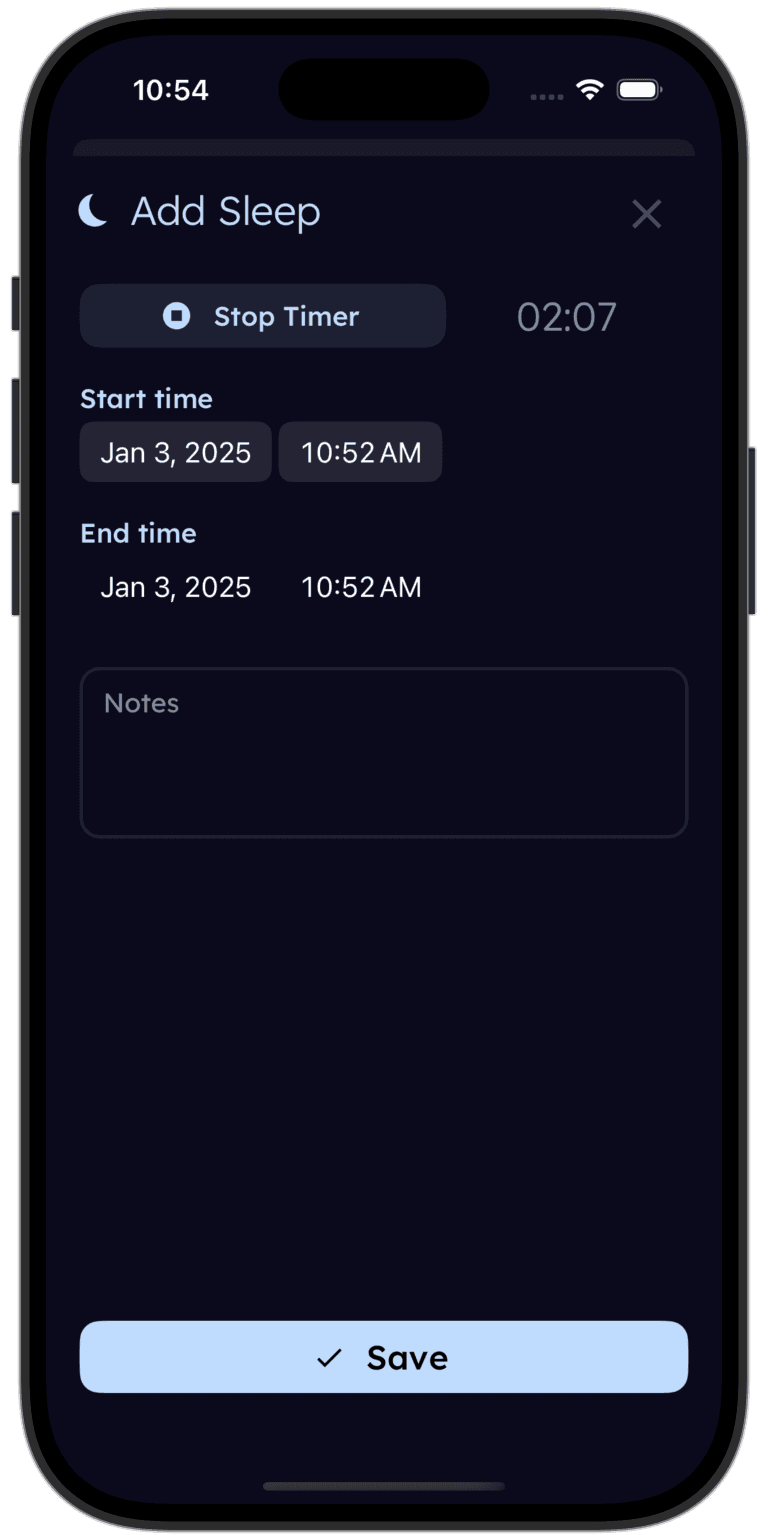
Whether your baby sleeps in your bed or their crib, Tinylog tracks sleep duration, wake-ups, and patterns — so you can compare setups with real data instead of guessing.


The relationship between sleep location and SIDS is the central issue in this debate, so it's worth getting the details right.
The AAP's 2022 safe sleep guidelines recommend room-sharing without bed-sharing, citing evidence that room-sharing reduces SIDS risk by up to 50%. The mechanism likely involves parental arousal — parents who are nearby respond to changes in breathing or distress faster.
Bed-sharing risk is real but context-dependent. The Blair et al. (2014) analysis of UK data found that in the absence of parental smoking, alcohol, and drug use, bed-sharing risk for breastfed babies older than 3 months on a firm surface was not statistically significant. However, the authors still recommended a separate sleep surface because the conditions are hard to guarantee consistently.
The safest middle ground that most sleep researchers agree on: room-sharing with a bedside bassinet or crib. You get the proximity benefits — easier night feeds, faster response — without the surface-sharing risks.
Start with an honest assessment of your specific situation. Are you breastfeeding? Do either parent smoke? Is alcohol or sedating medication involved? Is your mattress firm? Do you have soft bedding you're willing to remove? Your answers to these questions matter more than ideology.
If you choose to bed-share, follow the Safe Sleep Seven rigorously: breastfeeding, non-smoking, sober, no soft bedding, firm mattress, baby on their back, full-term healthy baby. These conditions reduce risk substantially. If you can't meet all of them, a bedside bassinet gives you most of the proximity benefits with a separate sleep surface.
If you choose crib sleeping, keep the crib in your room for at least six months. This gives you the lowest SIDS risk and makes splitting night feeds more manageable than a separate room. Many parents find that a crib in the bedroom is the practical sweet spot.
Logging when your baby sleeps and wakes — regardless of where — gives you real data on what's working. Two weeks of logs will tell you more than two months of guessing.
A crib with a fluffy blanket and bumper pads isn't safer than a firm bed with no soft bedding. Focus on the conditions: firm surface, no loose bedding, baby on their back, sober and non-smoking caregivers.
Many families start with co-sleeping and transition to a crib, or start with a crib and bring baby into bed when night feeds become unsustainable. Flexibility isn't failure — it's responsive parenting.
This guide is for informational purposes only and is not a substitute for professional medical advice. Consult your pediatrician for guidance specific to your baby.