GUIDE

Combination Feeding vs. Exclusive Breastfeeding

Exclusive breastfeeding maximizes immune benefits. Combination feeding gives you flexibility without sacrificing nutrition. Both are valid, evidence-supported choices.

If you're combo feeding out of necessity or choice, you're not 'failing at breastfeeding.' You're feeding your baby.

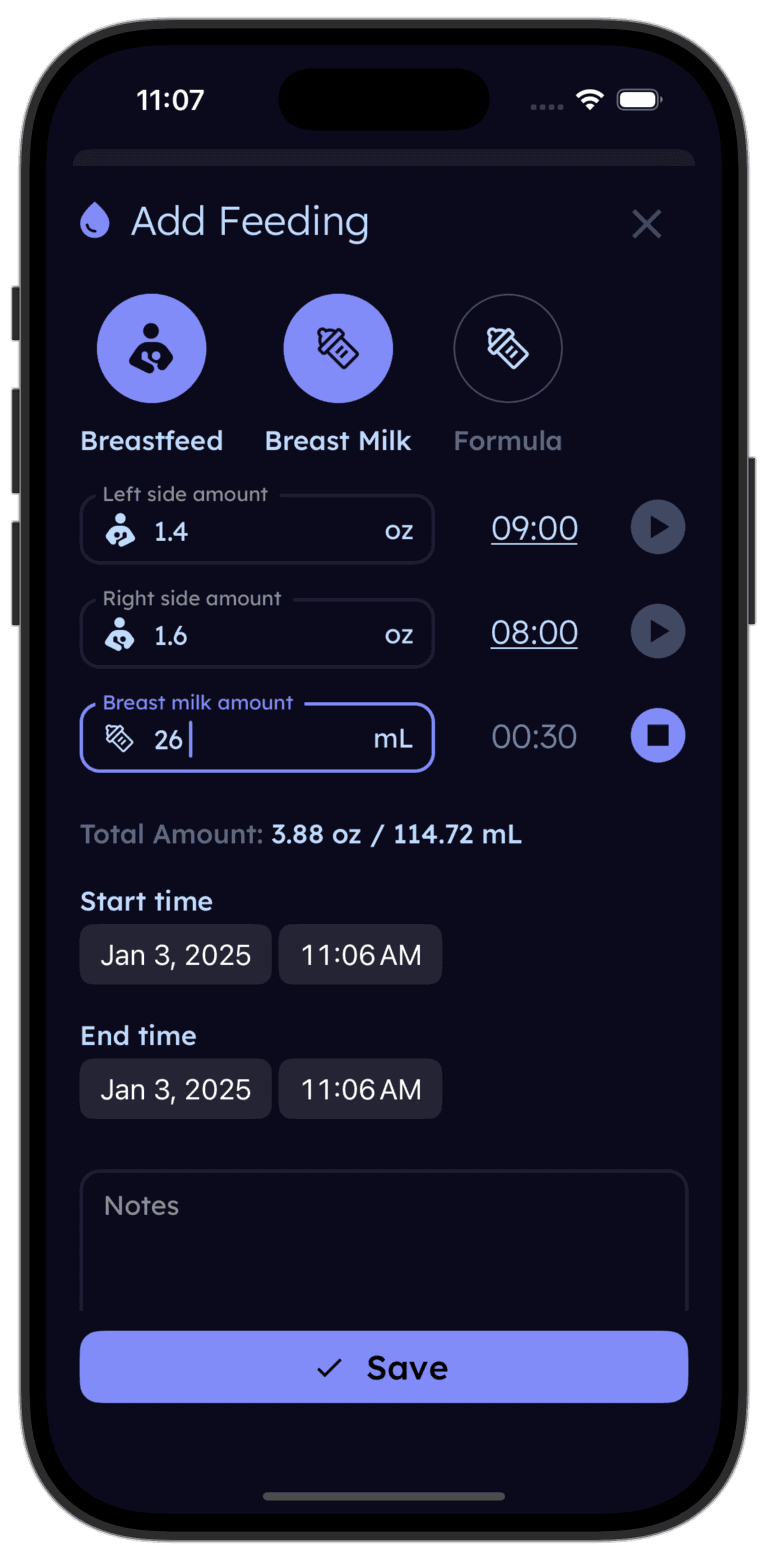
Track breast and bottle feeds

See exactly how much comes from each source

Your worth as a parent isn't tied to the number of drops of breast milk you feed your baby. Some parents are limited in how much milk they can produce.
Dr. Heidi SzugyeDr. Heidi Szugye, DO, Board-Certified Breastfeeding Medicine Physician, Cleveland Clinic

The Space Between All-or-Nothing

The breastfeeding conversation often gets framed as binary: exclusive breastfeeding or formula. But a huge number of families — estimates suggest 30-40% in the US — end up doing some combination of both. And for most of them, it wasn't the original plan.

Combo feeding happens for many reasons: supply challenges, return to work, medical necessity, a partner who wants to participate in feeding, or simply a mother who needs sleep. None of these reasons require justification. But the lack of guidance is striking — most breastfeeding resources focus on exclusivity, and most formula resources assume you're fully formula feeding. Combo feeders often feel like they're in a no-man's-land without a playbook.

The AAP recommends exclusive breastfeeding for approximately six months, and this recommendation is based on solid evidence about immune protection. But the AAP also recognizes that any amount of breastfeeding is beneficial. A 2016 study in JAMA Pediatrics (Victora et al.) found that the dose-response relationship is real — more breast milk means more immune benefit — but it's not all-or-nothing. A baby getting three breast feeds and two formula bottles per day is still receiving significant immune support.

Exclusive Breastfeeding vs. Combination Feeding
Immune protection
Exclusive BreastfeedingMaximum dose of antibodies, HMOs, and immune cells. Baby's gut colonized primarily by breast-milk-promoted bacteria.
Combination FeedingPartial immune protection — still significant. Any breast milk contributes antibodies. Gut microbiome is a blend of both feeding types.
Milk supply
Exclusive BreastfeedingSupply fully matched to demand. The more baby nurses, the more milk is produced.
Combination FeedingSupply may decrease over time as formula replaces breast feeds. Maintaining consistent breast sessions helps preserve production.
Flexibility
Exclusive BreastfeedingMother must be available for every feed or pump. Limits independence and shared caregiving.
Combination FeedingAnyone can give the formula feeds. Mother gets breaks, sleep, and the ability to be away from baby.
Intake visibility
Exclusive BreastfeedingDifficult to measure exact volume. Relies on wet diapers, weight checks, and feeding behavior cues.
Combination FeedingFormula portions are measurable. Combined with breast feeds, gives a clearer picture of total intake.
Cost
Exclusive BreastfeedingNo formula cost. May need nursing supplies, pump, and lactation support.
Combination FeedingPartial formula cost — less than exclusive formula feeding. Still need nursing supplies.
Sleep sharing
Exclusive BreastfeedingAll night feeds are on the mother unless pumped milk is available.
Combination FeedingPartner can handle some night feeds with formula, allowing mother longer sleep stretches.
Return to work
Exclusive BreastfeedingRequires full pumping schedule during work hours. Pumping output must replace all missed feeds.
Combination FeedingBreast feed when together, formula when apart. Reduces or eliminates pumping at work.
This comparison assumes a healthy, term infant. Premature or medically complex babies may have different considerations.

Exclusive Breastfeeding Advantages

  • Maximum immune protection — full dose of antibodies, HMOs, and bioactive factors
  • Supply naturally calibrates to baby's needs through the feedback loop of demand
  • No formula cost, preparation, or sterilization required
  • Associated with slightly lower rates of infant infections, eczema, and SIDS
  • Convenient for nighttime feeds — no bottles to prepare at 3 AM

These advantages are real, and they're strongest during the first six months.

Exclusive Breastfeeding Challenges

  • Mother bears 100% of the feeding responsibility unless pumping
  • Night feeds can be exhausting with no option to share without a pump
  • Supply anxiety is common — you can't see how much baby is getting
  • Returning to work requires a full pumping schedule to maintain supply
  • Social pressure and judgment can add stress if breastfeeding is difficult

These challenges are common, not personal failings. They're why combo feeding exists.

Combination Feeding Advantages

  • Flexibility — breast feed when you're together, formula when you're apart or need a break
  • Partner or caregiver can share feeding responsibility, including night feeds
  • Reduces or eliminates the need to pump at work
  • Baby still receives immune benefits from whatever breast milk they get
  • Can ease the mental load — less pressure to be the sole source of nutrition

Combo feeding is a legitimate strategy, not a consolation prize.

Combination Feeding Challenges

  • Milk supply may gradually decrease if breast feeds are significantly reduced
  • Requires managing two feeding systems — breast and bottle supplies
  • Some babies develop a bottle preference, making breast feeds harder
  • Partial formula cost and preparation still required
  • May receive less support from breastfeeding-focused communities or providers

Most of these challenges are manageable with consistent routines and tracking.

Tinylog feeding log showing breast and formula feeds together

Combo feeding works best when you can see the whole picture.

Tinylog logs breast feeds and bottle feeds separately so you can see exactly how your feeding mix breaks down each day. Track duration, volume, and which source each feed came from — all in one timeline.

Download on the App StoreGet It On Google Play

The Supply Question Everyone Worries About

The biggest fear around combo feeding is losing milk supply. Here's the reality: supply is driven by demand. Every breast feed or pump session tells your body to keep producing. Every skipped session tells it to slow down. This is basic lactation physiology.

But "supply will decrease" is not the same as "supply will disappear." Many mothers maintain a partial supply for months by keeping a consistent baseline of breast feeds. The key is consistency, not volume. If you breast feed morning and evening and use formula during the day, your body will adjust to produce for those sessions. You may not be able to suddenly go back to exclusive breastfeeding, but you can maintain the pattern you've established.

If supply preservation is important to you, lactation consultants recommend maintaining at least 6-8 breast stimulations (feeds or pumps) per 24 hours in the first 6-8 weeks while supply is being established. After that, a lower number can maintain a stable partial supply. For more strategies on maintaining production, see our guide on how to increase milk supply.

How to Choose Your Path

If your physical and mental health allows for exclusive breastfeeding and you want to do it, the immune advantages are strongest with full exclusivity in the first six months. Lean into support systems — lactation consultants, breastfeeding groups, and a partner who handles everything that isn't feeding.

If exclusive breastfeeding isn't working, is causing significant stress, or doesn't fit your life, combo feeding preserves the most valuable parts of breastfeeding (immune factors, bonding, convenience for some feeds) while giving you the flexibility of formula. There is no research showing that combo-fed babies have worse outcomes than exclusively breastfed babies when you control for confounders.

If you're returning to work, combo feeding is often the most sustainable long-term approach — breast feed when you're home, formula when you're not. It eliminates or reduces the pumping burden that working parents face, which causes many working mothers to stop breastfeeding entirely.


Tips That Apply Either Way

Protect the feeds that matter most to you

If you want to combo feed long-term, identify which breast feeds you want to keep (morning and bedtime are common) and make those non-negotiable. Replace the others with formula. This preserves bonding time while giving you flexibility.

Track both sources separately

When you're combo feeding, knowing how much comes from breast vs. bottle helps your pediatrician assess intake and helps you make supply decisions. A tracking app that logs both types of feeds in one place makes this much easier than trying to remember.

Don't let perfect be the enemy of good

Any amount of breast milk provides immune benefit. Going from exclusive breastfeeding to combo feeding isn't a downgrade — it's an adaptation. Many families combo feed for a year or more with great results.

Related Guides

Sources

  • Victora, C. G., et al. (2016). Breastfeeding in the 21st Century: Epidemiology, Mechanisms, and Lifelong Effect. The Lancet, 387(10017), 475-490.
  • American Academy of Pediatrics. (2012). Breastfeeding and the Use of Human Milk. Pediatrics, 129(3), e827-e841.
  • Chantry, C. J., et al. (2006). Full Breastfeeding Duration and Associated Decrease in Respiratory Tract Infection in US Children. Pediatrics, 117(2), 425-432.
  • Kent, J. C., et al. (2006). Volume and Frequency of Breastfeedings and Fat Content of Breast Milk Throughout the Day. Pediatrics, 117(3), e387-e395.

This guide is for informational purposes only and is not a substitute for professional medical advice. Consult your pediatrician for guidance specific to your baby.

Get this comparison in your inbox.
Share this guide with your partner so you can make the feeding plan decision together.
Combo feeders need data more than anyone.
Track breast and bottle feeds separately in Tinylog to see the full picture.
Download on the App StoreGet It On Google Play